Would you like to hear the narrated version?
I was waiting in line at a supermarket when the card machine froze.
No alarms. No apology. Just that small, awkward silence where the cashier looks at the screen and you look at the ceiling, both pretending this is normal. After a few seconds, it worked again. The line moved. Life resumed.
Nothing happened. And yet, something had already happened.
Modern life depends on systems that are only noticed when they hesitate. Electricity, logistics, payment networks, supply routes. They rarely collapse with noise. They stutter first. A delay here. A shortage there. An explanation later.
I left with my groceries and the vague feeling that the problem was not the machine. It was the structure behind it.

For a long time now, a single word has dominated economic speeches and policy debates. Reindustrialization.
It sounds practical. Almost nostalgic. As if bringing factories back would bring stability back with them. Jobs, growth, predictability. A return to something familiar.
But familiarity is not the same as relevance.
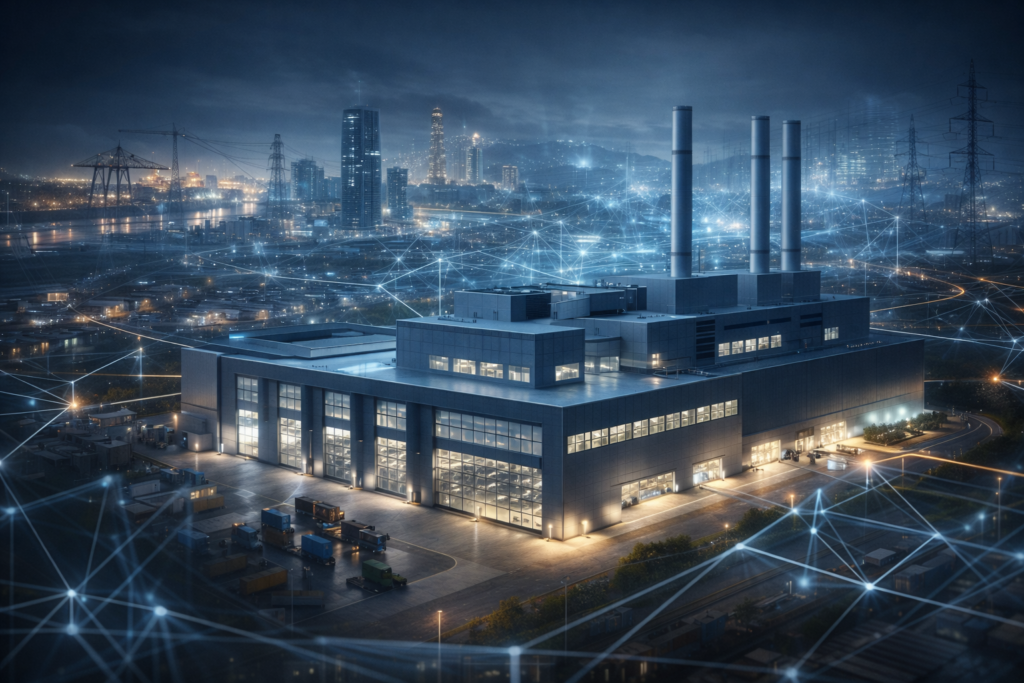
Factories used to be centers of power. Today, they are endpoints.
The real power lies upstream and downstream, in everything that allows a factory to exist without interruption. Raw materials that arrive on time. Energy that does not fluctuate. Logistics that do not depend on a single corridor. Software that coordinates machines faster than humans ever could. Data that predicts failure before it happens.
Factories are where things appear. Chains are where decisions are made.
That distinction changes everything.
When people say a country needs more factories, they usually mean it needs more jobs. More income. More stability. These are legitimate desires. But factories alone do not deliver them anymore.
A factory without control over its inputs is not an asset. It is a hostage.
It depends on energy prices it does not set. On components it does not produce. On software it does not own. On transport routes it cannot secure. On geopolitical conditions it cannot influence.
In that sense, building factories without building chains is not development. It is exposure.
This is why the industrial race of this century feels so strange. There is massive investment, impressive technology, and constant talk of innovation, yet the sense of fragility keeps growing. Shortages happen faster. Crises spread wider. Recovery feels slower.
The system is fast, but it is brittle.
Some countries understood this early. Not loudly. Not through slogans. Quietly, through patience.
They invested in boring things. Mines. Refineries. Power grids. Ports. Training systems. Industrial coordination. They accepted lower margins in the short term to gain continuity in the long term.
Others focused on what was visible. Factories, branding, quarterly growth. They optimized efficiency and forgot resilience.
Both looked successful. Until stress arrived.
Stress always reveals structure.
Energy sits at the center of this story, even when it is not mentioned.
No industrial chain survives without stable energy. Not cheap energy slogans. Stable energy reality. The kind that does not care about weather, elections, or public mood. The kind that allows machines to run at night, data centers to hum without interruption, logistics to keep moving.
When energy becomes uncertain, everything downstream becomes negotiable. Production schedules. Prices. Jobs. Political promises.
That is why energy crises never stay technical. They turn social very quickly.
Emerging economies often stand at the most uncomfortable point of this map.
They have resources, but not chains. Potential, but not closure. They export the beginning of the story and import the ending.
The result is a permanent feeling of effort without progress. Growth that does not accumulate. Work that does not stabilize. Development that resets with every external shock.
It is not a moral failure. It is a structural one.
And structures do not respond to optimism.
This is where the factory narrative becomes dangerous.
Because it offers comfort instead of clarity.
It tells people that building more buildings will fix what is, at its core, a coordination problem. A continuity problem. A sovereignty problem.
Factories are concrete. Chains are invisible. And humans tend to trust what they can see.
But the future belongs to what does not flicker.
For most of the 20th century, industrial power followed a simple logic.
People worked. Machines amplified them. Population growth fed production. Production fed wages. Wages fed consumption. It was imperfect, but it had inertia.
That logic is dissolving.
Not because technology advanced too fast, but because people disappeared too quietly.
This is the part most discussions avoid, maybe because it feels uncomfortable, almost impolite. Demography is not dramatic. It does not explode. It fades. Birth by birth. Year by year. Until one day the math no longer closes.
Factories once competed for labor. Now they prepare for its absence.
This is why automation is not a choice anymore. It is a demographic response.
Countries that face shrinking working-age populations have two options. Import people or replace them. Immigration is political. Automation is structural. One creates friction. The other creates silence.
Silence usually wins.
This is where the idea of the industrial chain becomes unavoidable.
Robots do not work alone. They need energy stability. They need components. They need software updates. They need maintenance ecosystems. They need supply continuity that does not panic when borders tighten or ships delay.
A robot without a chain behind it is just an expensive sculpture.
The same is true for advanced factories, AI-driven plants, and so-called smart industry. Intelligence does not remove dependency. It multiplies it.
The smarter the system, the more fragile its interruptions become.
That is why the new industrial race is so asymmetric. Some countries prepare entire ecosystems for absence. Absence of workers. Absence of growth. Absence of forgiveness from the system.
Others still prepare speeches.
There is a quiet shift happening in how states think about people.
Not in moral terms. In logistical ones.
Citizens used to be the engine. Now they are a variable.
When populations shrink, states compensate by centralizing. Energy grids. Data flows. Industrial policy. Surveillance infrastructure. Coordination becomes more valuable than persuasion.
This is not ideology. It is physics.
Large, complex systems do not tolerate unpredictability. And humans are unpredictable.
Chains reduce randomness.
They also reduce autonomy.
This is the tradeoff no one likes to state clearly.
When a country invests in full industrial chains, it gains resilience. It also gains leverage over behavior. Over movement. Over consumption. Over work.
Individuals feel this as pressure, not policy.
More rules. More dependency. Less margin for error.
The system becomes efficient, but tight.
From the outside, this looks like strength.
From the inside, it often feels like compression.
Jobs become specialized, then automated. Skills narrow. Mobility decreases. People sense that stability exists, but only if they stay inside predefined lanes.
The promise of the industrial chain is continuity.
The cost is flexibility.
That tension defines the next decades.
Not collapse versus prosperity. But rigidity versus adaptation.

This is where emerging countries face their hardest decision.
Build chains and accept centralization.
Or stay flexible and accept vulnerability.
There is no neutral path.
Exporting raw materials keeps autonomy at the individual level, but sacrifices national leverage. Closing chains increases national power, but tightens individual margins.
Neither option is comfortable. Both are rational.
The mistake is pretending a third option exists.
And here is where the narrative returns to the individual.
Because people do not live inside chains. They live around them.
When chains are fragile, life becomes volatile. Prices swing. Jobs vanish suddenly. Planning feels naive.
When chains are strong, life becomes predictable. But also narrower. Careers become pipelines. Mistakes cost more. Deviations feel dangerous.
In both cases, the individual adapts.
But adaptation without understanding breeds anxiety.
Understanding, even without control, breeds calm.
So when someone says the future of industry is about factories, they are missing the quiet part.
Factories are the surface.
Chains are the pressure underneath.
And pressure always shapes behavior.
The countries that understand this are not louder. They are calmer. Slower. Less theatrical. They build redundancy where others build narratives.
They do not promise abundance. They promise continuity.
The industrial race is not about producing more.
It is about failing less often.
And that changes how power is built, how work is designed, and how people learn to live inside systems that no longer apologize when they hesitate.
There is one country that did not arrive at this moment by elegance, but by collision.
For decades, the American system optimized for speed.
What followed was not a sudden awakening, but a series of inconveniences that refused to stay small. Delays. Shortages. Empty shelves. Strategic components missing. Entire industries waiting for parts that existed, but not where they were needed.
The lesson was not abstract. It was humiliating.
And humiliation is a powerful teacher.
The American response has been quieter than many assume. Less about speeches, more about reconstruction. Not rebuilding factories in isolation, but stitching together chains that had been allowed to fray.
Energy came first, because it always does. Without stable, abundant energy, no industrial ambition survives beyond the press release. The United States understands this at a structural level. It does not debate whether energy is political. It plans as if energy is destiny.
Then came semiconductors. Not as consumer electronics, but as sovereignty. Chips are not products. They are coordination devices. Whoever controls them controls the tempo of everything else.
Logistics followed. Ports. Rail. Data. Software. Redundancy.
Not elegance. Insurance.
This is what makes the United States uniquely positioned in this phase of the industrial race.
It does not need to invent a system from scratch. It needs to rewire one that already exists at scale.
Few countries can do that.
The United States has energy diversity, technological depth, capital markets, research infrastructure, and an industrial culture that never fully disappeared. It outsourced production, not competence.
That difference matters.
What also matters is geography.
The American continent is not a metaphor.
It is an asset. Protected coastlines. Internal waterways. Agricultural self-sufficiency. Energy reserves. Space to absorb mistakes without immediate collapse.
Chains need buffers. The United States has them.
This does not mean perfection. It means tolerance.
In complex systems, tolerance is power.
There is also something less tangible, but just as important.
The American system is built to absorb contradiction.
It tolerates inefficiency in the short term to preserve adaptability in the long term. It argues publicly, but reorganizes quietly. It fails loudly, but corrects structurally.
This makes it messy. Uncomfortable. Often criticized.
It also makes it resilient.
Chains do not require harmony. They require correction mechanisms.
If the 20th century was about industrial volume, and the early 21st was about financial speed, the next phase is about continuity under stress.
That is the American advantage.
Not moral superiority. Not inevitability.
Structural capacity.
The ability to lose, adjust, and rebuild without abandoning the system itself.
That is rare.
For individuals, this matters more than it seems.
Because global chains shape local life. Prices. Jobs. Stability. Expectations.
When the center of chain coordination is stable, the periphery breathes easier. When it is fragile, everyone feels it.
The United States, by reconstructing its chains rather than chasing nostalgia, increases not only its own resilience, but the predictability of the systems connected to it.
That does not make the world fair. It makes it legible.
And legibility is underrated.
The future of industry will not be decided by who builds more factories.
It will be decided by who keeps systems running when nothing goes according to plan.
The United States understands this now, not as theory, but as scar tissue.
That is why it remains, and may become even more, a superpower of chains.
Not because it promises abundance.
But because it plans for interruption.
And in a century defined by hesitation, those who prepare for silence tend to endure.
Lizandro Rosberg
Independent analyst of technology, science, and civilizational transformations. Graduated from Estácio de Sá. He writes about artificial intelligence, science, applied history, the future of work, and the real impact of technology on human life. His focus is on translating complex changes into practical understanding.
You will certainly be interested in:
-
Chess in Childhood: How it Teaches a Kid to Think Before Acting
The child can learn to shake hands even while sad. He can learn to review the game. He can learn to admit a mistake. He can learn to come back in the next round. He can learn that winning without respect makes the winner smaller, and losing without learning makes the loss heavier.
-
Wright brothers, Santos Dumont, and the Long Road from the First Airplane to the Moon
The history of aviation is often told as if it belonged to one man, one machine, and one magical afternoon when mankind suddenly beat the impossible. That version is simple. It is also too small. Aviation was never the work of a single hero standing alone under the sky. It was a civilizational project. Long […]
-
21st Century Economy | Artificial Intelligence | Future of Work | Future of Work & Automation | Life Strategy
The World Is Too Old to Run on Yesterday’s Assumptions
Modern societies are aging faster than their institutions, cities, and care systems were designed to handle. Population aging is no longer a forecast. It is a present condition. Fertility rates across developed economies remain structurally below replacement, while life expectancy continues to rise. More people stay in the system for longer, and fewer enter it to sustain what that system demands. This is not a moral debate. It is arithmetic.
The text dismantles the idea that declining birth rates can be reversed through incentives alone. Children have ceased to be a default continuation of life and have become high-risk projects, requiring time, stability, and energy. At the same time, large cities have grown expensive, regulated, and hostile to family formation. Housing costs, long commutes, and constant friction quietly discourage long-term planning. Fertility declines not because people reject families, but because the environment makes them fragile bets.
Longevity adds a second layer of tension. Medical and technological progress has extended human life by decades, but social structures have not adapted accordingly. Families are smaller, communities weaker, and informal care networks thinner. Care, once distributed among many, now concentrates on a few, often exhausted individuals. As demand rises and supply stagnates, eldercare becomes a systemic bottleneck.
At this point, the article reframes technology. Automation, AI, and robotics are not replacing human care. They are filling gaps left by demographic reality. Safety automation, assisted living systems, and care-support technologies emerge as infrastructure, not luxury. The comparison between regions is telling. China treats automation as capacity planning, scaling solutions pragmatically under demographic pressure. Europe, despite facing even sharper aging trends, often responds with moral discourse and procedural delay. The United States sits between these poles, still assuming it has time.
The article closes without apocalypse. It argues for early, practical adaptation. Designing homes and cities that reduce risk. Introducing assistive technology before crisis. Treating care as infrastructure rather than a private afterthought. Building redundancy not only in finances, but in human networks.
The final note is sober but constructive. The world did not become colder. It became older. And older societies need smarter designs. Less nostalgia. More alignment. In that sense, adapting early is not pessimism. It is a form of responsibility, and perhaps the most realistic kind of optimism available.
-
The Mistake That Kept Rome Standing for Centuries
At its height, the Roman Empire controlled millions of square kilometers and governed tens of millions of people. Some estimates place that peak at over four million square kilometers and roughly 60 million inhabitants, a scale that’s hard to visualize without modern maps.
-
Personal AI for Finances: How Language Models Help You Stop Losing Money
When finances are reviewed regularly, without drama and without emotional drain, something subtle happens. Anxiety drops. Decisions stop being reactive. Small corrections happen early, before they turn into damage.
-
The Rat Race Was Designed, Not Chosen
Most people never sit down and choose a life of constant pressure. They don’t decide to trade freedom for anxiety or flexibility for fragility.






No Responses