This morning I opened my banking app without a clear reason.
No bill was due. No purchase planned. I just checked it, the same way you look out the window to see the weather, even when you’re not planning to go anywhere.
The numbers hadn’t changed much since a few months ago. What had changed was how they felt. The balance looked fine. The sense of ground underneath it didn’t.
It wasn’t fear.
It was something quieter. The feeling you get when you realize you’ve been leaning on a wall you never actually tested.
The Old Promise of Money No Longer Holds
For a long time, money meant ascent. Earn more and life becomes easier. More income meant more safety, more freedom, more room for mistakes. That promise wasn’t naïve. It was historically accurate for a while.
It belonged to a world with expanding populations, stable career paths, predictable economic cycles, and governments capable of keeping most long-term commitments. In that environment, rising income often did translate into rising stability.
That environment is fading.
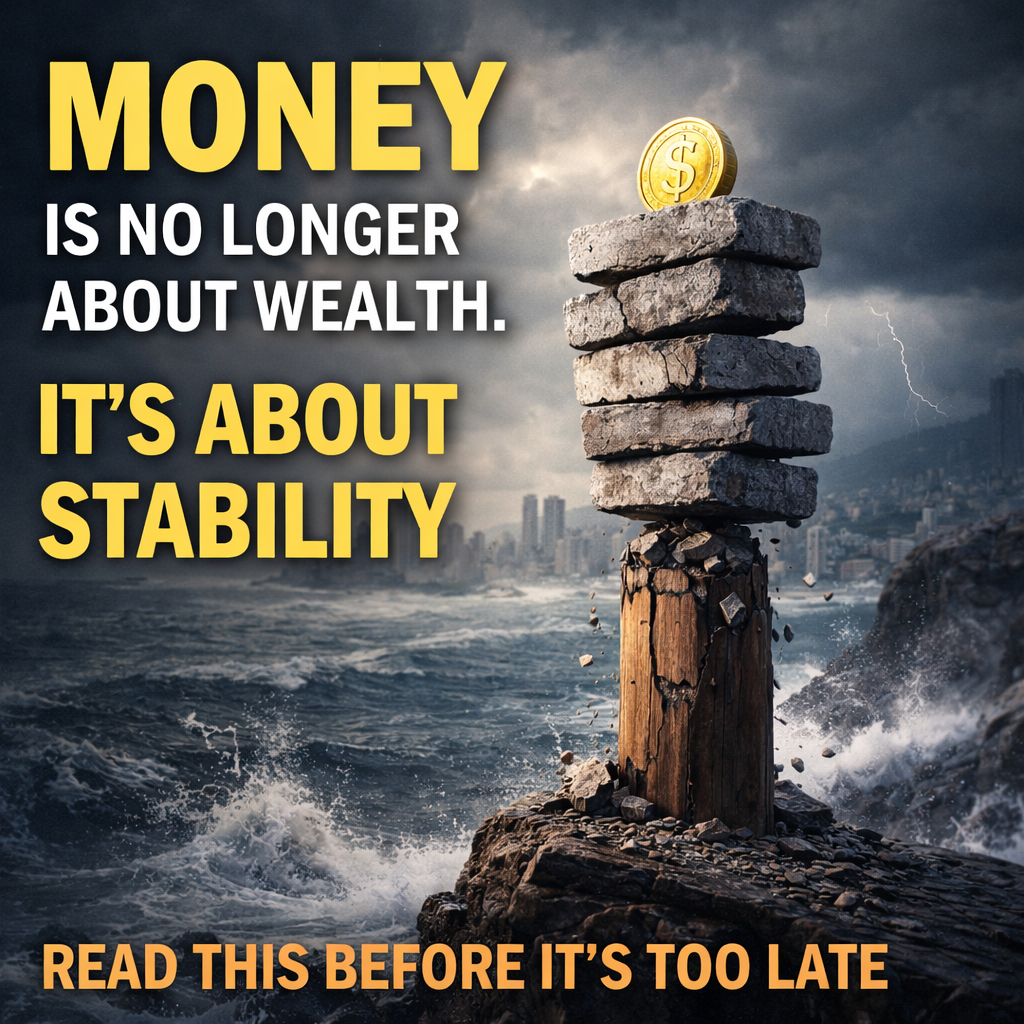
Today, money no longer works mainly as a ladder. It works as insulation. It absorbs shocks, buys time, and reduces exposure to forces individuals can’t control. People who still treat money as a trophy often discover too late that trophies don’t hold buildings together when the structure starts shaking.
This shift isn’t cultural. It’s structural.
According to the International Monetary Fund’s World Economic Outlook (2023), global growth is slower and significantly more volatile than in previous decades, with shorter cycles and more frequent disruptions. At the same time, United Nations demographic reports show rapid population aging across advanced economies, putting pressure on labor markets, pension systems, and public finances.
Those aren’t opinions. They’re conditions.
The practical result is simple. Risk is no longer occasional. It’s ambient.
Why Stability Matters More Than Wealth in the 21st Century
In an unstable system, wealth without stability behaves oddly. It looks impressive, but it fails under stress. Like expensive furniture in a house with a cracked foundation, it signals success while quietly increasing vulnerability.
Stability works differently. It doesn’t announce itself. It doesn’t impress anyone. But it does one critical thing. It allows error without collapse.
Stability means having room to breathe when something breaks. It means not being one surprise away from panic. It means being able to say no without your nervous system switching into emergency mode.
In the 21st century, this isn’t a luxury. It’s baseline survival.
Many people resist this idea because stability sounds passive. Like slowing down. Like giving up ambition. That impression is persistent and wrong.
Stability isn’t about standing still. It’s about sustaining motion over time.
When Money Becomes Identity, It Stops Protecting You
One of the most common financial mistakes today is turning money into identity. Income becomes a measure of worth. Lifestyle becomes a signal of belonging. Consumption becomes a quiet contract with your past self.
This is who I am now.
So this is what I must maintain.
The trap is subtle because it doesn’t begin with excess. It begins with reasonable upgrades. A slightly better place. A few fixed commitments. Comforts that feel earned. Over time, the cost of staying the same becomes higher than the cost of changing.
The problem isn’t luxury.
It’s rigidity.
When money is used to maintain image, it loses its defensive role. Instead of absorbing shocks, it amplifies them. Small disruptions feel enormous. Minor changes trigger disproportionate stress. The system has no slack.
This is why so many high-income households live under constant pressure. Not because they lack money, but because they lack margin.
Federal Reserve surveys over recent years consistently show that a large share of American households struggle to absorb a moderate unexpected expense without borrowing. This persists even during periods of economic growth. The issue isn’t income alone. It’s structural fragility.
Money as a Shock Absorber, Not a Status Symbol
In a volatile world, money works best when it’s boring.
Liquidity isn’t exciting. Predictability doesn’t trend. Margin doesn’t get applause. Yet these are the elements that turn money from decoration into defense.
Thinking of money as a shock absorber changes behavior. The goal shifts from maximizing upside to limiting downside. From chasing growth to preserving optionality.
Less obsession with how fast you can grow.
More attention to how easily you can recover.
This mindset isn’t pessimistic. It’s realistic. It accepts that disruption is common, careers are nonlinear, and long-term plans will be interrupted more than once.
Stability doesn’t eliminate ambition. It filters it.
People with financial margin tend to make better decisions not because they’re smarter, but because they’re calmer. They negotiate better. Choose projects more carefully. They don’t need every opportunity to work.
In practice, stability becomes a quiet competitive advantage.
The System Was Built to Keep You Running
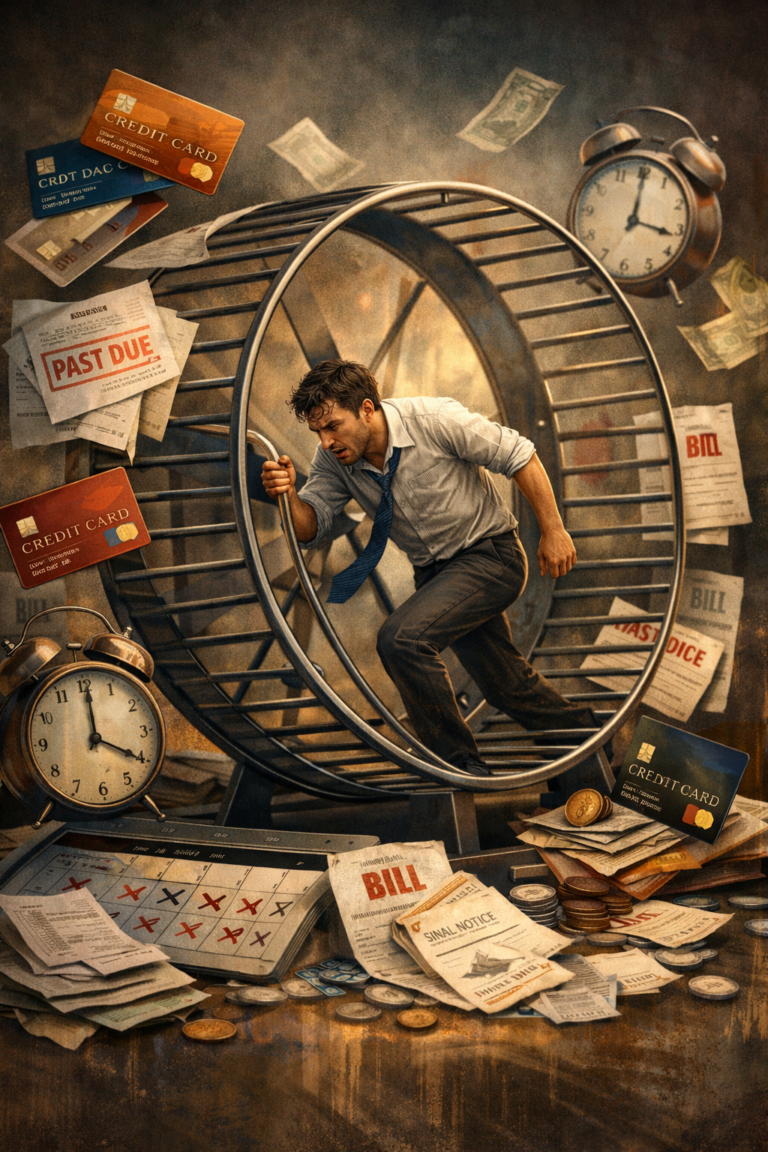
What people call the rat race isn’t a moral failure or lack of discipline. It’s a system that works exactly as designed, and it works best on capable, responsible people.
It doesn’t start with greed. It starts with normal life.
A raise arrives. Expenses quietly follow. One commitment here, another there. Nothing reckless. Everything defensible. Over time, the cost of staying where you are becomes higher than the cost of moving forward. Not forward in purpose, but forward in obligation.
The problem isn’t the step.
It’s the endless staircase.
Behavioral economists describe this as hedonic adaptation. The brain normalizes gains and resets its baseline. What once felt like security becomes ordinary. Ordinary becomes insufficient. Research by Daniel Kahneman and Angus Deaton shows that beyond a certain point, income has diminishing returns on well-being. Behavior rarely adjusts.
So people keep chasing income as if the next level will finally settle things.
Ironically, higher income without structure often increases fragility. Fixed costs rise. Flexibility shrinks. Margin disappears. Life becomes dependent on everything going right at the same time.
In a world that rarely cooperates, that’s a dangerous setup.
Why High Income No Longer Guarantees Financial Security
There’s a quiet collapse beneath modern prosperity. Many people earn more than previous generations ever did and feel less secure doing it.
This isn’t anecdotal. Federal Reserve data over the past decade shows that a significant portion of U.S. households would struggle to cover a moderate unexpected expense without borrowing, even during economic expansions.
The issue isn’t effort.
It’s exposure.
High income paired with high rigidity creates a system that looks strong and breaks easily. Any disruption feels personal. A slowdown feels existential. The income is real. The control is not.
That background tension isn’t stability. It’s conditional survival.
True financial security isn’t about how much you earn when everything works. It’s about how well your life holds together when it doesn’t.
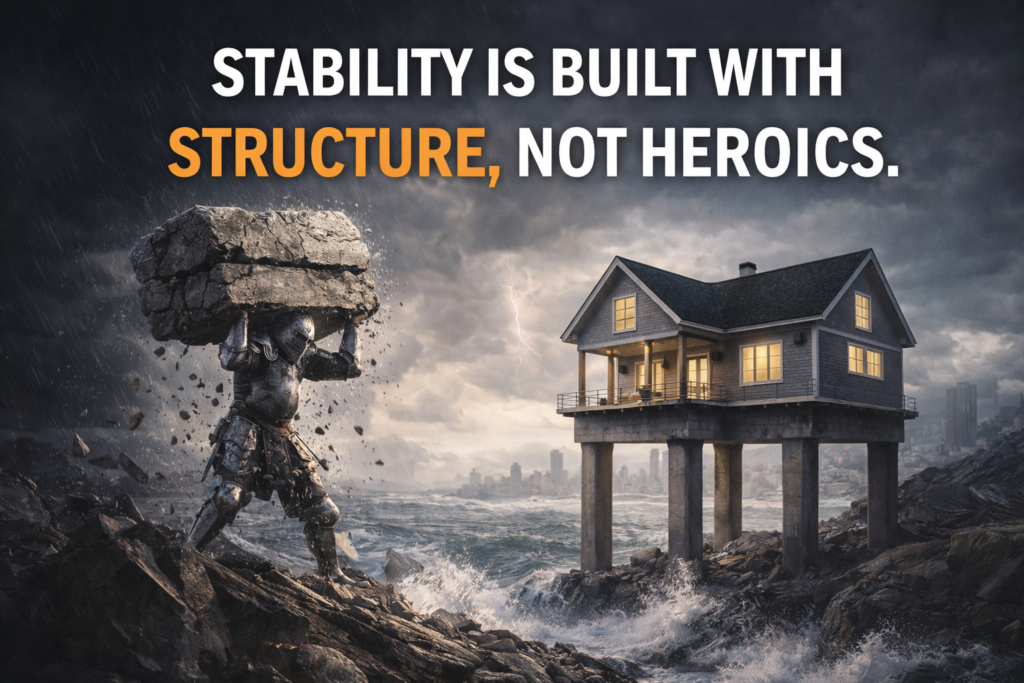
Stability Is Built With Structure, Not Heroics
Most attempts to escape financial pressure fail because they target symptoms instead of structure. People cut expenses aggressively without margin. Chase side income without reducing fragility. Rely on motivation where systems are needed.
Stability isn’t built through dramatic moves. It’s built through quiet engineering.
Enough liquidity to make mistakes.
Fixed costs designed for bad months, not good ones.
Income sources that don’t fail simultaneously.
Decisions that account for fatigue, not just return.
None of this is glamorous. That’s why it works.
A financially stable life functions even when you’re tired, distracted, or unlucky. It doesn’t require perfection. It survives imperfect weeks.
That’s the difference between comfort and dependence. Comfort reduces friction. Dependence increases vulnerability. Most people confuse the two.
Why Stability Creates Better Long-Term Growth
Here’s the quiet irony. People who build stability first often improve income more consistently over time. Not because they chase growth harder, but because they operate better.
They choose projects with clearer upside.
They negotiate without desperation.
They turn down offers that pay well but cost too much.
Margin changes behavior. Behavior changes outcomes.
Growth driven by stability looks slower at first. Then it becomes hard to stop.
Time Is the Real Financial Asset
Time is the most undervalued asset in modern finance, not poetically but operationally.
Time allows recovery.
Time dilutes mistakes.
Time turns average decisions into good outcomes.
But time only works if structure can support it. Without margin, time becomes an enemy. Deadlines tighten. Options close. Pressure escalates.
With structure, time becomes leverage.
That’s why stability matters less for the money itself and more for what money buys indirectly. Time to decide. Time to wait. Time to say no. Time to adapt.
In an economy defined by speed and disruption, time is power.
Money matters.
Ambition still matters. Growth still matters.
But in this century, stability decides whether any of that actually holds.
Stability isn’t about shrinking your life. It’s about giving it a foundation that doesn’t crack under stress. It doesn’t make you slower. It makes you harder to knock down.
In a volatile world, staying intact isn’t conservative.
It’s quietly strategic.
Lizandro Rosberg
Independent analyst of technology, science, and civilizational transformations. He writes about artificial intelligence, science, applied history, the future of work, and the real impact of technology on human life. His focus is on translating complex changes into practical understanding.
You will certainly be interested in:
-
Chess in Childhood: How it Teaches a Kid to Think Before Acting
The child can learn to shake hands even while sad. He can learn to review the game. He can learn to admit a mistake. He can learn to come back in the next round. He can learn that winning without respect makes the winner smaller, and losing without learning makes the loss heavier.
-
Wright brothers, Santos Dumont, and the Long Road from the First Airplane to the Moon
The history of aviation is often told as if it belonged to one man, one machine, and one magical afternoon when mankind suddenly beat the impossible. That version is simple. It is also too small. Aviation was never the work of a single hero standing alone under the sky. It was a civilizational project. Long […]
-
21st Century Economy | Artificial Intelligence | Future of Work | Future of Work & Automation | Life Strategy
The World Is Too Old to Run on Yesterday’s Assumptions
Modern societies are aging faster than their institutions, cities, and care systems were designed to handle. Population aging is no longer a forecast. It is a present condition. Fertility rates across developed economies remain structurally below replacement, while life expectancy continues to rise. More people stay in the system for longer, and fewer enter it to sustain what that system demands. This is not a moral debate. It is arithmetic.
The text dismantles the idea that declining birth rates can be reversed through incentives alone. Children have ceased to be a default continuation of life and have become high-risk projects, requiring time, stability, and energy. At the same time, large cities have grown expensive, regulated, and hostile to family formation. Housing costs, long commutes, and constant friction quietly discourage long-term planning. Fertility declines not because people reject families, but because the environment makes them fragile bets.
Longevity adds a second layer of tension. Medical and technological progress has extended human life by decades, but social structures have not adapted accordingly. Families are smaller, communities weaker, and informal care networks thinner. Care, once distributed among many, now concentrates on a few, often exhausted individuals. As demand rises and supply stagnates, eldercare becomes a systemic bottleneck.
At this point, the article reframes technology. Automation, AI, and robotics are not replacing human care. They are filling gaps left by demographic reality. Safety automation, assisted living systems, and care-support technologies emerge as infrastructure, not luxury. The comparison between regions is telling. China treats automation as capacity planning, scaling solutions pragmatically under demographic pressure. Europe, despite facing even sharper aging trends, often responds with moral discourse and procedural delay. The United States sits between these poles, still assuming it has time.
The article closes without apocalypse. It argues for early, practical adaptation. Designing homes and cities that reduce risk. Introducing assistive technology before crisis. Treating care as infrastructure rather than a private afterthought. Building redundancy not only in finances, but in human networks.
The final note is sober but constructive. The world did not become colder. It became older. And older societies need smarter designs. Less nostalgia. More alignment. In that sense, adapting early is not pessimism. It is a form of responsibility, and perhaps the most realistic kind of optimism available.
-
The Mistake That Kept Rome Standing for Centuries
At its height, the Roman Empire controlled millions of square kilometers and governed tens of millions of people. Some estimates place that peak at over four million square kilometers and roughly 60 million inhabitants, a scale that’s hard to visualize without modern maps.
-
Personal AI for Finances: How Language Models Help You Stop Losing Money
When finances are reviewed regularly, without drama and without emotional drain, something subtle happens. Anxiety drops. Decisions stop being reactive. Small corrections happen early, before they turn into damage.
-
The Rat Race Was Designed, Not Chosen
Most people never sit down and choose a life of constant pressure. They don’t decide to trade freedom for anxiety or flexibility for fragility.