If you prefer listening, this story is also available in narrated form below
This morning started quietly enough. No rush. No noise demanding my attention. Coffee cooling on the table while the day waited its turn. Nothing remarkable. Just space.
I sometimes remember when this kind of silence felt impossible. Not because life was better back then, but because it was louder. More compressed. More urgent. Living outside major urban centers didn’t solve everything. It never does. But it gave something back that I hadn’t realized was missing: margin.
And once you regain margin, it becomes harder to ignore how expensive certain choices were for what they actually delivered.
When cost stopped being only financial
For a long time, calling a city “expensive” meant talking about rent, transportation, groceries. A tough but straightforward equation. You paid more, but you received something in return. Opportunity. Access. Movement.
That equation quietly broke.
Today, urban cost spills far beyond bank statements. It leaks into time, attention, mental energy, health. A city might still fit your budget, but no longer fits your life.
The discomfort many people feel isn’t vague dissatisfaction. It’s the friction between what they’re paying and what they’re actually getting.
The original promise of big cities
Big cities didn’t emerge by accident. They were engines of concentration. People, capital, ideas, infrastructure. Proximity meant advantage. Being closer meant seeing earlier, learning faster, earning sooner.
That logic held for centuries.
But it depended on one condition: physical presence being necessary for almost everything that mattered. Work, learning, negotiation, visibility. Distance meant delay.
Technology eroded that condition quietly. First slowly. Then all at once.
Today, much of economic value moves without a fixed address. Knowledge, digital income, coordination, skill acquisition. The city remains. Its monopoly on access does not.
Costs stayed. Returns shrank.
This is where tension emerges.
Cities continue charging as if they were still indispensable. High rents. Long commutes. Permanent density. Competition for space and attention. Yet the marginal return has diminished. What once differentiated is now background noise.
Living in a major city increasingly requires paying a premium to access benefits that are no longer exclusive to it. Like paying full price for a show that’s now playing down the street for free.
No conspiracy. Just inertia. Large systems move slowly, even when reality shifts fast.
Time as the invisible tax
There is a tax that never shows up on a bill, yet weighs heavier than many others. Time lost in small daily fragments. Thirty minutes here. Forty there. Hours that never return, but accumulate into entire weeks over a year.
OECD urban data and time-use databases published up to 2022 consistently show that residents of large metropolitan regions often spend between one and one and a half hours per day commuting. Not shocking at first glance. The real cost appears when you multiply it by months, years, decades.
Time isn’t just duration. It’s decision quality. Fragmented time erodes clarity. And decisions made under fatigue tend to be expensive, even when they don’t look dramatic.

When cities stopped guaranteeing stability
The Industrial Revolution didn’t destroy jobs. It dismantled comfortable illusions. Work didn’t disappear; it simply stopped rewarding repetition, brute force, and inherited positions. What collapsed was the belief in automatic stability. Each technological leap shifted value toward those able to learn, adapt, and assume intellectual risk. The same pattern is unfolding with automation and AI. This isn’t the end of human work. It’s the end of the expectation that cities, systems, or institutions owe income, meaning, or security to those who refuse to reposition.
The bill doesn’t land the same for everyone
This matters. The urban equation still works well for a minority. People earning far above average. Those extracting direct value from city density. Roles that truly require physical proximity.
For everyone else, the cost is premium while the benefit is generic.
Cities rarely push people out directly. They simply make staying less rational over time. Discomfort turns into doubt. Doubt becomes fatigue. Fatigue starts asking for change.
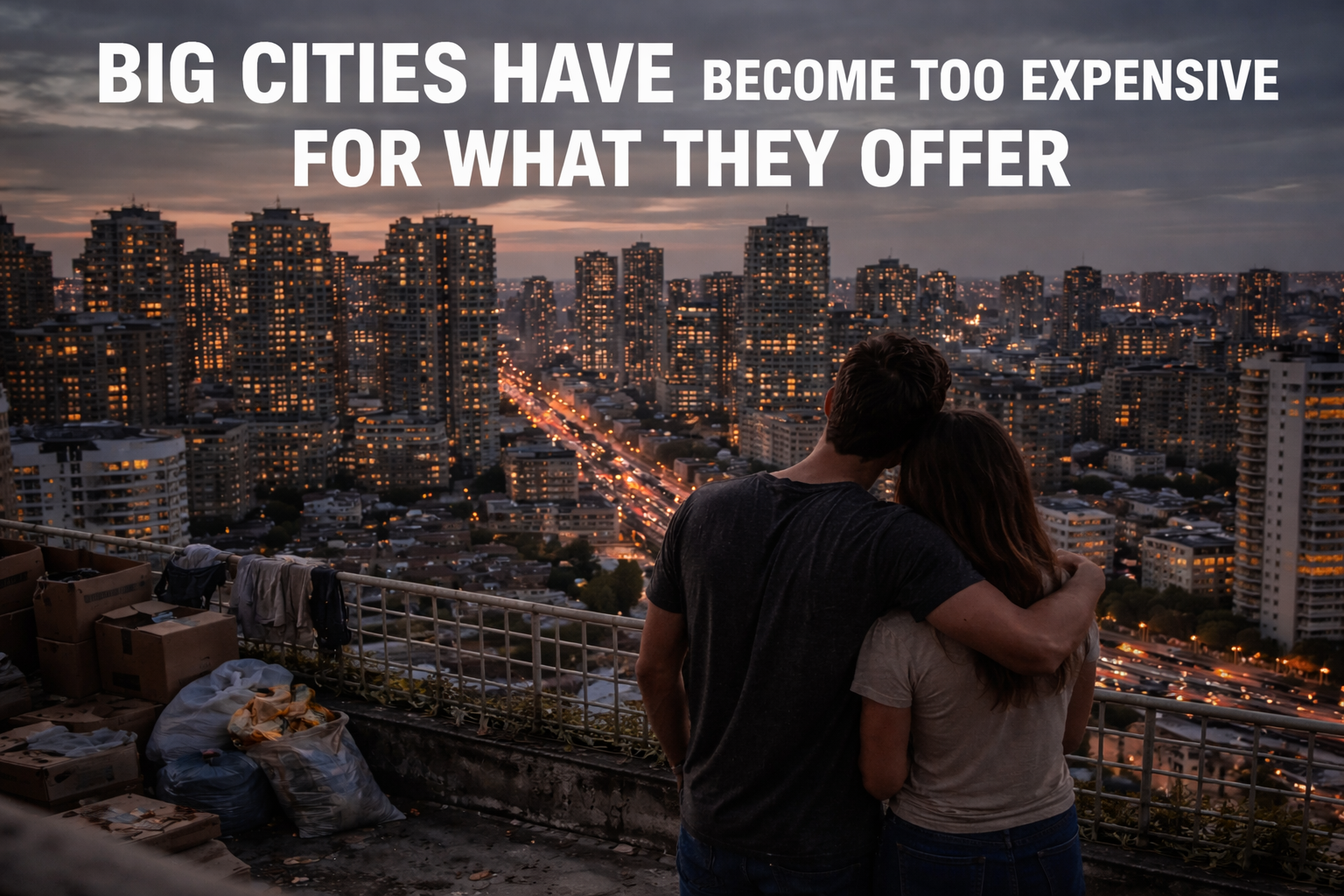
Big Cities Have Become Too Expensive for What They Offer
This morning started quietly enough. No rush. No noise demanding my attention. Coffee cooling on the table while the day waited its turn. Nothing remarkable. Just space.
I sometimes remember when this kind of silence felt impossible. Not because life was better back then, but because it was louder. More compressed. More urgent. Living outside major urban centers didn’t solve everything. It never does. But it gave something back that I hadn’t realized was missing: margin.
And once you regain margin, it becomes harder to ignore how expensive certain choices were for what they actually delivered.
When cost stopped being only financial
For a long time, calling a city “expensive” meant talking about rent, transportation, groceries. A tough but straightforward equation. You paid more, but you received something in return. Opportunity. Access. Movement.
That equation quietly broke.
Today, urban cost spills far beyond bank statements. It leaks into time, attention, mental energy, health. A city might still fit your budget, but no longer fits your life.
The discomfort many people feel isn’t vague dissatisfaction. It’s the friction between what they’re paying and what they’re actually getting.
The original promise of big cities
Big cities didn’t emerge by accident. They were engines of concentration. People, capital, ideas, infrastructure. Proximity meant advantage. Being closer meant seeing earlier, learning faster, earning sooner.
That logic held for centuries.
But it depended on one condition: physical presence being necessary for almost everything that mattered. Work, learning, negotiation, visibility. Distance meant delay.
Technology eroded that condition quietly. First slowly. Then all at once.
Today, much of economic value moves without a fixed address. Knowledge, digital income, coordination, skill acquisition. The city remains. Its monopoly on access does not.
Costs stayed. Returns shrank.
This is where tension emerges.
Cities continue charging as if they were still indispensable. High rents. Long commutes. Permanent density. Competition for space and attention. Yet the marginal return has diminished. What once differentiated is now background noise.
Living in a major city increasingly requires paying a premium to access benefits that are no longer exclusive to it. Like paying full price for a show that’s now playing down the street for free.
No conspiracy. Just inertia. Large systems move slowly, even when reality shifts fast.
Cities as permanent noise
There’s something hard to quantify but easy to feel. Constant stimulation. Layered sounds. Informal vigilance. The low-grade sense of always being slightly behind, even when you’re not.
This isn’t drama. It’s physiology.
Dense environments demand continuous cognitive processing. The brain never truly rests. It just reallocates priorities. Over time, that state extracts a price. Less patience. Less depth. Less tolerance for error.
Big cities don’t exhaust people because they’re dangerous all the time. They exhaust because they’re never truly quiet.

The demographic outcome is already visible
The result is measurable. According to OECD and United Nations data published between 2021 and 2023, most highly urbanized countries now operate well below replacement fertility. This is not driven primarily by lack of desire for children, but by delayed transitions into stable housing and family-ready environments.
Urban concentration has become a demographic bottleneck.
Cities optimized for productivity and consumption struggle to sustain generational continuity. They function well for individuals. Poorly for families.
Interiorization as structural correction
Leaving major cities is often framed as lifestyle choice. In practice, it is increasingly a structural correction.
Households relocate to regions where housing absorbs a smaller share of income. Where space is affordable again. Where time recovers coherence. This isn’t nostalgia. It’s demographic logic.
Lower fixed costs restore optionality. Optionality restores long-term thinking. And long-term thinking is a prerequisite for family formation.
The interior doesn’t create children. It removes obstacles.
Geography alone is not enough
Still, geography by itself solves nothing. Without adjustments in work structure, income models, and expectations, relocation becomes cosmetic.
The interior amplifies outcomes. Those who arrive with strategy gain leverage. Those who arrive with disorder lose urban buffers and feel exposed. The difference is not cultural. It’s organizational.

The real question
The wrong question remains “can I afford to live here this year?”
The right one is harder to ignore once framed:
Does this environment support the kind of life that extends beyond myself over twenty years?
Big cities didn’t fail. They specialized. They became efficient ecosystems for a narrow life phase. Treating them as the default setting for family formation now collides with demographic reality.
Across the Western world, declining birth rates are not a mystery. They are the predictable outcome of environments where space is scarce, time is fragmented, and stability is expensive.
Quality of life requires room. Demography follows structure. And where structure breaks, the future quietly recedes.
If big cities stopped delivering what they once promised, the question isn’t where to live next. It’s how to think and position yourself in a system that already changed.
In the ebook Highly Qualified, Quietly Poor, I explore why so many capable, educated people are working harder than ever while getting less in return, and how technology, especially AI, can be used as leverage instead of pressure. Not as a shortcut, but as a structural adjustment.
It’s not a manual. It’s a clear-eyed reflection on work, value, and adaptation in a post-illusion economy.

The ebook costs JUST $9.90.
If this article resonated, it’s a natural next step.
Access it here:
https://go.hotmart.com/B103519504F
Sometimes the problem isn’t effort. It’s the framework you’re operating inside.
Lizandro Rosberg
Independent analyst of technology, science, and civilizational transformations. He writes about artificial intelligence, science, applied history, the future of work, and the real impact of technology on human life. His focus is on translating complex changes into practical understanding.
You will certainly be interested in:
-
21st Century Economy | Artificial Intelligence | Future of Work | Future of Work & Automation | Life Strategy
The World Is Too Old to Run on Yesterday’s Assumptions
Modern societies are aging faster than their institutions, cities, and care systems were designed to handle. Population aging is no longer a forecast. It is a present condition. Fertility rates across developed economies remain structurally below replacement, while life expectancy continues to rise. More people stay in the system for longer, and fewer enter it to sustain what that system demands. This is not a moral debate. It is arithmetic.
The text dismantles the idea that declining birth rates can be reversed through incentives alone. Children have ceased to be a default continuation of life and have become high-risk projects, requiring time, stability, and energy. At the same time, large cities have grown expensive, regulated, and hostile to family formation. Housing costs, long commutes, and constant friction quietly discourage long-term planning. Fertility declines not because people reject families, but because the environment makes them fragile bets.
Longevity adds a second layer of tension. Medical and technological progress has extended human life by decades, but social structures have not adapted accordingly. Families are smaller, communities weaker, and informal care networks thinner. Care, once distributed among many, now concentrates on a few, often exhausted individuals. As demand rises and supply stagnates, eldercare becomes a systemic bottleneck.
At this point, the article reframes technology. Automation, AI, and robotics are not replacing human care. They are filling gaps left by demographic reality. Safety automation, assisted living systems, and care-support technologies emerge as infrastructure, not luxury. The comparison between regions is telling. China treats automation as capacity planning, scaling solutions pragmatically under demographic pressure. Europe, despite facing even sharper aging trends, often responds with moral discourse and procedural delay. The United States sits between these poles, still assuming it has time.
The article closes without apocalypse. It argues for early, practical adaptation. Designing homes and cities that reduce risk. Introducing assistive technology before crisis. Treating care as infrastructure rather than a private afterthought. Building redundancy not only in finances, but in human networks.
The final note is sober but constructive. The world did not become colder. It became older. And older societies need smarter designs. Less nostalgia. More alignment. In that sense, adapting early is not pessimism. It is a form of responsibility, and perhaps the most realistic kind of optimism available.
-
The Mistake That Kept Rome Standing for Centuries
At its height, the Roman Empire controlled millions of square kilometers and governed tens of millions of people. Some estimates place that peak at over four million square kilometers and roughly 60 million inhabitants, a scale that’s hard to visualize without modern maps.
-
Personal AI for Finances: How Language Models Help You Stop Losing Money
When finances are reviewed regularly, without drama and without emotional drain, something subtle happens. Anxiety drops. Decisions stop being reactive. Small corrections happen early, before they turn into damage.
-
The Rat Race Was Designed, Not Chosen
Most people never sit down and choose a life of constant pressure. They don’t decide to trade freedom for anxiety or flexibility for fragility.
-
The Industrial Revolution Didn’t Destroy Jobs. It Stripped Away Illusions.
Modern automation, especially software-driven automation and AI, is hitting symbolic professions first. Not the poorest. Not the wealthiest. It’s hitting the middle layer that learned to trade intellectual routine for stability.
-
21st Century Economy | Artificial Intelligence | Future of Work & Automation | Geopolitics & Energy | Life Strategy
Highly Qualified, Quietly Poor
This morning was unremarkable. I made coffee the same way I always do. Same mug. Same chipped edge. I scrolled through messages I didn’t answer yesterday and noticed something small, almost silly. Three different people, unrelated, all talking about money. Not investment tips. Not ambition. Just fatigue. Quiet, practical fatigue. No drama. No despair. Just […]