A quiet morning, nothing to prove
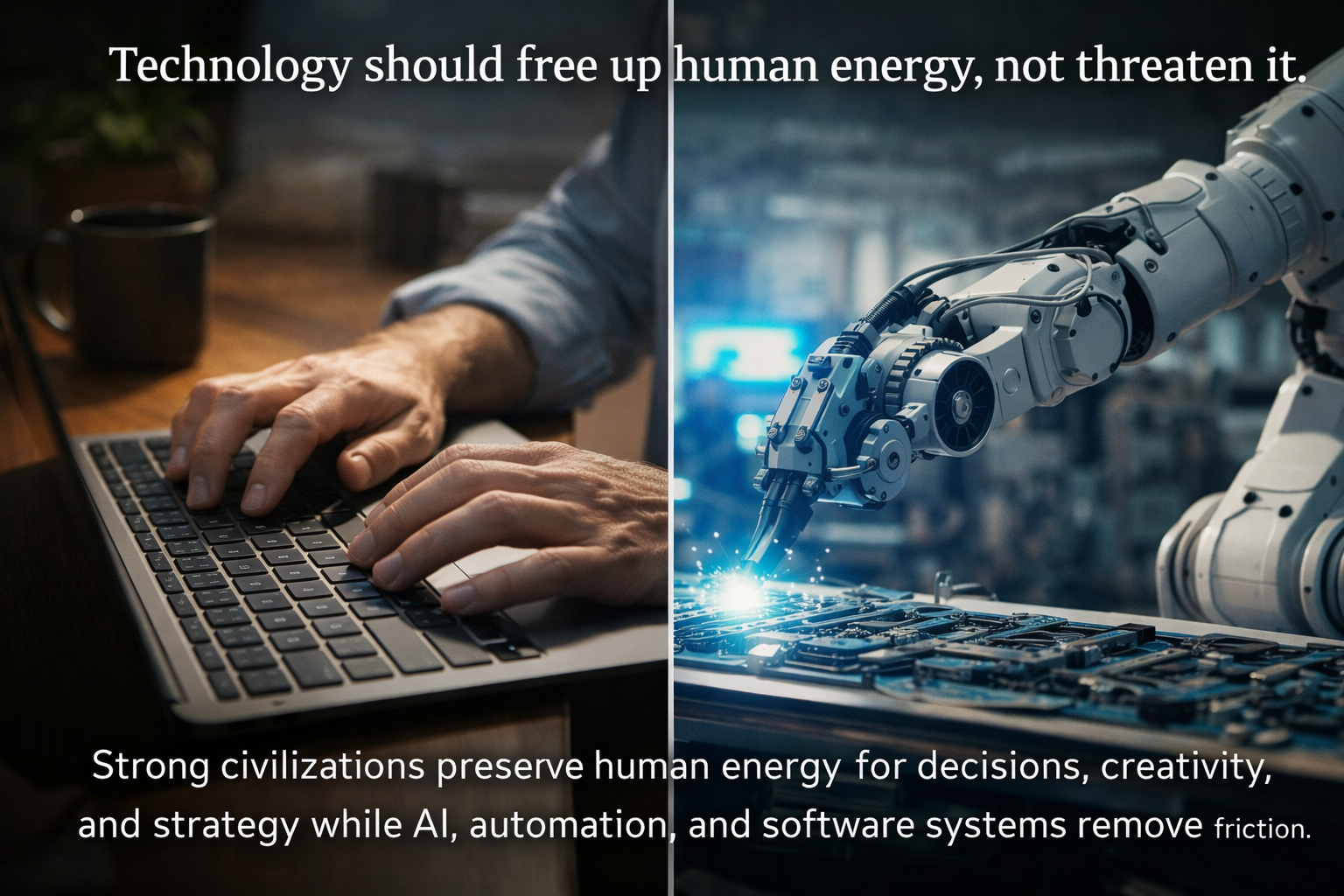
This morning didn’t come with insight. I woke up, made coffee, and sat down to work without leaving home. No rush. No negotiation with traffic or clocks. Just the day beginning where it was supposed to begin.
There was a time when the same morning demanded more from the body than from the mind. Shower fast. Move fast. Arrive already spent. It never felt dramatic enough to question. It was just how things were. Like cold winters. You dress for it and keep going.
Only later does it register that this small difference isn’t comfort. It’s information.
Why modern civilization burns people instead of fuel
We like to believe that progress comes from effort. From pushing harder. From long days and short patience. Somewhere along the way, exhaustion stopped being a side effect and became a moral signal.
This idea feels old, almost natural. It isn’t.
It’s an inheritance from an industrial mindset that treated human beings as energy units. First muscle, then attention. The system didn’t care what kind of energy it consumed, as long as it kept moving.
That model scaled well when the world was simpler.
It scales poorly now.
As societies become more complex, every unit of wasted human energy gets more expensive. Not symbolically. Structurally.
Complexity raises the price of fatigue
This is where things quietly shift.
In low complexity systems, fatigue is tolerable. Mistakes stay local. Decisions don’t cascade far. You can brute force your way through inefficiency.
In high complexity systems, fatigue is lethal.
Errors spread. Bad judgment multiplies. A tired decision doesn’t just fail once. It replicates. What used to be personal burnout turns into systemic fragility.
This isn’t philosophy. It’s systems logic.
And it leads to an uncomfortable conclusion.
Modern civilization no longer advances by extracting more effort from people. It advances by removing unnecessary friction from their lives.
Data does not reward suffering

Let’s ground this before it floats away.
According to the OECD report Working Time and Productivity published in 2022, countries with shorter average working hours consistently show higher productivity per hour than countries with longer workweeks. Germany and the Netherlands are not outliers. They are patterns.
This is not cultural softness. It’s arithmetic.
Tired people make slower decisions. They commit more errors. They require more correction. The system pays for fatigue whether it admits it or not.
Working longer often looks productive. It rarely is.
The civilizational misunderstanding of effort
Here’s where the confusion deepens.
When societies sense stagnation, their instinct is to demand more effort. Longer hours. More presence. More sacrifice. It feels intuitive. If things aren’t working, push harder.
That instinct belongs to simpler times.
In complex systems, pushing harder often increases noise, not signal. It raises volume without improving clarity.
The irony is that this looks virtuous. Suffering always does.
But history doesn’t reward virtue displays. It rewards alignment between human limits and system design.
Rome didn’t collapse because people rested too much. It collapsed because it kept structures that required more energy than its demographic base could supply. Comfort wasn’t the threat. Mismatch was.
Today, we face the same equation with better tools and worse habits.
The everyday waste everyone accepts
Nothing exposes this mismatch more clearly than daily commuting.
Millions of people wake up and immediately begin spending energy on movement that produces no value. No insight. No creativity. No connection. Just transit.
This is treated as neutral. It isn’t.
Every hour spent navigating congestion is an hour of cognitive depletion before meaningful work even begins. It shows up later as impatience, shallow focus, and poor judgment. Not because people are weak, but because systems are careless.
When remote work removes this friction, the result isn’t laziness. It’s conservation.
The same person. The same job. Less energy burned on nonsense.
Civilization doesn’t advance when people run faster. It advances when fewer people need to run at all.
Opinion, stated plainly
There is nothing noble about wasting humans.
The belief that effort equals meaning is emotionally comforting and structurally stupid. It flatters the exhausted and excuses bad design.
Mature societies learn something else. They learn that human energy is rare, finite, and expensive. And once they learn that, everything starts to reorganize around preservation instead of extraction.
This is not the end of work.
It’s the end of treating exhaustion as proof of value.
Automation is not about replacement. It’s about unclogging
Once you accept that human energy is expensive, a lot of modern anxiety starts to look misplaced.
Automation and AI are often framed as threats because we still read them through an old moral lens. The story goes like this. If a machine does something, a human must be losing meaning. As if meaning were stored in repetition.
That assumption doesn’t survive contact with reality.
Most of what drains people today is not meaningful work. It’s coordination overhead. Repetition. Checking what has already been checked. Filling forms so other forms can exist. Tasks that demand attention but offer nothing back.
This is where machines quietly outperform us, not because they’re smarter, but because they don’t leak energy.
A system that automates low judgment tasks is not dehumanizing work. It’s protecting the parts of work that are still human.
Judgment. Context. Tradeoffs. Those don’t scale well under fatigue.
What the data actually says about productivity and technology
Here’s the uncomfortable part for the “work harder” crowd.
According to the OECD and corroborated by labor productivity studies from the International Labour Organization in the early 2020s, productivity gains in advanced economies increasingly come from process efficiency, not longer hours or higher individual output.
That means better systems beat stronger workers.
Countries and organizations that invest in reducing friction consistently outperform those that rely on heroic effort. Not immediately. But reliably.
This isn’t optimism. It’s pattern recognition.
The future doesn’t belong to people who grind harder. It belongs to societies that grind less because they designed better.
The quiet shift from loud success to silent stability
For most of the twentieth century, success was noisy.
You could see it in long commutes, packed calendars, overflowing inboxes. Busyness functioned like a public signal. If you were exhausted, you must have been important.
That signal is losing credibility.
A different kind of prosperity is emerging, one that doesn’t announce itself. Fewer meetings. Shorter days that still produce results. Systems that work even when people step away for a moment.
It looks unimpressive. That’s the point.
Civilizations don’t collapse because they get quieter. They collapse because they confuse noise with strength.
Silence, when it comes from order rather than emptiness, is a sign of maturity.
Why fatigue became a cultural value
This deserves a pause.
Fatigue didn’t become a virtue by accident. It became useful.
In systems that couldn’t optimize design, suffering filled the gap. If you couldn’t make things efficient, you made them honorable. Long hours became character. Burnout became commitment.
It worked until it didn’t.
In complex systems, fatigue stops being proof of dedication and starts being evidence of failure. Either the system is poorly designed, or it is asking humans to do what tools already can.
Neither is a moral achievement.
The false fear of a slower future
One of the most persistent fears about a less exhausting world is stagnation. People worry that if we remove pressure, ambition will vanish.
That fear misunderstands human nature.
Pressure doesn’t create ambition. It narrows it.
When people are constantly depleted, they stop thinking long term. They optimize for survival, not strategy. They choose speed over accuracy. Familiar paths over better ones.
Reducing unnecessary effort doesn’t make societies lazy. It makes them capable of planning again.
Long horizons require spare energy.
Cities, work, and the return of breathing room

You can already see this playing out.
Remote work reduces daily friction. Hybrid models lower coordination costs. Digital services compress time once lost to queues and paperwork.
None of this makes headlines. It doesn’t feel revolutionary. It feels… lighter.
That’s how real transitions usually feel while they’re happening.
Civilizations don’t announce their next phase. They slip into it quietly, through small changes that add up faster than people notice.
There is a strange moral pride in exhaustion. It flatters people who endure bad systems and protects those systems from scrutiny.
But endurance is not wisdom.
A society that learns how to spend less human energy is not becoming weak. It is becoming selective. It is choosing where effort matters and where it doesn’t.
That selectivity is the difference between survival and stagnation.
A historical pattern hiding in plain sight
Every major civilizational leap followed the same structure.
Fire reduced physical strain. Agriculture reduced constant movement. Industrial machines reduced raw labor. Digital systems reduced coordination costs.
Each time, someone argued that ease would ruin us.
Each time, we adapted and moved on.
What looks like loss at the individual level often turns out to be resilience at the collective level.
The future won’t belong to the loudest or the busiest.
It will belong to societies that learned how to stop wasting people.
Less friction. Better judgment. Longer horizons.
Not softer humans.
Smarter systems.
Lizandro Rosberg
Independent analyst of technology, science, and civilizational transformations. He writes about artificial intelligence, science, applied history, the future of work, and the real impact of technology on human life. His focus is on translating complex changes into practical understanding.
You will certainly be interested in:
-
21st Century Economy | Artificial Intelligence | Future of Work | Future of Work & Automation | Life Strategy
The World Is Too Old to Run on Yesterday’s Assumptions
Modern societies are aging faster than their institutions, cities, and care systems were designed to handle. Population aging is no longer a forecast. It is a present condition. Fertility rates across developed economies remain structurally below replacement, while life expectancy continues to rise. More people stay in the system for longer, and fewer enter it to sustain what that system demands. This is not a moral debate. It is arithmetic.
The text dismantles the idea that declining birth rates can be reversed through incentives alone. Children have ceased to be a default continuation of life and have become high-risk projects, requiring time, stability, and energy. At the same time, large cities have grown expensive, regulated, and hostile to family formation. Housing costs, long commutes, and constant friction quietly discourage long-term planning. Fertility declines not because people reject families, but because the environment makes them fragile bets.
Longevity adds a second layer of tension. Medical and technological progress has extended human life by decades, but social structures have not adapted accordingly. Families are smaller, communities weaker, and informal care networks thinner. Care, once distributed among many, now concentrates on a few, often exhausted individuals. As demand rises and supply stagnates, eldercare becomes a systemic bottleneck.
At this point, the article reframes technology. Automation, AI, and robotics are not replacing human care. They are filling gaps left by demographic reality. Safety automation, assisted living systems, and care-support technologies emerge as infrastructure, not luxury. The comparison between regions is telling. China treats automation as capacity planning, scaling solutions pragmatically under demographic pressure. Europe, despite facing even sharper aging trends, often responds with moral discourse and procedural delay. The United States sits between these poles, still assuming it has time.
The article closes without apocalypse. It argues for early, practical adaptation. Designing homes and cities that reduce risk. Introducing assistive technology before crisis. Treating care as infrastructure rather than a private afterthought. Building redundancy not only in finances, but in human networks.
The final note is sober but constructive. The world did not become colder. It became older. And older societies need smarter designs. Less nostalgia. More alignment. In that sense, adapting early is not pessimism. It is a form of responsibility, and perhaps the most realistic kind of optimism available.
-
The Mistake That Kept Rome Standing for Centuries
At its height, the Roman Empire controlled millions of square kilometers and governed tens of millions of people. Some estimates place that peak at over four million square kilometers and roughly 60 million inhabitants, a scale that’s hard to visualize without modern maps.
-
Personal AI for Finances: How Language Models Help You Stop Losing Money
When finances are reviewed regularly, without drama and without emotional drain, something subtle happens. Anxiety drops. Decisions stop being reactive. Small corrections happen early, before they turn into damage.
-
The Rat Race Was Designed, Not Chosen
Most people never sit down and choose a life of constant pressure. They don’t decide to trade freedom for anxiety or flexibility for fragility.
-
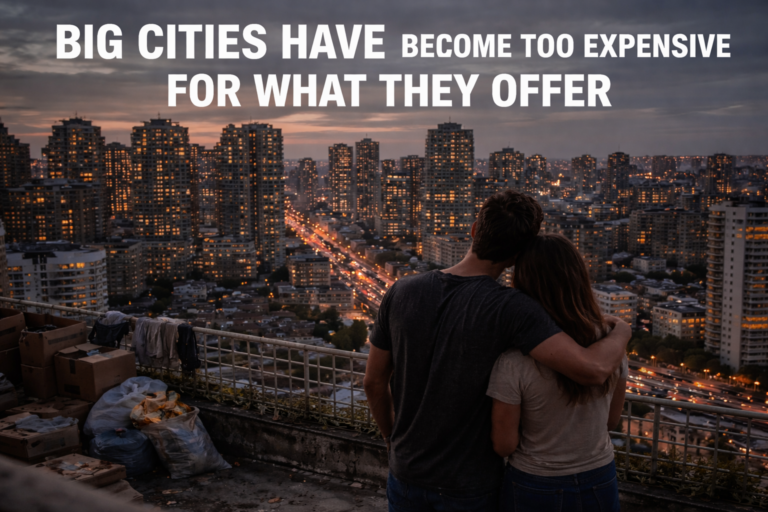
Big Cities Have Become Too Expensive for What They Offer
Dense environments demand continuous cognitive processing. The brain never truly rests. It just reallocates priorities. Over time, that state extracts a price. Less patience. Less depth. Less tolerance for error.
-
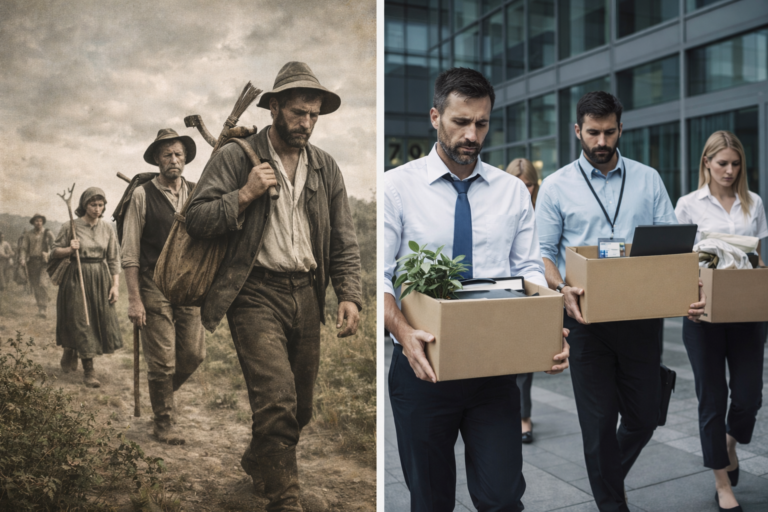
The Industrial Revolution Didn’t Destroy Jobs. It Stripped Away Illusions.
Modern automation, especially software-driven automation and AI, is hitting symbolic professions first. Not the poorest. Not the wealthiest. It’s hitting the middle layer that learned to trade intellectual routine for stability.




No Responses