This morning I opened my banking app the same way people check the time. No tension. No surprise. The balance was there, the bills were there, everything lined up in that quiet, bureaucratic way that makes life feel grounded. When nothing beeps, you get the impression that the system knows what it’s doing.
I closed the app and caught myself thinking something a little embarrassing. We treat this kind of normality as if it were a permanent feature of reality, like the universe signed a maintenance contract and promised to keep things running. It didn’t. It never does. It just lets us believe for long enough that the belief itself becomes expensive.
Why Stability Feels Like the Natural State of Modern Life
Stability has a neat trick. When it works, it disappears. It turns into background noise. The lights come on, water flows, transportation runs, salaries hit accounts, cards get approved, and that’s it. Stability becomes invisible, like the foundation of a house. Nobody applauds the foundation. They applaud the living room.
But foundations don’t exist by default. They’re active work. Stability is too.
Historically speaking, what we call “stable periods” were almost always moments when three things happened to align at the same time. Enough resources to keep the machine fed. Institutions capable of coordinating more people than any individual could ever know. And collective confidence that tomorrow wouldn’t contradict today in any dramatic way. When one of those pieces slips, the system doesn’t suddenly “become unstable.” It starts charging interest.
The uncomfortable part is that stability rarely ends with fireworks. It fades. One day you have a routine. Then you have the same routine with friction. Then the routine starts requiring improvisation. Then quiet concessions. And when you finally notice, what you’ve been calling a “rough phase” turns out to be structural change wearing casual clothes.
Rome at Its Peak: When Stability Was a Project, Not a Condition
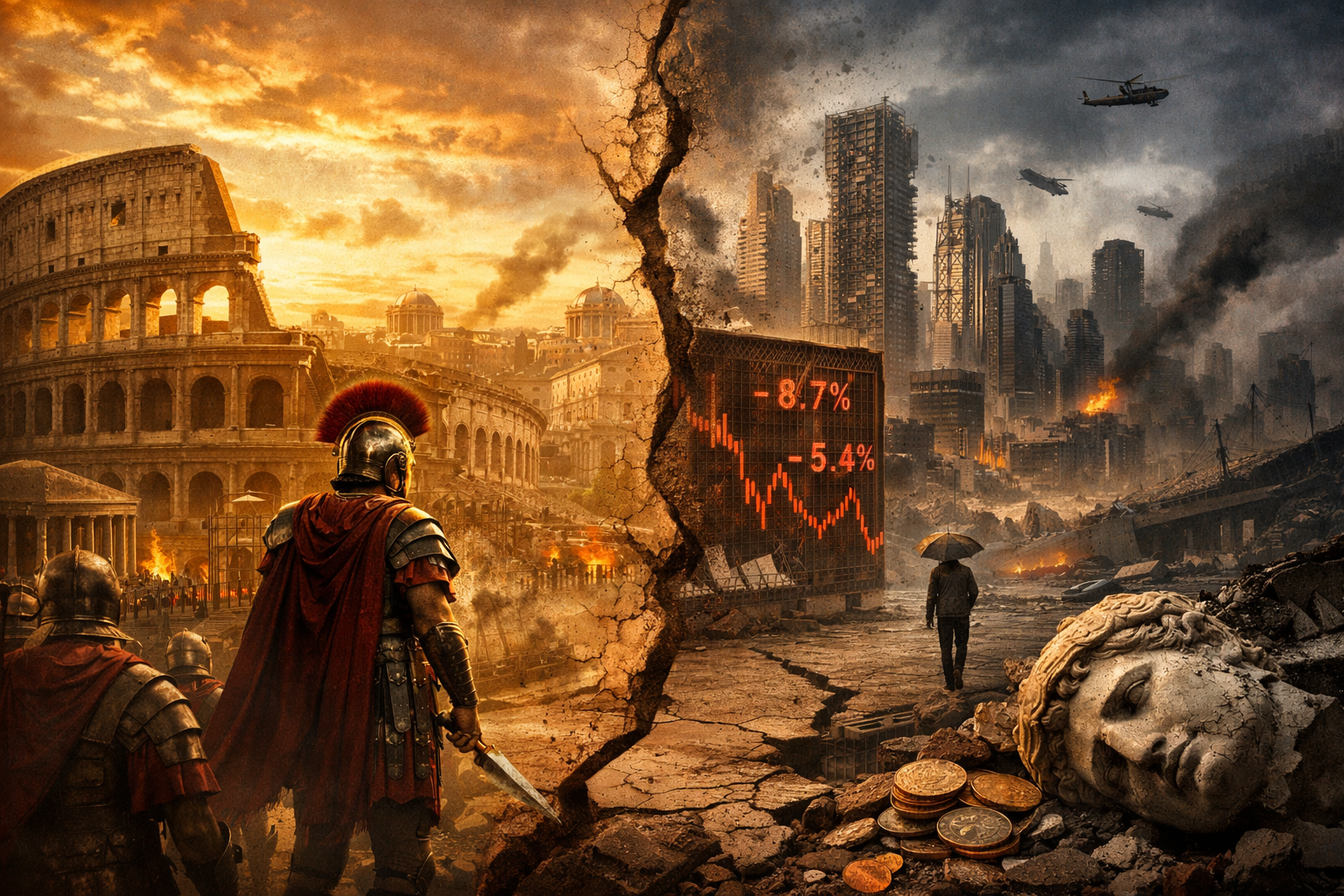
At its height, the Roman Empire controlled millions of square kilometers and governed tens of millions of people. Some estimates place that peak at over four million square kilometers and roughly 60 million inhabitants, a scale that’s hard to visualize without modern maps. University of Cambridge, 2025.
Here’s the detail that usually gets lost somewhere between textbooks and documentaries. Roman stability wasn’t a gift. It was engineering.
The relative peace people associate with Rome, especially during certain periods, depended on constant heavy maintenance. Roads, ports, provincial administration, currency circulation, troop logistics, city supply chains, command hierarchies, local agreements, co-opted elites. None of this is a “natural state.” It’s machinery.
And machinery works beautifully until the day it starts working for itself.
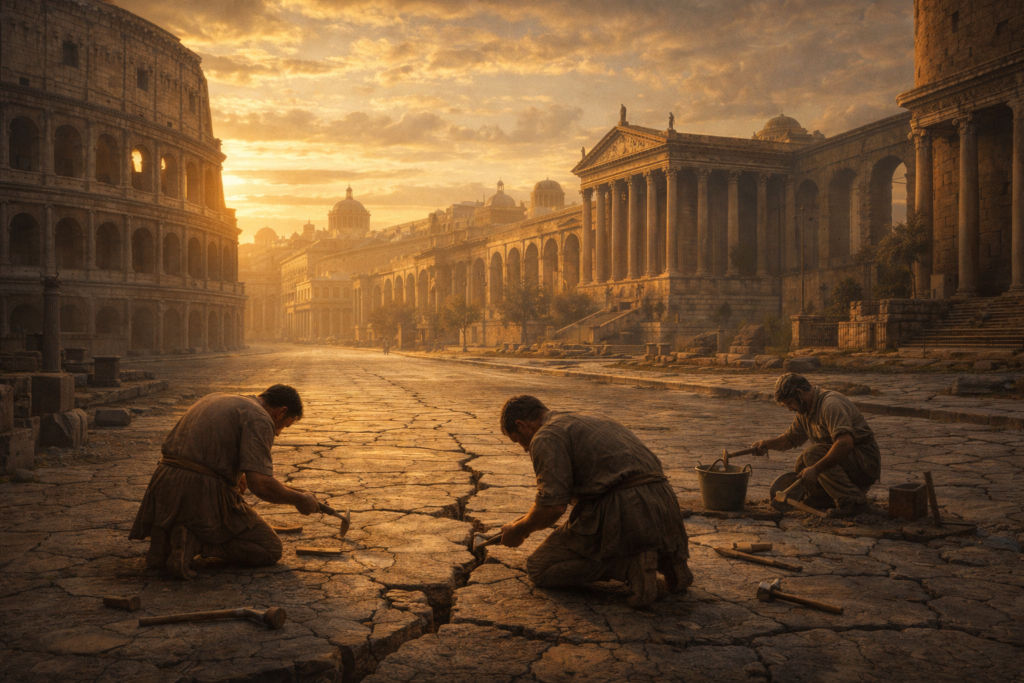
Rome understood something modern people tend to forget. Stability isn’t something you arrive at. It’s something you keep paying for. Every single day. When that payment feels light, you stop noticing it. That’s usually when the invoice is quietly growing in the background.
The Invisible Cost of Keeping Everything Running
Stability has always had a price. The only real question is who pays it and when.
In an expanding system, that price is easy to miss because growth covers the bill. It’s like a company growing fast enough to confuse revenue with health. You can afford the hires, the offices, the marketing, the narrative. Everything looks solid. The problem only shows up when growth slows down.
Rome had its own version of this. As long as expansion continued, there were new lands, new routes, new taxes, new sources of wealth and manpower. The machine was expensive, but expansion helped finance it. When expansion lost momentum, the machine stayed expensive. The difference is that now it had to be paid for with the system’s own body.
That’s when something almost universal in history starts to happen. Maintaining the structure begins to compete with real life.
Administration needs more people. The army needs more resources. Borders get longer. Corruption finds more cracks. Bureaucracy grows because when growth fades, systems try to compensate with control. And control has an appetite that doesn’t know when to stop.
This is where the dangerous illusion is born. Elites and populations get so used to stability that they treat it as proof of permanence. As if the model itself were eternal. That kind of thinking works extremely well right up until the exact minute it fails forever.
When Systems Grow Too Large to Adjust
What brings complex systems down is rarely a single blow. It’s the loss of adaptability.
Small systems make mistakes and correct them. Large systems make mistakes and justify them. Justification becomes policy. Policy becomes doctrine. Doctrine hardens into rigidity. And rigidity turns into fragility.
That’s the moment when Rome stops being “a chapter in history” and starts acting like a lens.
Because modern life is full of systems that feel stable precisely because they’re complex, integrated, and well choreographed. The difference today is the choreography depends on a different set of variables. Debt, demographics, energy, global supply chains, technology, institutional trust. All of it working together, every day, as if continuity were guaranteed.
It isn’t guaranteed. It’s sustained.
And sustaining something is very different from owning it.
The Stability of the 21st Century
Why It Looks Solid and Why That’s Exactly the Risk
To see how modern stability also runs on expensive maintenance, we don’t need dystopia. We just need numbers that don’t shout.
Start with public debt. The International Monetary Fund estimates that global public debt surpassed 93 percent of global GDP in 2024 and is projected to approach 100 percent by the end of this decade. IMF, 2024.
That’s not the end of the world. Debt is a tool. Civilizations have used it for centuries. Rome did too, just without spreadsheets. The issue isn’t debt itself. It’s what debt quietly eats away at.
Margin.
Margin is what allows a system to absorb shocks without breaking rhythm. It’s slack in the rope. Space to improvise. Room to be wrong without collapsing. As margin shrinks, every surprise becomes louder. Every adjustment hurts more. Every decision feels urgent even when it shouldn’t.
Now add demography.
The OECD projects that, on average, the number of people aged 65 and over for every 100 people aged 20 to 64 will rise from 33 in 2025 to 52 by 2050. OECD, 2025.
Again, not an apocalypse. It’s a reconfiguration. But reconfiguration has costs. It demands fiscal rearrangement. Labor market changes. Political trade-offs. And, most of all, it breaks old expectations that were built under very different population structures.
Put those two pressures together and you get something familiar. A system that still works, still delivers normal days, but does so with less room to maneuver. Less tolerance for error. Less patience for friction.
That’s not collapse. That’s fragility wearing a calm face.
Rome lived in that phase for longer than most people realize.
Stability Doesn’t End. It Gets Expensive.

One of the biggest mistakes people make when thinking about historical collapse is imagining a clean before-and-after. That’s comforting, but it’s wrong.
Rome didn’t wake up one morning and stop being Rome. Life went on. Markets opened. Laws were enforced. Taxes were collected. Roads were repaired. The machinery kept running.
What changed was the ratio between effort and outcome.
More energy went into preserving what already existed. Less went into adapting the structure itself. Over time, the system became very good at explaining why it couldn’t change. Which is a polite way of saying it got trapped by its own past successes.
Modern societies are extremely good at this too.
We optimize everything. Supply chains. Labor. Time. Credit. Information. We squeeze inefficiencies until there’s barely any slack left. Optimization feels smart. It looks like maturity. It photographs well in presentations.
But optimization trades resilience for efficiency. You don’t notice the trade until something slips.
Rome optimized too. It standardized administration, taxation, law, logistics. That’s part of why it lasted so long. The problem wasn’t competence. The problem was scale without margin.
When systems reach that point, they don’t adapt poorly because people get stupid. They adapt poorly because adaptation itself becomes too costly.
The Comfort Trap of Normal Days
Here’s the part that usually hits closest to home.
Most people don’t plan their lives around collapse scenarios. They plan around continuity. Steady income. Predictable expenses. Career paths that make sense if the background conditions hold.
And to be fair, that’s not irrational. Stability is real. It’s just conditional.
The danger starts when conditional stability gets treated as permanent. When people build lifestyles with no slack. When fixed costs quietly eat flexibility. When identity fuses with routine so tightly that any disruption feels existential.
Rome didn’t fall because people stopped believing in Rome. It fell because belief outpaced structure.
Modern life runs on a similar misunderstanding. We confuse smooth operation with durability. We see systems working today and assume they’ll absorb tomorrow the same way. That assumption is rarely tested until it’s tested all at once.

The Real Lesson Rome Leaves Behind
Rome isn’t useful as nostalgia. It’s useful as a warning label.
Systems don’t collapse because they’re evil or incompetent. They collapse because they become too expensive to maintain the way they were designed.
Modern society has a design too. We just call it “normal life.”
Normal life depends on debt rolling forward, demographics cooperating, energy flowing, institutions coordinating, and trust staying intact. Most days, it works. When it doesn’t, it doesn’t fail gently.
The mistake isn’t enjoying stability. The mistake is organizing your entire life as if stability were a law of nature instead of an agreement that needs constant renewal.
When Stability Shapes Your Decisions Without You Noticing
The impact of all this isn’t philosophical. It’s operational.
When people believe stability is permanent, a few patterns tend to show up almost automatically. They don’t look reckless. They look responsible. That’s what makes them dangerous.
The first is building a lifestyle with no margin. Fixed costs rise quietly. Commitments stack. Flexibility shrinks. Life turns into a machine that works beautifully as long as every piece behaves. The problem is machines without reserves panic when one part fails. And they always do, eventually.
The second is turning predictability into identity. Job titles, routines, neighborhoods, status markers. They stop being tools and start being who you are. When those shift, it feels like the ground disappears. It doesn’t. The ground just moved, and the map was outdated.
Then comes over-optimization. This one is seductive. You streamline everything. Time, money, effort. You squeeze inefficiencies and call it maturity. What you’re really doing is trading resilience for elegance. Efficiency feels smart until the day flexibility would’ve mattered more.
And finally, there’s outsourcing the future to systems that don’t know your name. As if the world had a dedicated support desk. It doesn’t. It has averages, probabilities, and adjustment mechanisms that don’t care who gets caught in the middle.
None of this requires fear. It requires structure.
History keeps whispering the same advice people don’t like because it sounds too simple. Those with margin choose. Those without it react.
Margin Is Not Pessimism. It’s Strategic Clarity.
Margin gets misunderstood because it doesn’t look ambitious. It looks boring. Cash buffers. Time buffers. Reputation buffers. Optionality that doesn’t photograph well.
Rome didn’t lose because it lacked intelligence or strength. It lost velocity. It became a massive body trying to turn in the same narrow street it had used for centuries. The street changed. The body didn’t.
Modern systems love to describe themselves as strong. And often they are. Strength, though, isn’t permanence. It’s the ability to keep changing direction without tearing yourself apart.
The same applies to individuals.
When you accept that stability is temporary, something counterintuitive happens. You don’t become anxious. You become precise.
You invest more carefully because you stop confusing good phases with destiny.
You diversify not out of paranoia, but because single points of failure are elegant right up until they’re fatal.
You protect liquidity, time, and reputation as reserves, not accessories.
You choose simplicity where others choose complexity, and that simplicity gives you speed.
That’s not retreat. That’s positioning.
Rome as a Mirror, Not a Monument
Rome isn’t a tragedy to mourn. It’s a pattern to recognize.
Its systems didn’t fail overnight. They became expensive to sustain without delivering proportional flexibility. Maintenance crowded out adaptation. Stability turned into inertia. Inertia hardened into fragility.
The modern world isn’t immune to that logic. It just runs it faster, with better interfaces and cleaner language.
Calling stability temporary isn’t cynicism. It’s literacy.
It means treating normal days as a favorable condition, not a guaranteed one. It means planning life as if adjustments will be required, not as if continuity were owed to you. It means understanding that agreements, unlike laws of nature, can expire.
A Short Closing, Without Drama
Stability doesn’t need to turn into fear. It can turn into lucidity.
And lucidity, when used well, becomes freedom of choice.
Not the illusion of control. The real thing.
Lizandro Rosberg
Independent analyst of technology, science, and civilizational transformations. He writes about artificial intelligence, science, applied history, the future of work, and the real impact of technology on human life. His focus is on translating complex changes into practical understanding.
You will certainly be interested in:
-
21st Century Economy | Artificial Intelligence | Future of Work | Future of Work & Automation | Life Strategy
The World Is Too Old to Run on Yesterday’s Assumptions
Modern societies are aging faster than their institutions, cities, and care systems were designed to handle. Population aging is no longer a forecast. It is a present condition. Fertility rates across developed economies remain structurally below replacement, while life expectancy continues to rise. More people stay in the system for longer, and fewer enter it to sustain what that system demands. This is not a moral debate. It is arithmetic.
The text dismantles the idea that declining birth rates can be reversed through incentives alone. Children have ceased to be a default continuation of life and have become high-risk projects, requiring time, stability, and energy. At the same time, large cities have grown expensive, regulated, and hostile to family formation. Housing costs, long commutes, and constant friction quietly discourage long-term planning. Fertility declines not because people reject families, but because the environment makes them fragile bets.
Longevity adds a second layer of tension. Medical and technological progress has extended human life by decades, but social structures have not adapted accordingly. Families are smaller, communities weaker, and informal care networks thinner. Care, once distributed among many, now concentrates on a few, often exhausted individuals. As demand rises and supply stagnates, eldercare becomes a systemic bottleneck.
At this point, the article reframes technology. Automation, AI, and robotics are not replacing human care. They are filling gaps left by demographic reality. Safety automation, assisted living systems, and care-support technologies emerge as infrastructure, not luxury. The comparison between regions is telling. China treats automation as capacity planning, scaling solutions pragmatically under demographic pressure. Europe, despite facing even sharper aging trends, often responds with moral discourse and procedural delay. The United States sits between these poles, still assuming it has time.
The article closes without apocalypse. It argues for early, practical adaptation. Designing homes and cities that reduce risk. Introducing assistive technology before crisis. Treating care as infrastructure rather than a private afterthought. Building redundancy not only in finances, but in human networks.
The final note is sober but constructive. The world did not become colder. It became older. And older societies need smarter designs. Less nostalgia. More alignment. In that sense, adapting early is not pessimism. It is a form of responsibility, and perhaps the most realistic kind of optimism available.
-
Personal AI for Finances: How Language Models Help You Stop Losing Money
When finances are reviewed regularly, without drama and without emotional drain, something subtle happens. Anxiety drops. Decisions stop being reactive. Small corrections happen early, before they turn into damage.
-
The Rat Race Was Designed, Not Chosen
Most people never sit down and choose a life of constant pressure. They don’t decide to trade freedom for anxiety or flexibility for fragility.
-
Big Cities Have Become Too Expensive for What They Offer
Dense environments demand continuous cognitive processing. The brain never truly rests. It just reallocates priorities. Over time, that state extracts a price. Less patience. Less depth. Less tolerance for error.
-
The Industrial Revolution Didn’t Destroy Jobs. It Stripped Away Illusions.
Modern automation, especially software-driven automation and AI, is hitting symbolic professions first. Not the poorest. Not the wealthiest. It’s hitting the middle layer that learned to trade intellectual routine for stability.
-
21st Century Economy | Artificial Intelligence | Future of Work & Automation | Geopolitics & Energy | Life Strategy
Highly Qualified, Quietly Poor
This morning was unremarkable. I made coffee the same way I always do. Same mug. Same chipped edge. I scrolled through messages I didn’t answer yesterday and noticed something small, almost silly. Three different people, unrelated, all talking about money. Not investment tips. Not ambition. Just fatigue. Quiet, practical fatigue. No drama. No despair. Just […]




No Responses