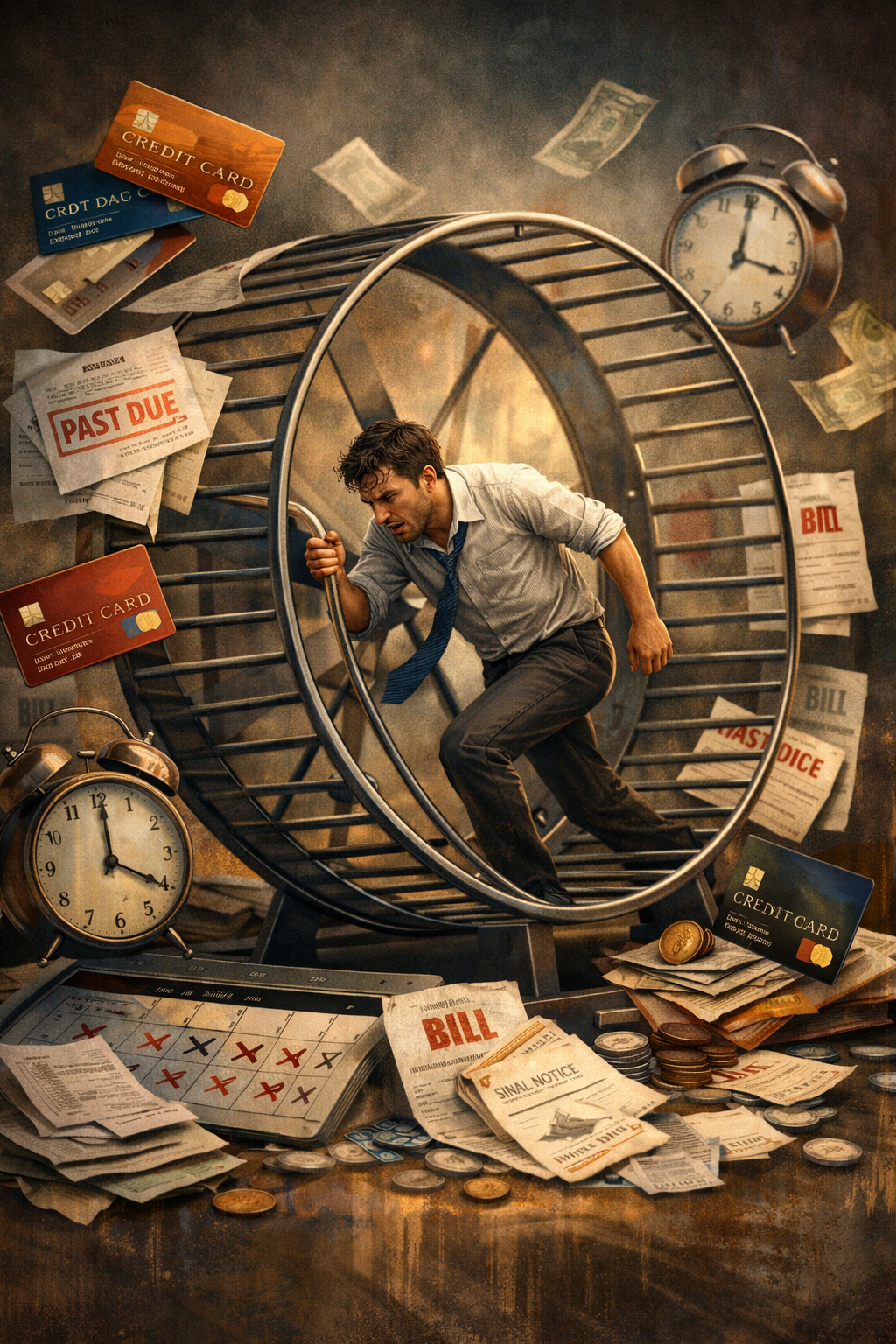
A Normal Day, a Familiar Calculation
This morning I caught myself checking my account balance before doing anything else.
No emergency. No overdue bill. Just habit. The kind you don’t remember building, but follow anyway.
The numbers looked acceptable. What didn’t was the feeling underneath them. Not panic. Not fear. Just a quiet awareness that if one thing shifted, the day would tilt with it.
That’s when it hit me.
This wasn’t poor planning.
It was the system doing exactly what it was built to do.
Why Most People Never Choose the Rat Race
There’s a story we like to tell about financial struggle. That people end up trapped because they spent too much, saved too little, or lacked discipline. It’s a comforting explanation because it keeps everything personal. If the problem is individual failure, the system stays innocent.
But that story doesn’t hold.
Most people never sit down and choose a life of constant pressure. They don’t decide to trade freedom for anxiety or flexibility for fragility. What happens instead is gradual, reasonable, and almost invisible while it’s happening.
The rat race isn’t entered through a dramatic decision.
It’s entered through a series of sensible ones.
A better apartment. Reliable transportation. Credit that smooths the month. Installments that make life manageable. Each step feels adult, responsible, justified. None of them look like a trap on their own.
Together, they form one.

Credit, Consumption, and Paychecks as a Closed Loop
Modern life runs on a simple loop. Earn. Spend. Finance the gap. Repeat.
Credit doesn’t arrive as danger. It arrives as relief. It bridges timing problems. It reduces friction. It turns big costs into smaller monthly commitments. Consumption doesn’t look excessive. It looks normal. Necessary. Expected.
Installments become the grammar of adult life.
Over time, something subtle happens. Fixed expenses grow faster than flexibility. The monthly number becomes more important than the total cost. The paycheck stops being income and starts being oxygen.
This isn’t accidental.
Federal Reserve data over the past decades shows consumer credit expanding steadily as a structural feature of household finances, not an emergency tool. Credit cards, auto loans, and revolving balances are no longer exceptions. They are infrastructure.
When credit becomes infrastructure, dependency follows.
The system doesn’t need you to fail. It only needs you to keep showing up.
Income Feels Like Progress, Until It Becomes a Trap
Here’s one of the most misunderstood dynamics of modern money. Higher income often feels like freedom, right up until it removes it.
As income rises, expenses tend to lock in. Housing adjusts. Commitments multiply. Standards solidify. The cost of maintaining your current life quietly increases. At some point, earning less is no longer an option, even temporarily.
That’s when income stops being power and becomes obligation.
From the outside, it still looks like success. From the inside, it feels like running in place while the ground moves faster.
This is why so many high earners feel oddly fragile. One disruption. One delay. One health issue. Suddenly the margin vanishes.
That fragility isn’t a character flaw.
It’s structural exposure.
Assets, Expenses, and the Direction Money Flows
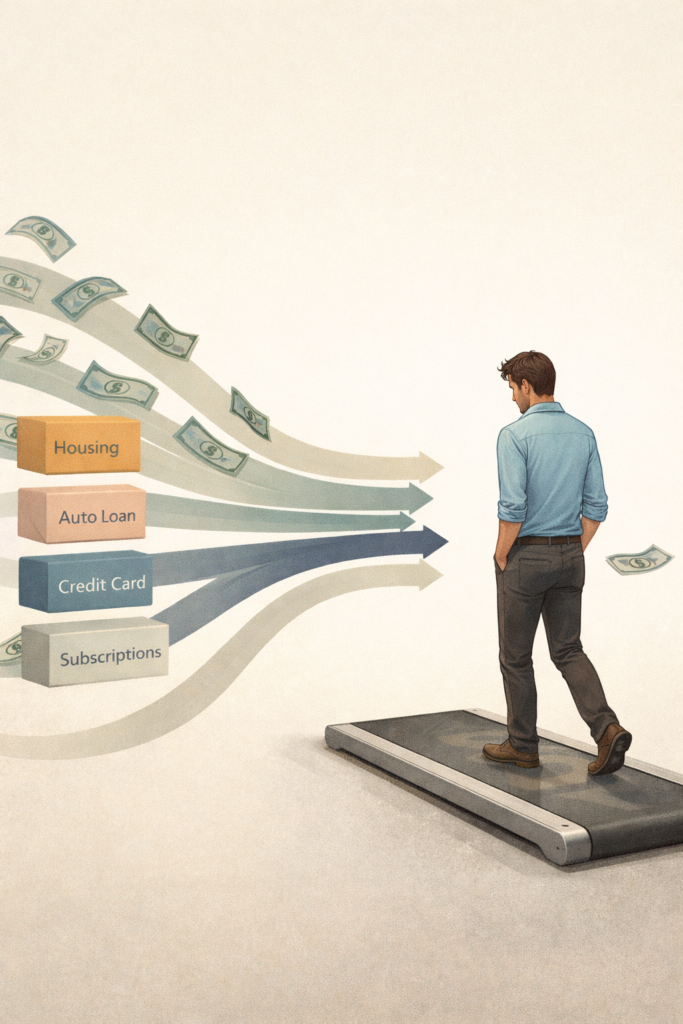
There’s a quiet distinction most people aren’t taught early enough. Some things put money in your pocket. Others take it out. Many do both, but rarely in equal measure.
When most of your life is built around expenses that demand constant income, your financial system becomes one directional. Money flows in and immediately flows out. The moment inflow stops, pressure spikes.
This is why paycheck dependency is so exhausting. Not because work is bad, but because there’s no buffer between effort and survival.
Over time, the system trains behavior. Safer choices. Shorter horizons. Less experimentation. Not because the person lacks ambition, but because the structure punishes risk.
You don’t stop dreaming.
You just postpone it indefinitely.
The System Rewards Endurance, Not Escape
Here’s the part that’s hardest to see while you’re inside it. The system doesn’t reward freedom. It rewards endurance.
If you keep paying, keep showing up, keep consuming, everything works. Promotions feel like progress. Raises feel like relief. But the underlying mechanics don’t change. They tighten.
The rat race doesn’t need you to be unhappy. It just needs you to stay busy enough not to redesign your life.
And most people do.
Not because they’re weak.
Because redesign requires clarity, margin, and time.
The very things the system quietly removes.
The rat race doesn’t begin with bad choices. It begins with normal ones, stacked inside a structure that converts effort into dependency.
How Fatigue Becomes a Financial Cost
Fatigue is usually treated as a personal problem. Something you fix with rest, motivation, or a long weekend. In reality, fatigue is one of the most expensive hidden variables in modern finance.
Fatigue raises the cost of every decision.
When you’re tired, you don’t stop deciding. You decide worse. You choose convenience over efficiency. Certainty over improvement. Immediate relief over long-term gain. Not because you’re careless, but because your cognitive margin is gone.
This isn’t opinion. Behavioral economics and neuroscience research consistently show that chronic stress reduces executive function, shortens time horizons, and impairs risk assessment. In plain terms, a tired brain plans badly and pays more for everything.
The system understands this better than most people do.
That’s why financial pressure rarely comes all at once. It’s distributed. Spread across months. Hidden inside subscriptions, minimum payments, renewals, and quiet obligations. Nothing feels catastrophic. Everything feels heavy.
And heavy decisions get expensive.
Why Discipline Alone Rarely Breaks the Cycle
When people finally feel trapped, the advice they hear is almost always the same. Budget harder. Cut spending. Be disciplined. Take control.
Discipline matters. But discipline without structure is just endurance.
Most attempts to escape the rat race fail because they rely on constant effort in an environment designed to drain it. Aggressive cuts without margin increase stress. Rigid plans collapse at the first surprise. Motivation burns out faster than obligations disappear.
This leads to a familiar pattern. Short bursts of control followed by exhaustion and relapse. Not because the person didn’t want it badly enough, but because willpower was asked to solve a structural problem.
Discipline works when the ground is stable.
Without ground, it becomes friction.
The system benefits from this misunderstanding. As long as people blame themselves for failing to escape, they never question the architecture that keeps pulling them back.
When Side Hustles Become Another Cage
At some point, many people try to run harder. A second job. A late-night project. An opportunity that promises freedom but demands exhaustion upfront.
Sometimes it helps. Often it doesn’t.
The problem isn’t extra effort. It’s unchanged structure.
If new income is built on the same fragile foundation, pressure remains. One dependency replaces another. The calendar fills. Fatigue deepens. The race continues under a different name.
This is how people mistake movement for escape.
Real exit doesn’t come from doing more inside the same system. It comes from changing how money flows through your life.
Cash Flow Direction Shapes Behavior
Here’s a quiet truth most people feel but rarely articulate. The direction money flows determines how you think.
When money only flows in through effort and flows out through fixed obligations, your life becomes reactive. You protect income at all costs. You avoid pauses. You delay changes that could reduce earnings even temporarily.
When some money flows in independently of your daily effort, even in small amounts, behavior changes. Time horizons extend. Decisions slow down. Risk becomes calculated instead of terrifying.
This isn’t about becoming rich overnight. It’s about breaking one-way dependency.
Systems that rely entirely on earned income reward compliance. Systems with even modest independent cash flow reward design.
The difference isn’t income level.
It’s structure.

Why the System Feels Safe Until It Isn’t
One of the most dangerous aspects of the rat race is how normal it feels. As long as payments clear and income arrives on time, everything appears stable. The pressure is real, but manageable.
Until it isn’t.
A delay. A layoff. A health issue. A family need. Suddenly the system reveals its rigidity. Options vanish. Time compresses. Decisions turn urgent.
This is why so many people say they were doing fine right up until they weren’t. The structure worked perfectly in good conditions. It was never designed for disruption.
Stability isn’t about thriving when things go right.
It’s about surviving when they don’t.
The First Step Isn’t Escape. It’s Design Awareness
The most important shift doesn’t happen in income. It happens in perception.
When people realize the rat race wasn’t chosen but designed, guilt loosens its grip. The body relaxes slightly. The mind regains space. And space is where method begins.
Without that understanding, every attempt at change feels personal and heavy. With it, redesign becomes possible.
Not dramatic. Not heroic. Incremental and quiet.
The goal isn’t to stop working. It’s to stop being structurally dependent on constant effort for stability.
Structure Beats Motivation Every Time
Motivation is loud. Structure is quiet.
Motivation feels powerful because it shows up as energy. A surge of intent. A sense that this time will be different. Structure doesn’t feel like much at first. It feels small, almost boring. That’s why most people underestimate it.
But motivation fades. Structure remains.
A system that depends on you being sharp, rested, and disciplined every single day will eventually fail. Not because you’re weak, but because you’re human. A system that works even when you’re tired, distracted, or unlucky has a chance of lasting.
That’s the difference.
The rat race is powered by motivation cycles. Push harder. Try again. Reset next month. It keeps people moving without changing direction. Structure, on the other hand, changes the direction money flows, even if the speed stays the same.
You don’t need dramatic breakthroughs.
You need fewer points of failure.
What Real Financial Leverage Actually Looks Like
Leverage is often misunderstood. People hear the word and think of scale, debt, or big bets. In practice, real leverage is quieter and more personal.
Leverage is when effort and outcome stop being tightly coupled.
When every dollar you earn requires your immediate presence, leverage is zero. When some value continues to arrive without constant effort, leverage begins to exist. Even small amounts change behavior.
This doesn’t mean quitting work. It means reducing fragility.
A life built entirely on earned income is exposed to interruption. A life with layered cash flow has options. Options reduce fear. Reduced fear improves decisions. Better decisions compound.
The order matters.
Most people try to increase income before reducing exposure. That’s why gains feel temporary. Structure has to come first.
Why Most People Never Redesign Their Financial Life
Redesign requires three things most people don’t have at the same time. Clarity, margin, and time.
Clarity is lost under pressure. Margin disappears under fixed obligations. Time vanishes when every hour is monetized just to keep things running.
The system doesn’t need to stop people from escaping. It just needs to keep them busy enough not to rethink the design.
That’s why escape fantasies are popular. They’re exciting and harmless. Real redesign is quiet and disruptive. It doesn’t look impressive. It just works better.
The first real shift isn’t quitting anything. It’s questioning what depends on you being permanently exhausted to function.

Stability Is the First Form of Freedom
Freedom doesn’t arrive all at once. It starts as stability.
Stability is having room to absorb a hit. Room to pause. Room to decide without panic. It’s the difference between reacting and choosing.
In a volatile economy, stability is leverage. It buys time. It buys clarity. It buys the ability to say no.
Once stability exists, growth stops being desperate. It becomes intentional.
This is where many people get it backward. They chase growth hoping it will bring stability later. Often it doesn’t. Growth without structure just raises the stakes.
Stability first lowers them.
A Different Way Out of the Rat Race
The way out isn’t dramatic. It doesn’t require perfect timing or extreme sacrifice. It requires redesigning how money supports your life instead of controlling it.
Less dependency on constant income.
Motolerance for disruption.
Fewer fixed obligations.
More optionality.
None of this is exciting. That’s why it works.
The rat race feeds on urgency. Structure feeds on patience.
The rat race wasn’t chosen. It was designed.
Understanding that doesn’t solve everything, but it changes where responsibility really sits. Guilt fades. Clarity grows. Method becomes possible.
You don’t escape by running faster.
You escape by changing the ground you’re running on.
That doesn’t happen overnight.
But it does happen deliberately.
And once it starts, the race loses its grip.
Lizandro Rosberg
Independent analyst of technology, science, and civilizational transformations. He writes about artificial intelligence, science, applied history, the future of work, and the real impact of technology on human life. His focus is on translating complex changes into practical understanding.
You will certainly be interested in:
-
21st Century Economy | Artificial Intelligence | Future of Work | Future of Work & Automation | Life Strategy
The World Is Too Old to Run on Yesterday’s Assumptions
Modern societies are aging faster than their institutions, cities, and care systems were designed to handle. Population aging is no longer a forecast. It is a present condition. Fertility rates across developed economies remain structurally below replacement, while life expectancy continues to rise. More people stay in the system for longer, and fewer enter it to sustain what that system demands. This is not a moral debate. It is arithmetic.
The text dismantles the idea that declining birth rates can be reversed through incentives alone. Children have ceased to be a default continuation of life and have become high-risk projects, requiring time, stability, and energy. At the same time, large cities have grown expensive, regulated, and hostile to family formation. Housing costs, long commutes, and constant friction quietly discourage long-term planning. Fertility declines not because people reject families, but because the environment makes them fragile bets.
Longevity adds a second layer of tension. Medical and technological progress has extended human life by decades, but social structures have not adapted accordingly. Families are smaller, communities weaker, and informal care networks thinner. Care, once distributed among many, now concentrates on a few, often exhausted individuals. As demand rises and supply stagnates, eldercare becomes a systemic bottleneck.
At this point, the article reframes technology. Automation, AI, and robotics are not replacing human care. They are filling gaps left by demographic reality. Safety automation, assisted living systems, and care-support technologies emerge as infrastructure, not luxury. The comparison between regions is telling. China treats automation as capacity planning, scaling solutions pragmatically under demographic pressure. Europe, despite facing even sharper aging trends, often responds with moral discourse and procedural delay. The United States sits between these poles, still assuming it has time.
The article closes without apocalypse. It argues for early, practical adaptation. Designing homes and cities that reduce risk. Introducing assistive technology before crisis. Treating care as infrastructure rather than a private afterthought. Building redundancy not only in finances, but in human networks.
The final note is sober but constructive. The world did not become colder. It became older. And older societies need smarter designs. Less nostalgia. More alignment. In that sense, adapting early is not pessimism. It is a form of responsibility, and perhaps the most realistic kind of optimism available.
-
The Mistake That Kept Rome Standing for Centuries
At its height, the Roman Empire controlled millions of square kilometers and governed tens of millions of people. Some estimates place that peak at over four million square kilometers and roughly 60 million inhabitants, a scale that’s hard to visualize without modern maps.
-
Personal AI for Finances: How Language Models Help You Stop Losing Money
When finances are reviewed regularly, without drama and without emotional drain, something subtle happens. Anxiety drops. Decisions stop being reactive. Small corrections happen early, before they turn into damage.
-
Big Cities Have Become Too Expensive for What They Offer
Dense environments demand continuous cognitive processing. The brain never truly rests. It just reallocates priorities. Over time, that state extracts a price. Less patience. Less depth. Less tolerance for error.
-
The Industrial Revolution Didn’t Destroy Jobs. It Stripped Away Illusions.
Modern automation, especially software-driven automation and AI, is hitting symbolic professions first. Not the poorest. Not the wealthiest. It’s hitting the middle layer that learned to trade intellectual routine for stability.
-
21st Century Economy | Artificial Intelligence | Future of Work & Automation | Geopolitics & Energy | Life Strategy
Highly Qualified, Quietly Poor
This morning was unremarkable. I made coffee the same way I always do. Same mug. Same chipped edge. I scrolled through messages I didn’t answer yesterday and noticed something small, almost silly. Three different people, unrelated, all talking about money. Not investment tips. Not ambition. Just fatigue. Quiet, practical fatigue. No drama. No despair. Just […]





No Responses