
The other day at the grocery store, I stood in line a few seconds longer than usual. Not because I was annoyed. Just watching. A woman ahead of me paused, staring at the payment terminal like it had suddenly started speaking a foreign language. Behind me, a guy checked his watch every ten seconds, like her memory lapse was personally stealing minutes off his lifespan. Nobody said a word. The silence did all the talking.
Walking back home, I noticed something else that would’ve looked odd years ago. Most windows in the building across the street were shut, mid-afternoon, no movement, no noise. It didn’t feel spooky. It felt… consistent. Like the city had quietly updated its operating system and forgot to tell anyone.
Population aging crisis: the math stopped working, not the mood
There’s a low-grade discomfort hanging in the air lately. It doesn’t trend. It doesn’t become a headline. It’s more like the feeling you get when a machine keeps running, but you can hear a new rattle inside it.
Retirement systems, labor markets, family care, economic growth. We’re still talking and planning as if the human base is endless, young, and available on demand. It isn’t. The world got older, and it did it the way the most serious things always happen: slowly, then all at once.
By 2023, the global fertility picture looked nothing like the mid-20th century. Across regions that used to be “normal” in the sense of replacement-level family size, the average number of children per woman is now structurally low. The World Bank summarizes it bluntly: the replacement level is about 2.1 children per woman, yet whole regions have sunk far below that and stayed there. Europe and Central Asia, and North America, averaged about 1.6 in 2023. East Asia and the Pacific averaged about 1.3. This is not a temporary wobble. It’s a new baseline. (World Bank Blogs)
Here’s the part people hate admitting out loud: once the context changes, incentives don’t magically reverse it. You can throw money at births like you’re feeding quarters into a stuck vending machine. It might shake. It won’t necessarily drop the product.
And while births thin out, longevity keeps climbing. The World Health Organization notes that global life expectancy at birth reached 73.3 years in 2024, up 8.4 years since 1995. That’s a huge win. It’s also a quiet demolition crew for any society still built on the assumption that “old age” is brief, rare, and handled privately inside big families. (WHO)
So yes, we can call it “population aging,” but that phrase is too clean. It sounds like a demographic seminar. What it really means is this: more people are staying in the system longer, and fewer people are entering it to support what that system demands.
Not a moral problem. A throughput problem.
Declining birth rates: children stopped being default and became a high-risk project
For most of history, having children was continuity. It wasn’t always romantic, but it was normal. In modern developed life, it’s turned into a project. Projects require three resources that modern life is excellent at destroying.
Time. Predictability. Energy.
If you’re living in the United States, you can practically feel this in your bones. A job that’s “stable” still expects availability like you’re twenty-two with no responsibilities. Housing is priced like you’re competing with investors. Childcare is priced like it’s boutique surgery. Even people who could afford kids financially are often short on something else: margin.
When family formation becomes a high-stakes logistics puzzle, people act rationally. They delay. They reduce. They opt out.
The World Bank’s demographic overview captures how widespread this shift has become. Fertility decline has been pronounced enough that in 2023, some economies averaged less than one child per woman. That’s not “below replacement.” That’s a demographic free fall. (World Bank Blogs)
The uncomfortable implication is simple: fewer births today means fewer caregivers tomorrow. That’s the part the public conversation keeps dodging, because it feels too intimate. It drags the topic out of spreadsheets and into living rooms.

Cities got too expensive for what they deliver
There’s a detail most fertility discussions politely ignore: where people live, and what that life costs in attention, energy, and sanity.
Big cities used to justify themselves. They were expensive, sure, but they offered density, opportunity, cultural gravity. Now a lot of them have drifted into something else: highly sophisticated machines for extracting rent, time, and compliance.
In the U.S., you see it in the usual suspects. New York, San Francisco, Boston, D.C., Seattle. You also see it spreading outward. Suburbs that used to be the compromise now price like miniature versions of the core city, with longer commutes and fewer perks.
And there’s a specific European export that’s been creeping into the American urban mindset too. Call it Brusselsization: regulation-first living, where the default response to any human problem is a thicker rulebook and a new layer of administrative friction. The intention is usually noble. The result is often the same.
Life gets heavier.
When daily life gets heavier, people don’t suddenly become “anti-family.” They just stop pretending they can do everything at once. Having a child in an environment that punishes space, quiet, and predictability can feel like planning a garden inside a server room.
So fertility drops further. Not because people “hate kids.” Because the environment quietly tells them it’s a bad bet.
And then, ten years later, everyone acts surprised when the caregiver pipeline looks thin.
Population aging and the caregiver shortage problem: living longer without living with more people
This is where the story turns, because birth rates are only half the equation. The other half is longevity, and it’s accelerating.
The WHO projects that the number of people aged 60 and older will rise from 1.1 billion in 2023 to 1.4 billion by 2030. (WHO)
Read that again slowly. That’s not a distant future. That’s within the same decade most policymakers are still using to argue about symbolic issues that cost nothing and change nothing.
So we’re heading into a world with more older adults and fewer working-age adults to support the care load. That care load isn’t just “checkups and prescriptions.” It’s presence. It’s monitoring. It’s physical help. It’s continuity. It’s the stuff society used to outsource to the structure of big families and stable communities.
Those structures are weaker now, and pretending otherwise is just nostalgia wearing a policy suit.
This is the moment where a certain style of Western conversation usually collapses into a predictable loop: someone says “technology is dehumanizing.” Someone else says “family values.” Somebody writes a report. Everybody feels morally hydrated. Nothing changes.
Meanwhile, the actual bottleneck is still sitting there like a closed lane on a highway, backing everything up.
A quiet preview of what’s coming next
The West likes to imagine the future as a choice. Like we’ll hold a debate, vote on the vibe, and pick the version of reality that feels most ethical.
That’s adorable.
Reality shows up like gravity. It doesn’t ask permission.
And one region has been acting like it understands that. Not in speeches, but in deployment. While Western societies often treat automation as a philosophical threat, China has been treating it like staffing. Cold. Practical. Almost boring.
Even in manufacturing, the pace tells a story. The International Federation of Robotics reports the global average robot density hit 162 robots per 10,000 employees in 2023. China reached 470, surpassing Germany and Japan. The U.S. ranked tenth at 295. (IFR International Federation of Robotics)
That’s factories, not living rooms. But it’s a signal flare: when a society decides something is a strategic necessity, it scales. When a society decides something is a moral performance, it convenes.
And care for older adults is about to force that distinction into the open.
Aging population in the United States: when “later” shows up early

Now zoom in on the United States for a second, because it’s easy to assume America is the exception. Bigger economy, higher immigration, younger vibe, more “room.” That’s the story people like. The data is less sentimental.
In 2024, the U.S. Census Bureau reported that the population age 65 and older rose to 61.2 million, while the population under 18 ticked down to 73.1 million. More revealing than the national totals is the pattern: older adults outnumber children in 11 states and nearly half of U.S. counties. That’s not a coastal elite thing. That’s the country. (Census.gov)
Fertility tells the same story from the other side. The CDC’s National Vital Statistics Reports put the U.S. total fertility rate in 2023 at 1,621.0 births per 1,000 women, down 2% from 2022. Translation, again, without the academic tone: this is a country living below replacement for long enough that it becomes normal. (CDC)
This is where the conversation usually gets stuck in cultural blame games. People argue about values, attitudes, priorities, politics. Meanwhile the structural reality doesn’t care about anybody’s opinions. A society can argue itself into moral clarity and still fail to staff basic care.
The U.S. is aging in a way that turns eldercare from a private family issue into a public infrastructure load. The question is not whether you personally like that framing. The question is whether you can avoid it. You can’t.
Eldercare is becoming infrastructure, and we did not budget for infrastructure
When something becomes infrastructure, it stops being optional. You can’t “believe” your way out of it. You either build it, or it breaks.
For decades, eldercare ran on a quiet, unpaid engine: family time, mostly women’s time, plus proximity. The modern economy gradually dismantled all three.
Now the care sector is facing a double squeeze: rising demand and tight supply. The OECD has been blunt about it: aging populations are expected to significantly boost long-term care demand, yet the supply of care workers has stagnated over the past decade. Recruiting and retention are difficult, and shortages are already visible. (OECD)
And cost pressure follows. Another OECD report projects that long-term care spending, on average, is expected to at least double by 2050 across OECD countries. (OECD)
That’s not apocalyptic language. That’s the kind of sentence you write when the spreadsheet has stopped being polite.
This is also where a certain Western habit becomes costly: we keep treating care as an emotional topic first and an operational topic second. That ordering feels humane. It’s also how systems quietly fail.
Because when care fails operationally, the emotional part gets uglier, not prettier.
Robot caregivers and AI-assisted living: what the real future looks like
So here’s the hard pivot: if eldercare is turning into infrastructure, then technology is not an aesthetic choice. It’s a capacity multiplier.
But the “robot caregiver” people imagine is usually a Hollywood prop. The real shift is less dramatic and much more effective.
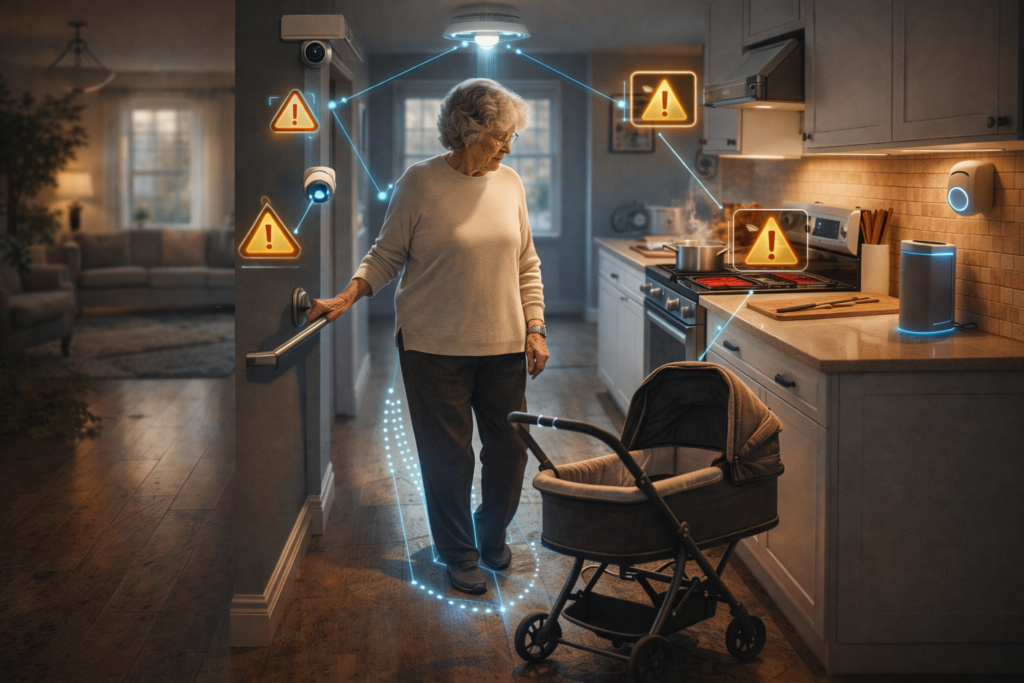
Think of the future of eldercare as a layered system:
- Safety automation
Fall detection, stove and water monitoring, door alerts, anomaly detection. Not to spy, but to reduce the chance that a small incident becomes a catastrophic one. - Routine automation
Medication reminders, appointment nudges, hydration prompts, simple daily check-ins. It sounds trivial until you’ve seen how quickly “trivial” becomes a hospital visit. - Communication automation
Fast, low-friction ways to loop in family, neighbors, or a wider care circle. The goal is not to replace humans. It’s to reduce the friction that prevents humans from showing up consistently. - Assistance devices
Mobility aids, lift supports, smart walkers, home retrofits that extend independence. Again, not sexy, just effective.
AI fits into this mostly as a coordinator. It reduces cognitive load and it reduces missed steps. It helps the system behave like a system instead of a pile of good intentions.
This is the part many people get wrong. They argue as if technology is competing with love. It isn’t. It’s competing with chaos.
And in aging societies, chaos wins by default if you don’t build against it.
Global demographic aging is accelerating, and the timeline is shorter than politics
The World Health Organization notes that global life expectancy at birth reached 73.3 years in 2024, up 8.4 years since 1995. It also projects the number of people aged 60 and older rising from 1.1 billion in 2023 to 1.4 billion by 2030. (WHO)
That’s the key timeline: 2030. This is not something your grandchildren will deal with. This is something your calendar will deal with.
And here’s a quiet pattern worth noticing. Societies that treat this as an engineering problem move faster. Societies that treat it mainly as a moral debate move slower.
You can guess which group tends to scale solutions.
China’s automation advantage: when necessity becomes strategy
China is not adopting automation because it loves shiny gadgets. It’s doing it because it understands something the West still performs confusion about: labor constraints are becoming structural.
Even if you ignore the eldercare domain and look only at manufacturing, the signal is loud. The International Federation of Robotics reported that China’s industrial robot density reached 470 robots per 10,000 employees in 2023, up from 402 in 2022, and that China surpassed Germany and Japan in the ranking. (IFR International Federation of Robotics)
This matters for two reasons.
First, it shows speed. China entered the top 10 in robot density in 2019 and doubled its density within four years, according to IFR. (IFR International Federation of Robotics)
Second, it shows intent. When a society decides something is strategic, it doesn’t just “discuss” it. It builds supply chains, trains talent, funds deployment, and normalizes adoption.
Now translate that mindset into eldercare, where the alternative is not “lower productivity,” but “nobody available.”
The West tends to treat that kind of rollout as morally suspicious. China tends to treat it as operationally obvious. The results show up in capacity.
This is not a compliment or a condemnation. It’s just what happens when one side treats reality like a constraint and the other treats reality like a debate prompt.
Europe’s demographic winter: the data says urgency, the posture says “later”

Europe is aging faster than most places, and it’s doing so with fertility levels that are hard to recover from.
Eurostat reports the EU total fertility rate at 1.38 live births per woman in 2023, down from 1.46 in 2022, with 3.67 million babies born in the EU that year. (European Commission)
Eurostat also reports that 21.6% of the EU population was aged 65 and over on 1 January 2024, with a median age of 44.7 years. (European Commission)
That is a region where aging is not approaching. It’s embedded.
And yet Europe often responds with a peculiar kind of passivity. Not inactivity, to be fair. Europe produces plans, frameworks, committees, resolutions. Lots of paper. Lots of moral language. The problem is that moral language can become a substitute for capacity.
In long-term care, for example, even the workforce composition tells you something about strain. OECD data points out that across 26 European OECD countries, the share of foreign-born long-term care workers rose from 14% in 2014 to 21% in 2024. (OECD)
That’s not “diversity.” That’s dependency. It means a region with one of the oldest populations is leaning increasingly on imported labor to keep care running, while simultaneously making it harder, through regulation and cost structure, for young families to form. You don’t need a conspiracy to see how that ends. You just need a calendar.
Europe’s vulnerability is not that it has values. Everybody has values. The vulnerability is the habit of mistaking values talk for execution. When demographic gravity hits, execution is the only thing that pays the bill.
The false comfort of “we’ll figure it out”: the West’s favorite lullaby
There’s a Western reflex that sounds mature but behaves like denial: “we’ll adapt.”
Sure. Humans adapt. That’s true.
What matters is how expensive adaptation becomes when it’s delayed.
When societies wait until a problem is visible, they pay crisis prices. When they build early, they pay wholesale. The difference is not just money. It’s dignity.
That’s why the robot caregiver question is framed wrong so often. People ask if it’s ethical to use robots and AI in care. A more honest question is: what’s your ethical plan when there aren’t enough humans to provide baseline coverage?
If the answer is “family will do it,” then you’re relying on a structure that is shrinking. If the answer is “the market will do it,” you’re relying on a workforce that is already constrained. If the answer is “the state will do it,” you’re relying on budgets under stress and political cycles that struggle with anything that doesn’t fit into a one-year narrative.
In practice, the solution will be hybrid. Families, communities, technology, and institutions, all stitched together. Not elegant. Just workable.
Which brings us to the only question most readers actually care about.
What can a normal person do?
Practical solutions for us, ordinary people: a realistic playbook for an aging world
This is not about panic. It’s about designing your life with fewer assumptions.
1) Build a “care map” before there’s a crisis
Write down, literally, who would be involved if an older family member needed help for three months. Not “in theory.” In reality.
Who is nearby? Who is reliable? Who has time? Who has constraints? Who can rotate? Who can handle logistics?
Most families discover the truth of their network at the worst moment. You want to discover it on a quiet Tuesday.
2) Reduce risk with boring home design
Most eldercare emergencies start with small, preventable things: falls, missed medication, dehydration, confusion. You don’t need a robot to fix the basics.
Better lighting. Fewer trip hazards. Grab bars in the right places. Clear labels. Simple routines. You’re not “making the home old.” You’re making it robust.
3) Adopt assistive tech early, while it still feels optional
Technology is hardest to introduce during chaos. Introduce it when things are stable.
Start with the lowest-friction tools: reminders, simple check-ins, emergency contacts, basic sensors. The point is not surveillance. The point is fewer silent failures.
Think of it like seatbelts. You don’t install seatbelts after the crash.
4) Pick your city, or your neighborhood, like fertility depends on it
Because it often does.
If housing, commuting, and daily friction are crushing margin, family formation becomes a stressful gamble. And later, eldercare becomes a nightmare because the environment itself is hostile to slow movement, community, and stability.
Walkability, quiet, proximity to essentials, and cost structure matter more than status. A “nice” place that burns your time and money is not nice. It’s just expensive.
5) Build human redundancy, not just financial savings
Savings help, but care failures are often about time, not dollars.
Cultivate a small circle of mutual support. Neighbors. Friends. Family. People you can actually call. In aging societies, social capital becomes a survival asset. Quietly, it becomes as important as income.
6) Upgrade your own skill set for the care economy
This one is counterintuitive: aging societies create opportunity. Not just for nurses or specialists, but for anyone who can reduce friction.
Basic competency with digital tools, scheduling, communication systems, simple automation, and AI assistants can make you more valuable in almost any role. It’s the difference between being overwhelmed by complexity and managing it.
7) Don’t wait for perfect policy
Policy helps, but policy is slow. Your life is not.
Aging is predictable enough that you can treat it like a project. Not a tragedy. A project. One that rewards early, boring steps.
A short, realistic ending: the world got older, so we have to get smarter
The world didn’t become bleak. It became older.
And older worlds need different designs. They need care as infrastructure, not as a whispered family secret. They need technology as a capacity tool, not as a moral Rorschach test. They need cities that give people margin again, not environments that drain it.
None of this requires apocalypse. It requires honesty.
The future probably won’t feel “romantic.” It might feel more engineered, more deliberate, more structured. But there’s a quiet upside in that: deliberate worlds can be kinder than accidental ones.
If we redesign early, we can trade panic for dignity.
And that’s not futuristic at all. That’s just adulthood, applied at the scale of a civilization.
A concrete next step, not a vague conclusion
If this article made sense to you, it’s probably because you already understand something many still resist:
the future doesn’t arrive with fireworks.
It arrives through slow shifts. Demographics. Automation. Cities that stop working as promised. Institutions that age faster than their assumptions.
That’s exactly the gap this book was written to address.
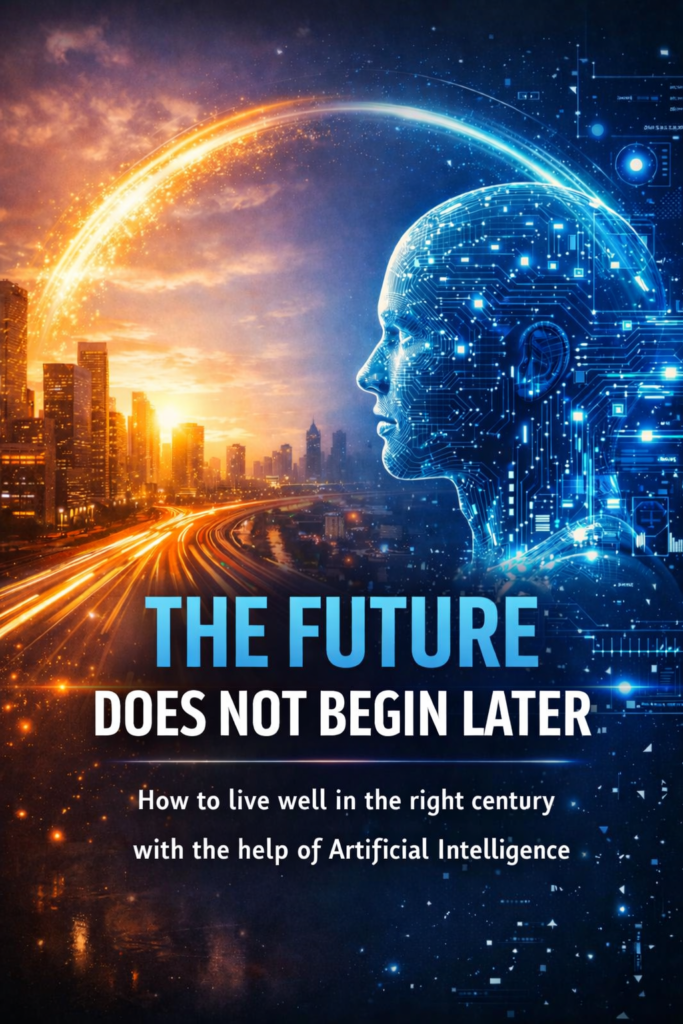
The Future Does Not Begin Later is not a guide to becoming an AI expert, and it’s definitely not motivational fluff.
It’s a practical map for people who want to grow alongside AI, instead of being quietly displaced by it, culturally, economically, or cognitively.
The book translates large forces
aging populations, automation, power reallocation, and intelligent systems
into clear, usable frameworks for ordinary life and work.
No hype.
No ideology.
No promises of shortcuts.
And here’s the part that matters:
It costs $9.90.
Not because it’s lightweight.
But because access is more important than prestige.
For less than the price of a single lunch, you get a condensed, carefully argued guide to understanding the century you’re already living in, written to be read slowly, not consumed anxiously.
You can access it directly here:
👉 https://go.hotmart.com/B103519504F
If the world is getting older, more automated, and structurally different, the rational move isn’t panic.
It’s alignment.
At $9.90, the real risk isn’t buying the book.
The risk is continuing to improvise in a world that has already changed its rules.
Lizandro Rosberg
Independent analyst of technology, science, and civilizational transformations. He writes about artificial intelligence, science, applied history, the future of work, and the real impact of technology on human life. His focus is on translating complex changes into practical understanding.
You will certainly be interested in:
-
The Mistake That Kept Rome Standing for Centuries
At its height, the Roman Empire controlled millions of square kilometers and governed tens of millions of people. Some estimates place that peak at over four million square kilometers and roughly 60 million inhabitants, a scale that’s hard to visualize without modern maps.
-
Personal AI for Finances: How Language Models Help You Stop Losing Money
When finances are reviewed regularly, without drama and without emotional drain, something subtle happens. Anxiety drops. Decisions stop being reactive. Small corrections happen early, before they turn into damage.
-
The Rat Race Was Designed, Not Chosen
Most people never sit down and choose a life of constant pressure. They don’t decide to trade freedom for anxiety or flexibility for fragility.
-
Big Cities Have Become Too Expensive for What They Offer
Dense environments demand continuous cognitive processing. The brain never truly rests. It just reallocates priorities. Over time, that state extracts a price. Less patience. Less depth. Less tolerance for error.
-
The Industrial Revolution Didn’t Destroy Jobs. It Stripped Away Illusions.
Modern automation, especially software-driven automation and AI, is hitting symbolic professions first. Not the poorest. Not the wealthiest. It’s hitting the middle layer that learned to trade intellectual routine for stability.
-
21st Century Economy | Artificial Intelligence | Future of Work & Automation | Geopolitics & Energy | Life Strategy
Highly Qualified, Quietly Poor
This morning was unremarkable. I made coffee the same way I always do. Same mug. Same chipped edge. I scrolled through messages I didn’t answer yesterday and noticed something small, almost silly. Three different people, unrelated, all talking about money. Not investment tips. Not ambition. Just fatigue. Quiet, practical fatigue. No drama. No despair. Just […]






No Responses