Would you like to hear the narrated version?
On Christmas Eve, the world slows down.
The streets grow quieter. Notifications arrive less frequently. Families gather. Time feels suspended, even if briefly. It’s a moment traditionally reserved for reflection, not forecasts. Yet paradoxically, it is precisely on nights like this that historical transitions become clearer.
While most people look backward, something fundamental is already moving forward.
Not loudly.
Not dramatically.
But irreversibly.
As this Christmas approaches, we are not standing at the end of a year. We are standing at the threshold of a decade that will redefine what it means to think, work, and produce value.
We are entering the decade of augmented intelligence.
A civilizational shift, not a trend
When we talk about technology and the future, we are not imagining science fiction. We are describing patterns that repeat across history. Every time a breakthrough changes how humans produce, decide, and interpret reality, a new civilizational chapter begins.
The printing press did this in the 15th century.
Electricity reshaped society at the end of the 19th century.
The internet redefined the world between 1995 and 2005.
Now, between 2023 and 2030, we are experiencing another turning point. Human cognitive capacity is being artificially expanded, day by day, through large language models, autonomous agents, and predictive systems.
This is not a linear upgrade.
It is a tectonic shift.
The evidence is already measurable
Research institutions such as MIT CSAIL, Stanford HAI, and DeepMind consistently show the same uncomfortable reality: modern AI systems are approaching general reasoning patterns in multiple domains.
The Stanford AI Index 2024 confirms that recent models already outperform average humans in tasks like knowledge synthesis, code generation, basic planning, complex pattern recognition, and short-term forecasting.
This does not signal replacement.
It signals amplification.
According to Harvard Business School, professionals who integrate AI into their workflows increase productivity by 25% to 40%, while improving output quality. Augmented intelligence is no longer theoretical. It is an economic variable.
The myth of “humans versus machines”
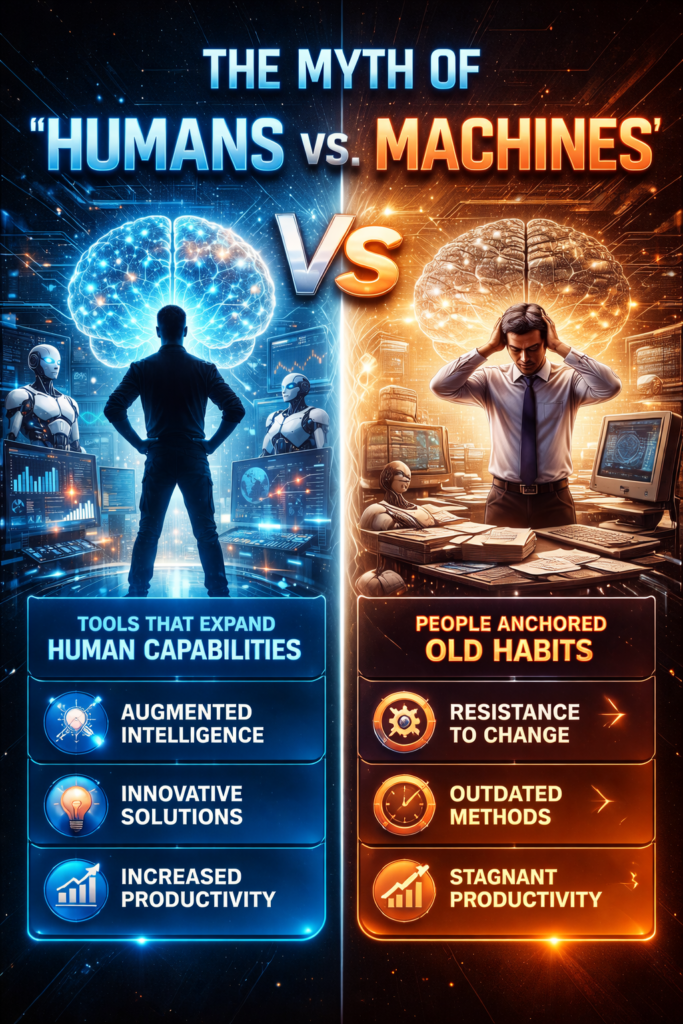
The idea that humans compete against machines has always been misleading. The real division has never been biological. It has been behavioral.
On one side: tools that expand human capability.
On the other: people anchored to outdated habits.
The steam engine did not eliminate workers; it eliminated inefficient methods.
Computers did not replace doctors; they replaced those unwilling to learn new tools.
Artificial intelligence will follow the same pattern. It will not replace individuals. It will replace stagnation.
The McKinsey estimates that over 70% of existing jobs in the United States will not disappear, but will be radically transformed. This transition gives rise to a new figure: the hybrid professional.
The rise of the hybrid professional
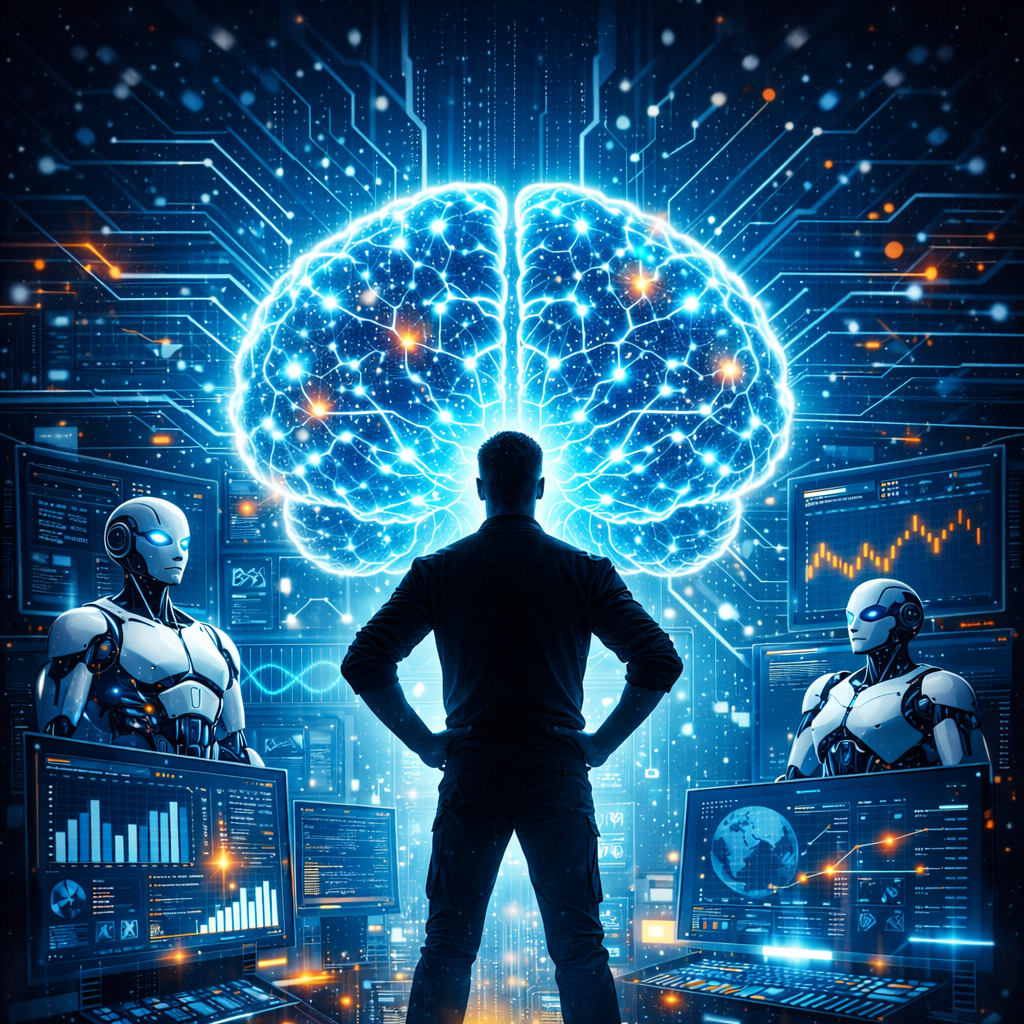
This new professional operates across three essential layers:
- mental clarity to ask precise questions
- curatorial judgment to separate signal from noise
- disciplined operation of AI systems
With these skills, individuals can accomplish in one day what required entire teams two decades ago. The MIT Sloan refers to this phenomenon as cognitive leverage.
It is not speculative.
It is observable.
The United States is reorganizing silently
The U.S. economy is already adjusting. Productivity growth has become a strategic priority as demographic expansion slows. AI is increasingly framed not as innovation hype, but as infrastructure.
Federal initiatives, private sector investment, and academic research converge on a single goal: scaling intelligence to sustain economic leadership.
Massive investments in data centers, AI research, and workforce retraining reflect a structural understanding: productivity must rise without proportional population growth.
Augmented intelligence becomes a national asset.
A quiet cognitive elite is forming
Research from the Pew Research Center reveals a critical asymmetry. While a majority of Americans have experimented with AI tools, over 60% use them superficially. Only a small minority integrates AI deeply into reasoning, analysis, and decision-making.
This gap creates an extraordinary window of opportunity.
The emerging cognitive elite will not necessarily come from elite universities or traditional institutions. It will come from individuals who practice, daily:
- production
- analysis
- method
- consistency
Quietly.
December as a moment of clarity
December is often associated with emotional closure. But historically, it is also a moment of strategic perspective.
We are entering the first full operational year of the augmented intelligence era. By 2026, we will observe:
- drastic productivity acceleration
- multiplication of individual knowledge capacity
- emergence of new intellectual authorities
- rapid project execution
- geographic independence from work
- deep analytical capability accessible to individuals
None of this is speculative. It is already unfolding.
The new definition of human capital
Human capital now concentrates on:
- curation
- problem formulation
- AI-assisted strategic reasoning
- authorial narrative
- rapid execution
- critical filtering
Professionals trained in AI consistently outperform peers operating alone. MIT data confirms that AI-augmented professionals match the output of early-2000s teams.
This is the new human capital.
And it is built in months, not decades.
The inevitability of the hybrid
This individual solves problems above the average baseline, builds businesses with less structure, and operates beyond traditional biological limits.
They do not fear automation.
They employ it.
They do not rely on credentials.
They rely on method.
The World Economic Forum projects that the fastest-growing professions through 2030 will require precisely this combination: AI mastery and critical thinking.
The first truly augmented generation is emerging now.
(Global AI Transform Industry Report)
Power in the age of intelligent computation
Computational costs have dropped by more than 60% in three years. Model capability has expanded exponentially. Governments and corporations invest billions into AI infrastructure.
Just as energy defined power in 1900, intelligent computation will define power by 2030.
Those who command:
- more advanced models
- greater processing capacity
- more hybrid operators
will shape global outcomes.
History repeats at the margins
Patterns are familiar.
In 1998, few used the internet professionally.
In 2008, few recognized smartphones as productivity tools.
In 2010, few understood social media’s economic potential.
In 2016, few mastered digital marketing.
In 2025, few operate AI deeply.
This represents one of the largest opportunity asymmetries of the modern era.
No technology in human history has transferred as much power to the individual.
The divide between those who step forward and those who remain anchored to the past will not be defined by ideology, class, or luck.
It will be defined by method.
By discipline.
By operation.
Augmented intelligence is not a promise.
It is a new human condition.
And for those who begin now, it will also become a new way of life.
Want to go deeper?
I wrote a concise, practical ebook for those who want to move from curiosity to real cognitive leverage with AI.
No hype. No promises. Just method, clarity, and disciplined use of intelligence amplification.
If you want to think better, decide faster, and operate at a higher level in this decade of augmented intelligence, this is your next step.
👉 Read the ebook here:
https://go.hotmart.com/B103519504F
Lizandro Rosberg
Independent analyst of technology, science, and civilizational transformations. He writes about artificial intelligence, science, applied history, the future of work, and the real impact of technology on human life. His focus is on translating complex changes into practical understanding.
You will certainly be interested in:
-
21st Century Economy | Artificial Intelligence | Future of Work | Future of Work & Automation | Life Strategy
The World Is Too Old to Run on Yesterday’s Assumptions
Modern societies are aging faster than their institutions, cities, and care systems were designed to handle. Population aging is no longer a forecast. It is a present condition. Fertility rates across developed economies remain structurally below replacement, while life expectancy continues to rise. More people stay in the system for longer, and fewer enter it to sustain what that system demands. This is not a moral debate. It is arithmetic.
The text dismantles the idea that declining birth rates can be reversed through incentives alone. Children have ceased to be a default continuation of life and have become high-risk projects, requiring time, stability, and energy. At the same time, large cities have grown expensive, regulated, and hostile to family formation. Housing costs, long commutes, and constant friction quietly discourage long-term planning. Fertility declines not because people reject families, but because the environment makes them fragile bets.
Longevity adds a second layer of tension. Medical and technological progress has extended human life by decades, but social structures have not adapted accordingly. Families are smaller, communities weaker, and informal care networks thinner. Care, once distributed among many, now concentrates on a few, often exhausted individuals. As demand rises and supply stagnates, eldercare becomes a systemic bottleneck.
At this point, the article reframes technology. Automation, AI, and robotics are not replacing human care. They are filling gaps left by demographic reality. Safety automation, assisted living systems, and care-support technologies emerge as infrastructure, not luxury. The comparison between regions is telling. China treats automation as capacity planning, scaling solutions pragmatically under demographic pressure. Europe, despite facing even sharper aging trends, often responds with moral discourse and procedural delay. The United States sits between these poles, still assuming it has time.
The article closes without apocalypse. It argues for early, practical adaptation. Designing homes and cities that reduce risk. Introducing assistive technology before crisis. Treating care as infrastructure rather than a private afterthought. Building redundancy not only in finances, but in human networks.
The final note is sober but constructive. The world did not become colder. It became older. And older societies need smarter designs. Less nostalgia. More alignment. In that sense, adapting early is not pessimism. It is a form of responsibility, and perhaps the most realistic kind of optimism available.
-
The Mistake That Kept Rome Standing for Centuries
At its height, the Roman Empire controlled millions of square kilometers and governed tens of millions of people. Some estimates place that peak at over four million square kilometers and roughly 60 million inhabitants, a scale that’s hard to visualize without modern maps.
-
Personal AI for Finances: How Language Models Help You Stop Losing Money
When finances are reviewed regularly, without drama and without emotional drain, something subtle happens. Anxiety drops. Decisions stop being reactive. Small corrections happen early, before they turn into damage.
-
The Rat Race Was Designed, Not Chosen
Most people never sit down and choose a life of constant pressure. They don’t decide to trade freedom for anxiety or flexibility for fragility.
-
Big Cities Have Become Too Expensive for What They Offer
Dense environments demand continuous cognitive processing. The brain never truly rests. It just reallocates priorities. Over time, that state extracts a price. Less patience. Less depth. Less tolerance for error.
-
The Industrial Revolution Didn’t Destroy Jobs. It Stripped Away Illusions.
Modern automation, especially software-driven automation and AI, is hitting symbolic professions first. Not the poorest. Not the wealthiest. It’s hitting the middle layer that learned to trade intellectual routine for stability.