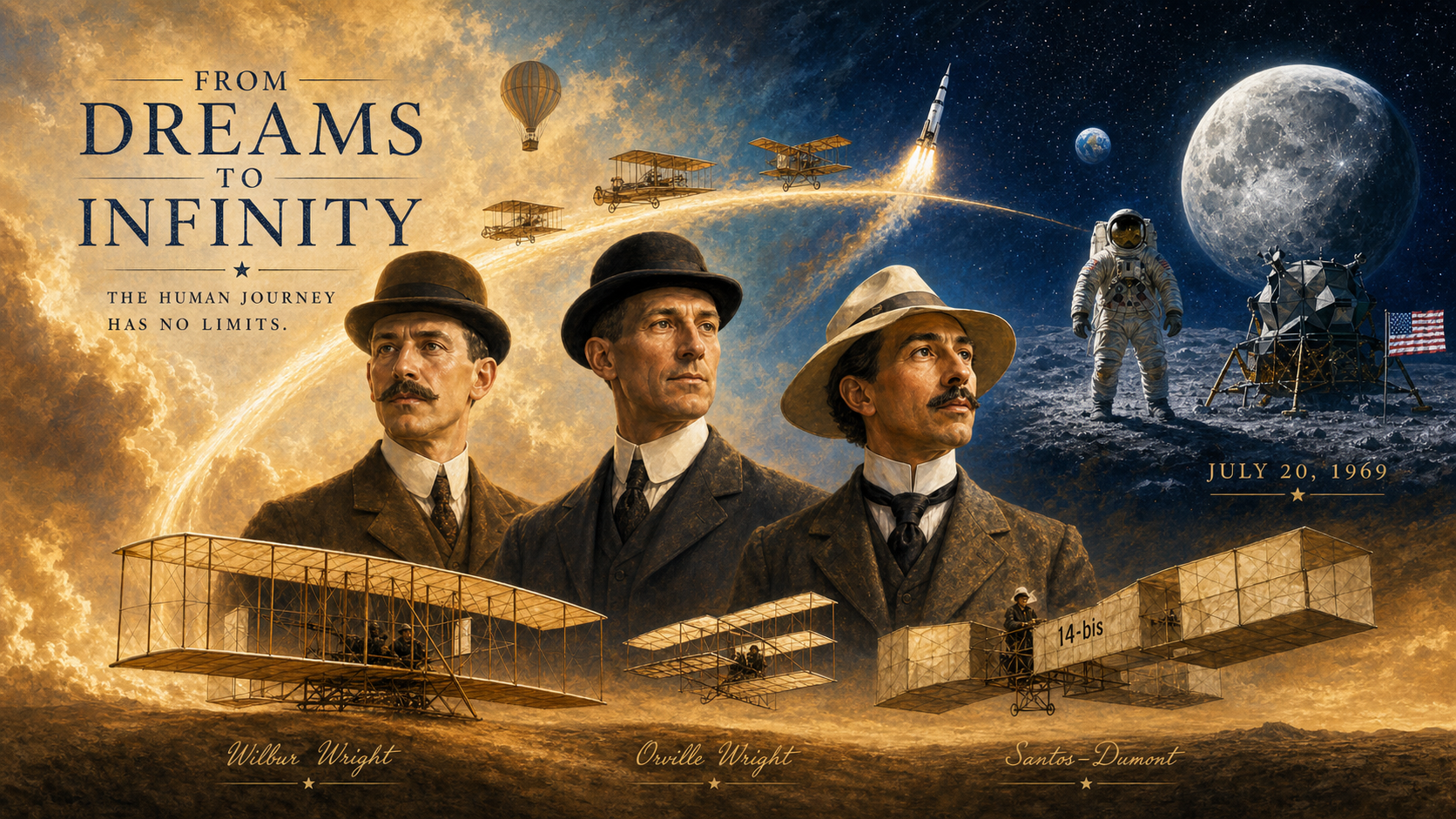
The history of aviation is often told as if it belonged to one man, one machine, and one magical afternoon when mankind suddenly beat the impossible.
That version is simple. It is also too small.
Aviation was never the work of a single hero standing alone under the sky. It was a civilizational project. Long before any airplane cut through the air under its own power, there was a long chain of thinkers, artists, scientists, craftsmen, mechanics, glider pilots, engine builders, and stubborn experimenters preparing the ground. Without them, the twentieth century would never have seen a motor leave the earth.
The question that moves this story, “How did aviation begin?”, does not have a clean answer. Flight did not appear all at once. It matured. It passed through centuries in the form of Renaissance sketches, experimental calculations, broken wings, painful falls, small technical victories, and quiet insights that seemed minor until history finally turned around and understood what they meant.
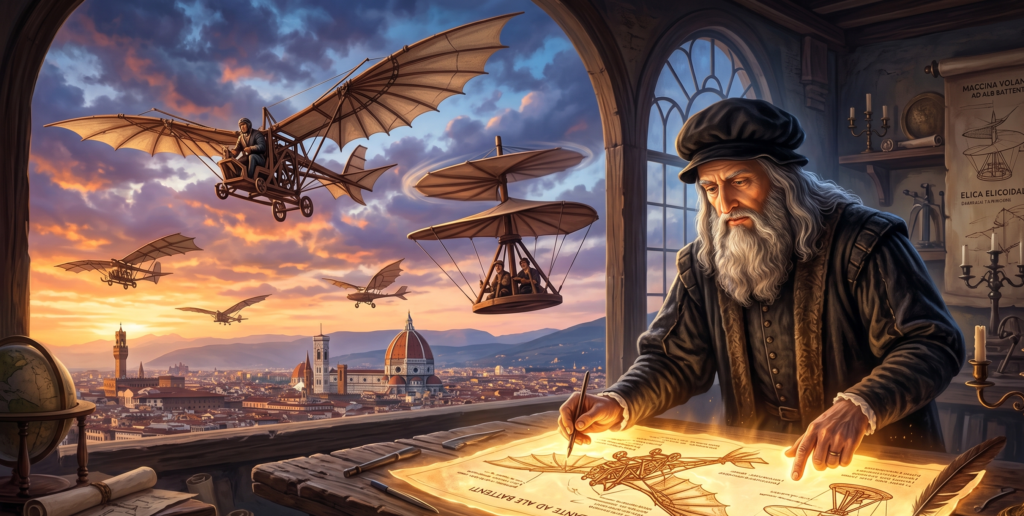
In the fifteenth and sixteenth centuries, Leonardo da Vinci drew some of the earliest conceptual models of flying machines. They never left the page, but they introduced something new: the idea that flight could be designed. In the middle of the Renaissance, before aerodynamics existed as a real science, Leonardo imagined mechanical wings, lifting surfaces, and human flight as an engineering problem.
For anyone trying to understand the origin of aviation, Leonardo cannot be skipped. He was the man who drew wings before physics had the language to explain them.
But Leonardo did not invent the airplane. He opened a door.
That is true of almost every major figure in the early history of flight. They did not invent aviation by themselves. They revealed one part of it. Each man widened the problem. Each one understood something nobody before him had fully understood. Together, they formed the foundation on which modern aviation could finally be built.
George Cayley understood that a flying machine needed separate systems for lift, propulsion, and control. Otto Lilienthal put his own body at risk to prove that gliding was more than fantasy. He demonstrated that the human body could be balanced in the air and that controlled descent was a real technical field, not just a dream.
Then came the Wright brothers.
And here, Orville Wright deserves more attention than he usually gets.
In many public retellings, “the Wright brothers” become a single historical unit, almost one person with two names. That is convenient, but it hides something important. Wilbur and Orville worked together, argued together, designed together, tested together, and solved problems together. Their achievement was collective. But Orville’s place in the story has a special weight because he was not merely part of the experiment. He was the man who physically carried the first powered, controlled, heavier-than-air flight into history.
On December 17, 1903, at Kitty Hawk, it was Orville Wright lying in the machine when the Flyer lifted from the ground.
That matters.
Aviation was not born only in the mind, or on paper, or in a workshop. At some point, someone had to climb into a fragile machine and trust the mathematics, the wood, the fabric, the propellers, the engine, the wind, and his own hands. Orville did that. He was not a passenger in history. He was the human body at the center of the transition between theory and flight.
The Wrights’ great contribution was not raw power. It was control.
That point is essential. Before the Wrights, many people imagined flight as a matter of force: build a strong enough engine, add wings, push hard, and the machine would rise. The Wrights understood that the real problem was not simply getting into the air. The real problem was staying in command once you got there.
A machine that rises but cannot be controlled is not an airplane in the full modern sense. It is a dangerous leap. Orville and Wilbur understood that the airplane had to become an extension of the pilot’s judgment. It had to respond. It had to bank, correct, stabilize, and recover. That is why their work on wing warping, rudder coordination, and three-axis control became so decisive.
Orville’s role as pilot gives this achievement a human face. He was not just proving that a motorized machine could lift itself. He was proving that a person could command it.
That is why the Wrights stand at the technical foundation of the airplane. They built the core engineering paradigm: powered, controlled, sustained heavier-than-air flight. They showed that the airplane was not just a powered glider, but a controllable system.
Still, aviation did not become public civilization at Kitty Hawk.
That is not an insult to the Wrights. It is a distinction.
Their early flights were extraordinary, but they happened under restricted conditions, away from broad institutional verification and without the kind of public homologation that would later define aviation as a shared scientific fact. Their achievement was real, deep, and technically revolutionary. But at that moment, it remained surrounded by secrecy, patent concerns, limited witnesses, and a private development model.
Orville Wright represents the moment when the airplane becomes technically possible.
Santos Dumont represents the moment when aviation becomes publicly undeniable.
Those are different historical functions. Both matter. Confusing them only makes the story weaker.
When we think about Santos Dumont or the Wrights, it is easy to imagine that one of them simply “started” the story. But nothing begins at its brightest point. Aviation was born in the shadows of time, in the patience of minds that would never see the final result.
And only when that foundation was ready could humanity finally leave the ground.
Santos Dumont and the Birth of Public Aviation: When the Sky Stopped Being a Mystery and Became a Demonstration
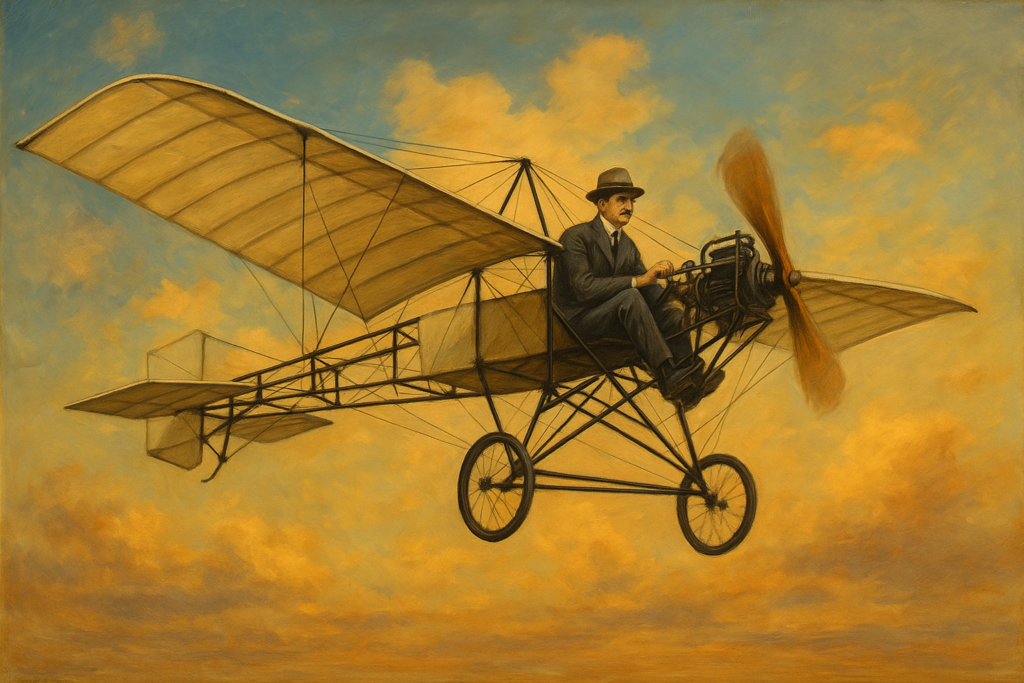
When Santos Dumont arrived in Paris, aerostation was living through a strange tension.
Airships existed, but they were fragile, hard to control, and dependent on large structures. The central question was no longer whether man could rise into the air. Balloons had already answered that. The real question was whether man could fly with autonomy.
And autonomy, at that time, meant something very practical: take off, navigate, control the machine, return, and land.
No major European figure had fully solved that cycle in a way the public could see, measure, and trust.
Dumont entered this story as a man who did not treat the sky as a spectacle. He treated it as a workplace. He was not merely trying to prove that flight was possible. He was trying to prove that flight could become practical. That changes everything in the history of aviation.
His dirigibles, especially No. 6, were not built simply to impress engineers. They were built to convince the world that flying could become part of ordinary life.
When Santos Dumont rounded the Eiffel Tower and won the Deutsch Prize, he did something no pioneer had done in quite the same way: he gave the public a controlled, stable, repeatable flight in the open air, over one of the most visible cities on earth. Aviation, which had been a technical curiosity, became a public fact.
This is where the modern answer to the question “Who invented the airplane?” begins to change.
An airplane is not only a machine. It is also a public standard.
Aviation truly begins as a civilizational force when flight leaves the private field of claims, workshops, isolated tests, and restricted observation, and becomes something that can be seen, judged, measured, repeated, and studied by society.
That principle became decisive with the 14-bis.
The scene is historic: Paris, October 1906, in front of the Aéro-Club de France, the leading institution of aeronautical verification at the time. There were no catapults, no rails, no ramps, no hidden launching systems. Santos Dumont’s airplane stood at the Campo de Bagatelle, accelerated under its own power, gained speed, and rose from the ground.
Witnesses saw it. Judges saw it. Engineers saw it. Curious Parisians saw it. Photographers recorded it. The event became measurable.
That is the defining impact of the 14-bis in world aviation history.
For the first time, a powered flight was:
public, recorded, homologated, witnessed, measured, and reproducible.
That is the birth of aviation as testable science.
That is the beginning of public aviation.
That is the kind of flight that can be taught, reproduced, studied, standardized, and placed inside an institutional framework.
The Wright brothers, and especially Orville Wright as the pilot of the 1903 Flyer, had already achieved something extraordinary before this. They had mastered aerodynamics and control in a way no one else had. They created systems that changed the technical logic of the airplane. Their flights in the United States were relevant and foundational.
But their early achievements did not enter the world through the same public door. They were not initially presented with the same institutional visibility, broad public witnessing, and scientific homologation that marked Santos Dumont’s 14-bis.
Again, this does not diminish them.
It clarifies the architecture of history.
Orville Wright gave aviation its technical body.
Santos Dumont gave aviation its public face.
The Wrights built the engineering paradigm of the airplane. Santos Dumont built the civilizational paradigm of aviation.
One solved the problem of controlled powered flight. The other showed the world that aviation could belong to public life.
After the 14-bis, Santos Dumont did something that made his vision even clearer. He created the Demoiselle, perhaps the first personal airplane in history. It was small, light, efficient, and reproducible. It became a model for many European inventors and influenced the development of early aviation across the continent.
Its importance goes beyond design.
Dumont made the plans freely available. He did not lock the future inside private ownership. He released knowledge into the world at a time when industrial technology was becoming increasingly tied to patents, secrecy, and economic control.
That gesture was not small. It accelerated civil aviation.
The Demoiselle inspired inventors, helped spread practical airplane design, and contributed to a new imagination: the idea that the sky could become accessible not only to governments, armies, millionaires, and elite engineers, but to individuals.
That is the core of Santos Dumont’s place in history.
His trajectory is not just a list of dates and machines. It is the story of someone who believed the sky should not belong only to engineers, armies, or patrons. He believed the sky should belong to people.
That is why, when we ask “Who invented the airplane?”, the answer never fits inside one name.
But when we ask “Who inaugurated public aviation?”, there is only one possible answer.
Santos Dumont.
The Civilizational Legacy of Santos Dumont and the Line from the 14-bis to the Moon
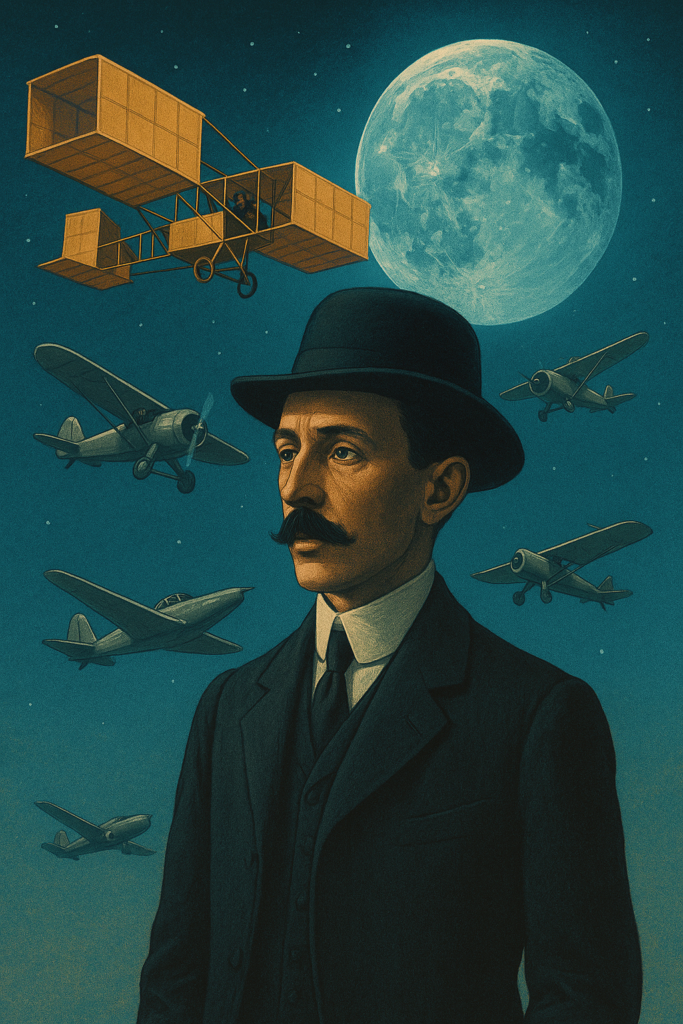
To understand Santos Dumont, aviation must be seen not as an isolated invention, but as the first stage of a much larger process.
Humanity only walked on the Moon because it first learned to walk through the sky.
Every advance in the history of flight is one step on a staircase no single person could climb alone. George Cayley understood lift. Otto Lilienthal proved the human body could be balanced in the air. Orville and Wilbur Wright showed that control mattered more than brute force. Orville, in particular, became the first pilot to carry powered, controlled, heavier-than-air flight into physical reality. Santos Dumont brought flight into public life and turned it into a civilizational event.
Then Robert Goddard created the liquid-fueled rocket. Wernher von Braun developed the architecture of orbital ambition and large-scale propulsion. Neil Armstrong took the final step on lunar soil.
But Armstrong did not walk alone.
He carried the whole lineage with him.
Each figure solved a specific problem the previous one had not solved. Seen this way, the history of aviation does not end with the airplane. It continues in every rocket, every satellite, every orbital mission, every spacecraft, and every attempt to push human presence beyond the earth.
Aeronautics is the foundation of cosmic exploration.
The space age begins the moment human beings learn how to sustain their own weight in the air.
That is why the impact of Santos Dumont is not a matter of nationalism. It is a matter of recognizing the exact point at which aviation became public, verifiable, and universal.
The 14-bis was not merely an airplane that flew. It was an open scientific demonstration. Every public homologated flight belongs, in some way, to the standard it helped establish. Every official record, every measured public attempt, every institutional certification of flight follows the logic of that moment.
Aviation as a technical and social discipline is directly tied to that event.
And there is something even deeper.
Santos Dumont never treated his inventions as mere private property. He opened projects, shared what he knew, encouraged new inventors, and pushed aviation beyond the restricted circle of scientific elites. His decision to release the Demoiselle plans freely helped accelerate European aviation and inspired an entire generation.
That kind of generosity has disappeared from many chapters of technological history. In Dumont, it is inseparable from his identity.
His legacy is not measured only in meters flown. It is measured in the kind of humanity he wanted to help build.
To democratize the air is to democratize the impossible.
To offer the sky is to offer the idea that ordinary people may one day touch what once seemed reserved for gods.
That is why Santos Dumont stands as a central figure in world aviation. He transformed flight from privilege into shared experience.
There is also a personal coincidence I have always carried with some delicacy.
I, Lizandro, was born on July 20.
That does not mean I am connected to Dumont or Armstrong by destiny. It simply reminds me that human history is arranged in layers of continuity. July 20, 1873, marks the birth of the man whose public flight helped open the path for all the others. July 20, 1969, marks the day the sky stopped being the limit and became the doorway to space.
Dates do not determine fate. But sometimes they suggest that we are part of a story larger than ourselves.
The true meaning of Santos Dumont is not found in a narrow dispute over who invented the airplane. That question is too small for the size of the phenomenon.
His impact lies in the emergence of aviation as a public institution, a measurable discipline, and an open gate to the technologies that shaped the twentieth century and continue to shape the twenty-first.
Without Orville Wright, the airplane would not have received its decisive technical proof in the same way.
Without Santos Dumont, aviation would not have become a public and universal field so early.
Without universal aviation, there would be no modern aerospace industry.
And without that industry, nothing we call the space age would have begun when it did.
Lizandro Rosberg
Independent analyst of technology, science, and civilizational transformations. He writes about artificial intelligence, science, applied history, the future of work, and the real impact of technology on human life. His focus is on translating complex changes into practical understanding.
You will certainly be interested in:
-
Chess in Childhood: How it Teaches a Kid to Think Before Acting
The child can learn to shake hands even while sad. He can learn to review the game. He can learn to admit a mistake. He can learn to come back in the next round. He can learn that winning without respect makes the winner smaller, and losing without learning makes the loss heavier.
-
21st Century Economy | Artificial Intelligence | Future of Work | Future of Work & Automation | Life Strategy
The World Is Too Old to Run on Yesterday’s Assumptions
Modern societies are aging faster than their institutions, cities, and care systems were designed to handle. Population aging is no longer a forecast. It is a present condition. Fertility rates across developed economies remain structurally below replacement, while life expectancy continues to rise. More people stay in the system for longer, and fewer enter it to sustain what that system demands. This is not a moral debate. It is arithmetic.
The text dismantles the idea that declining birth rates can be reversed through incentives alone. Children have ceased to be a default continuation of life and have become high-risk projects, requiring time, stability, and energy. At the same time, large cities have grown expensive, regulated, and hostile to family formation. Housing costs, long commutes, and constant friction quietly discourage long-term planning. Fertility declines not because people reject families, but because the environment makes them fragile bets.
Longevity adds a second layer of tension. Medical and technological progress has extended human life by decades, but social structures have not adapted accordingly. Families are smaller, communities weaker, and informal care networks thinner. Care, once distributed among many, now concentrates on a few, often exhausted individuals. As demand rises and supply stagnates, eldercare becomes a systemic bottleneck.
At this point, the article reframes technology. Automation, AI, and robotics are not replacing human care. They are filling gaps left by demographic reality. Safety automation, assisted living systems, and care-support technologies emerge as infrastructure, not luxury. The comparison between regions is telling. China treats automation as capacity planning, scaling solutions pragmatically under demographic pressure. Europe, despite facing even sharper aging trends, often responds with moral discourse and procedural delay. The United States sits between these poles, still assuming it has time.
The article closes without apocalypse. It argues for early, practical adaptation. Designing homes and cities that reduce risk. Introducing assistive technology before crisis. Treating care as infrastructure rather than a private afterthought. Building redundancy not only in finances, but in human networks.
The final note is sober but constructive. The world did not become colder. It became older. And older societies need smarter designs. Less nostalgia. More alignment. In that sense, adapting early is not pessimism. It is a form of responsibility, and perhaps the most realistic kind of optimism available.
-
The Mistake That Kept Rome Standing for Centuries
At its height, the Roman Empire controlled millions of square kilometers and governed tens of millions of people. Some estimates place that peak at over four million square kilometers and roughly 60 million inhabitants, a scale that’s hard to visualize without modern maps.
-
Personal AI for Finances: How Language Models Help You Stop Losing Money
When finances are reviewed regularly, without drama and without emotional drain, something subtle happens. Anxiety drops. Decisions stop being reactive. Small corrections happen early, before they turn into damage.
-
The Rat Race Was Designed, Not Chosen
Most people never sit down and choose a life of constant pressure. They don’t decide to trade freedom for anxiety or flexibility for fragility.
-
Big Cities Have Become Too Expensive for What They Offer
Dense environments demand continuous cognitive processing. The brain never truly rests. It just reallocates priorities. Over time, that state extracts a price. Less patience. Less depth. Less tolerance for error.