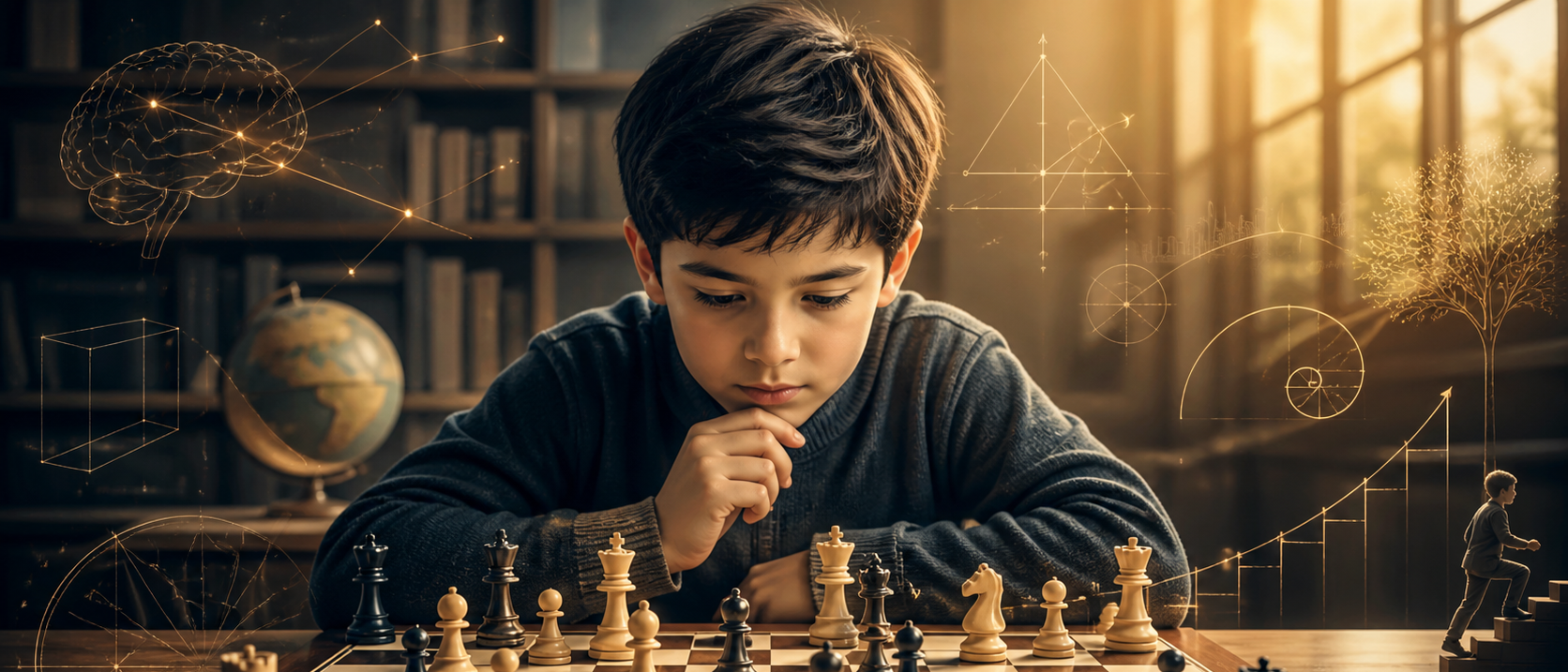
I learned chess when I was 11.
Back then, I was still a kid, but something about that board grabbed me in a way I never forgot. It was not just a game. It felt like a tiny world with clear rules, immediate consequences, and a depth that seemed almost endless.
Just 64 squares.
Just 32 pieces.
Just two sides.
And somehow, inside that little wooden universe, there was room for an entire war.
More than 20 years later, I still play. I still study. I still find positions that surprise me. I still see experienced adults make childish mistakes, and I still see children spot ideas that many grown-ups would miss completely.
That is one of the strange democratic powers of chess. It does not care about your age, your last name, your background, your clothes, or your social status. It asks one question, and one question only:
Are you paying attention?
And maybe that is why chess is one of the best intellectual activities a child can learn.
Before it teaches a kid to win, it teaches a kid to look.
Before it teaches calculation, it teaches patience.
Before it teaches strategy, it teaches consequence.
And before it creates a champion, it can create something even rarer: a mind capable of thinking before acting.
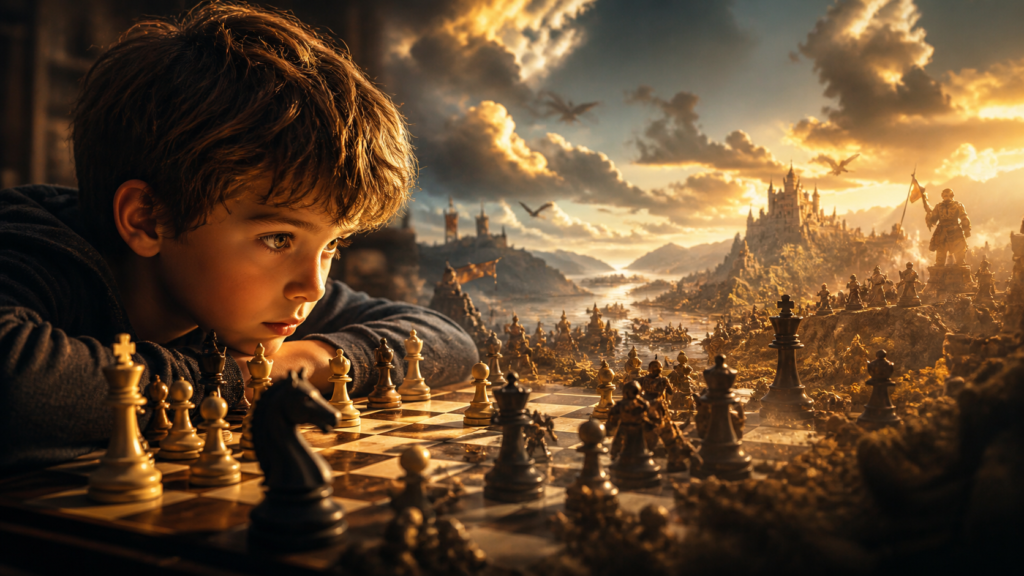
A child at the chessboard learns that the world answers back
One of the most beautiful things about childhood chess is that it kills a very common illusion: the idea that intention is enough.
A child may want to attack.
May want to capture the queen.
May want to give check.
May want to play a “cool” move.
But the board does not reward desire without consequence.
Move the king badly, and the attack comes.
Leave a piece hanging, and material disappears.
Attack too early, and your own position gets weak.
Copy a pattern without understanding it, and you walk right into a trap.
That is deeply educational.
In real life, consequences often arrive late. A child can build bad habits for years before feeling the cost. A student can study carelessly and only see the damage on a serious exam. A person can act on impulse and only later understand the mess.
In chess, consequence shows up fast.
The mistake sits right there on the board, in wood, plastic, or pixels.
That concrete feedback is powerful. A child sees his own thinking materialized in front of him. He discovers that poor thinking creates poor positions. Better thinking creates possibilities. And better thinking after a mistake is part of the process, not a humiliation.
That is one reason chess has been studied as an educational tool. A meta-analysis published in Educational Research Review found that chess instruction showed a modest positive effect on children’s cognitive and academic skills, especially in mathematics, while also warning that study quality varies and placebo effects cannot be ruled out.
That warning matters. Chess is not magic. It does not automatically turn every kid into a genius. But when it is taught with method, repetition, and joy, it creates something rare:
a laboratory of decisions.
And, man, that is no small thing.
Chess trains concentration in an age that destroys concentration
We live in a time when attention is treated like a battlefield.
A kid opens a screen and everything fights for his eyes. Bright colors. Fast cuts. Instant rewards. Short videos. Games designed to keep the brain chasing the next stimulus.
Chess moves the other way.
It asks for inner quiet.
It asks the child to observe the whole position before touching a piece. It asks him to notice invisible threats. It asks him to look at his own plan while also looking at the other player’s plan.
That is serious concentration training.
A child playing chess slowly learns that the first impulse is often weak. He sees a capture and realizes it was a trap. He sees a check and realizes it weakened his own king. He sees an attack and realizes he should have developed a piece first.
Chess teaches a silent sentence:
Hold on. Look again.
That skill is worth a lot.
In school, it appears when a child reads the whole question before answering.
In math, when he checks the logic before marking the result.
In writing, when he notices that an idea needs structure.
In social life, when he learns to pause before reacting.
The European Parliament’s 2012 “Chess in School” declaration explicitly mentioned chess as a tool that can support concentration, patience, persistence, creativity, intuition, memory, analytical thinking, decision-making, determination, and sportsmanship.
That list may sound broad, but anyone who has watched a child face a difficult position understands it.
The child looks.
He frowns.
He reaches for a piece.
He stops.
He looks again.
Right there, education is happening.
The greatest gift of chess may be teaching a child how to lose without falling apart
Many adults struggle with something chess teaches early: losing.
Losing a game is uncomfortable. Losing because of a silly mistake is worse. Losing a game you were winning is a special kind of instructional pain.
But that is exactly where chess becomes so valuable for childhood.
Because defeat on the board is clear, but limited. It hurts, but it ends. It exposes the mistake, but it also allows review. The child can return to the position and ask:
Where did I start losing?
Which piece was undefended?
Why did I miss that mate?
What was the better move?
That turns failure into information.
Few things are as formative as learning that a mistake is not the end of intelligence. Often, it is the beginning of it.
A child who plays chess learns that there is a difference between being defeated and being destroyed. He learns that one bad game does not define his ability. He learns that strong players also make mistakes. He learns that honest review is more useful than excuses.
And that builds a quiet kind of emotional muscle.
On the chessboard, complaining about the position does not save the position. What saves it is finding resources. Defending better. Creating complications. Resisting. Setting traps. Accepting a small loss to avoid a bigger one.
That is an adult lesson delivered in a child’s language.
Math without the punishment face
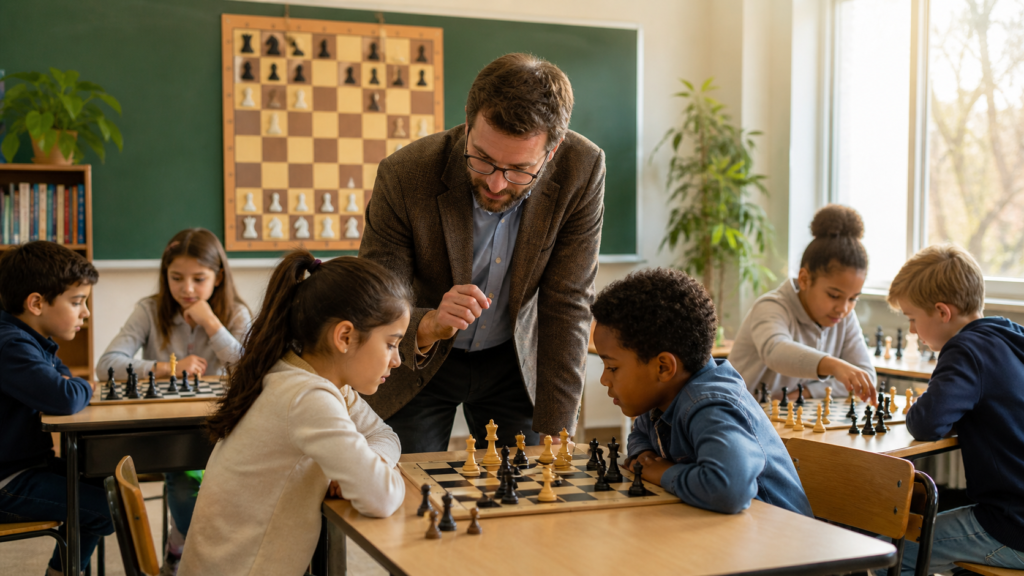
Chess also has a natural relationship with mathematics, but not in the cold way many kids experience math in school.
A child does not start with formulas. He starts with movement.
The rook teaches straight lines.
The bishop teaches diagonals.
The knight teaches strange, counterintuitive geometry.
The pawn teaches direction, restriction, advance, and transformation.
The queen teaches combined power.
The king teaches limits.
Without noticing it, the child is dealing with space, pattern, sequence, prediction, comparison, and mental calculation.
When he thinks, “If I capture, he recaptures, then I capture again,” he is building a logical chain. When he calculates three moves ahead, he is practicing structured prediction. When he understands that a piece may be worth less materially but more positionally, he begins to move beyond simple counting and into strategic evaluation.
That part is important.
Chess does not teach only how to count pieces. It teaches how to evaluate relationships.
A rook may be worth more than a bishop in basic material terms, but an active bishop can dominate an entire position. A pawn may seem small, but a passed pawn close to promotion can decide the whole game. A sacrifice may look like a loss, but it may open the path to checkmate.
The child learns that numbers matter, but context matters too.
That is one reason educational studies often find the strongest chess-related academic effects in mathematics. The literature reviewed by Sala and Gobet supports the idea that chess instruction can help mathematical performance, while still urging caution because the exact causal mechanisms are difficult to isolate cleanly.
That caution makes the argument stronger, not weaker.
A serious defense of childhood chess does not need to promise miracles. It only needs to show something far more concrete: chess gives children regular practice in attention, logic, memory, calculation, planning, and error correction.
For a kid, that is already a damn lot.
The chessboard as a child’s first school of strategy
Strategy is a big word. It sounds like business, war, politics, or geopolitics.
But a child can begin learning it through one simple question:
What is my plan?
At first, he moves pieces because he can. Then he begins moving pieces because he wants something. Later, he understands that wanting something requires preparation.
That leap is huge.
The child stops thinking only about one move and starts thinking about the whole position. He learns that developing pieces before attacking is usually better. He learns that king safety matters. He learns that controlling the center gives freedom. He learns that a strong threat can be more valuable than an immediate capture.
In other words, he learns how to organize means toward an end.
That is strategy.
And it is rare, because many people go through life without developing it well. They act on impulse, react to the environment, trade long-term goals for immediate rewards, and confuse movement with progress.
In chess, that confusion appears fast.
A child can move a lot of pieces and still make the position worse. He can attack a lot and threaten nothing. He can win material and give up king safety. He can do “things” without building anything.
Once he understands that, he learns a lesson that applies to school, work, and life:
activity is not strategy.
Strategy is direction.
And few activities teach direction as cleanly as chess.
Chess does not create only players. It can create transferable minds.
When I talk about chess in childhood, I also speak from experience.
A child who learns chess early is not just learning how to move pieces. He is learning to build a mind that asks:
What is the real threat?
What is hidden here?
What happens next?
Is this advantage real, or just appearance?
Am I winning now but losing later?
Those questions are small on the board and enormous outside it.
That is why great chess players are often fascinating examples of applied intelligence. Not just because they play well, but because they show how strategic training can cross borders: science, literature, politics, technology, education, communication, and public decision-making.
The obvious example is Garry Kasparov.
Garry Kasparov: when the chessboard becomes geopolitics
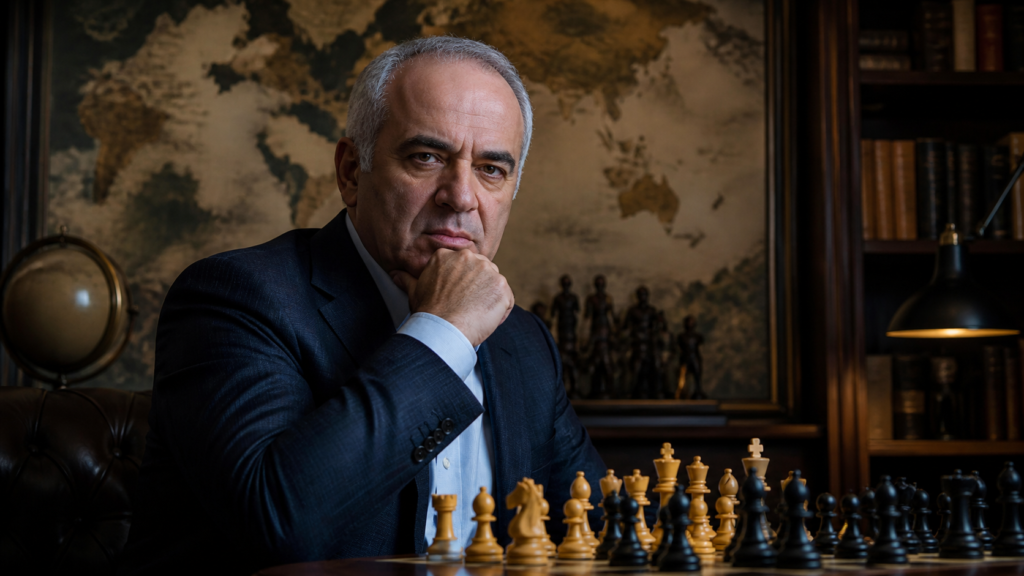
Garry Kasparov became World Chess Champion in 1985 at age 22, making him the youngest world champion at the time. For years, he dominated elite chess and became one of the most recognizable figures in the history of the game. His rivalry with Anatoly Karpov defined an era, and his matches against IBM’s Deep Blue helped bring artificial intelligence into mainstream public debate.
But Kasparov matters here for a larger reason.
He was not only a chess genius. He carried the chess way of thinking into other domains.
After retiring from professional chess in 2005, Kasparov became a writer, speaker, political dissident, and critic of Russian authoritarianism. He later founded the Renew Democracy Initiative, an organization focused on defending liberal democracy and confronting authoritarian regimes. He remains a major public voice on Russia, Ukraine, freedom, technology, and international strategy.
That matters for this article because Kasparov shows how chess can train a mind to handle complexity.
He thinks in forces, weaknesses, threats, timing, initiative, sacrifice, pressure, and long-term consequences. Those are chess categories, yes, but they are also geopolitical categories.
A weak player looks only at the attacked piece.
A good player looks at the whole position.
A strategist looks at today’s position and tomorrow’s structure.
In international politics, that distinction matters even more.
Kasparov became known for advocating a firmer Western response to Vladimir Putin and for reading Russian expansionism as part of a broader authoritarian threat. In his public writing and speaking, he often connects freedom, deterrence, strength, and strategic clarity as practical realities rather than empty slogans.
That is where chess becomes a real metaphor, not a cheap one.
On the board, giving up space without compensation usually has a price. Ignoring a threat because it has not yet become checkmate can be fatal. Confusing hope with a plan destroys promising positions. A child who learns this early receives a strategic education that is hard to find in ordinary childhood activities.
Kasparov is also frequently mentioned in conversations about IQ. Wild numbers circulate online, especially exaggerated claims around 180 or 190. A more cautious and commonly referenced account comes from a 1987 testing session arranged by the German magazine Der Spiegel, in which Kasparov reportedly scored 135 on one intelligence test prepared for the occasion and showed exceptional memory performance.
That detail is useful because it breaks a simplistic idea: chess genius is not just “high IQ.”
It is memory, yes.
Calculation, yes.
Spatial visualization, yes.
But it is also obsession, discipline, repertoire, courage, emotional control, opponent-reading, adaptation, ambition, and the ability to turn knowledge into decisions.
That is a useful lesson for parents and teachers.
Chess should not be presented to children as a machine for producing geniuses. That would be too shallow. Chess should be presented as a practical school of thinking. Some children will become competitors. Very few will reach the elite. But many can gain something more valuable: a calmer, sharper, more patient mind.
Judit Polgár: the girl who broke the ceiling of chess
If Kasparov represents chess intelligence transferred into global strategy, Judit Polgár represents something equally powerful: the construction of excellence from childhood.
Judit Polgár was born in Budapest in 1976 and became the strongest female chess player in history. She earned the Grandmaster title in 1991 at 15 years and 4 months, breaking Bobby Fischer’s previous record as the youngest grandmaster at that time. She later became the only woman ever to enter the world top 10 and reached a peak rating of 2735.
That alone would make her extraordinary.
But Judit’s real importance goes beyond statistics.
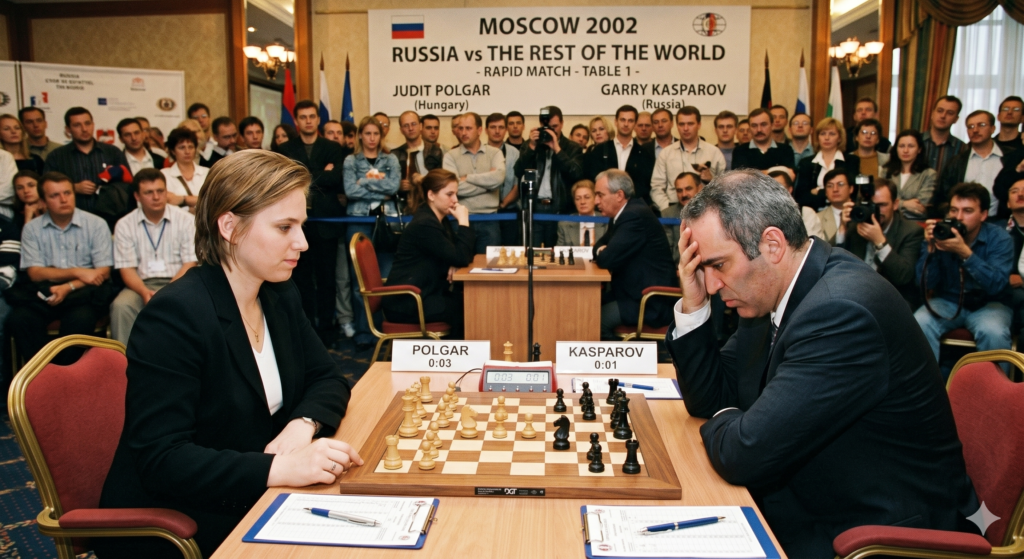
She did not dominate “women’s chess” as a separate protected category. She competed directly against the strongest male players in the world. She defeated world champions. She beat Garry Kasparov in 2002. She forced the chess world to confront a brutal fact: the ceiling people imagined for women in chess was not a law of nature. It was a cultural assumption waiting to be smashed.
And she smashed it.
Not loudly.
Not symbolically.
Not with slogans.
Over the board.
That is the cleanest form of argument chess has: moves, results, strength.
Her story is especially important in an article about childhood because Judit was not an accidental genius drifting into greatness. She was part of one of the most famous educational experiments of the 20th century.
László Polgár and the theory that genius is made, not born
Judit’s father, László Polgár, was a Hungarian educational psychologist with a radical thesis:
geniuses are made, not born.
He believed that exceptional achievement could be built through early specialization, deliberate education, family environment, and intense long-term training. He did not want merely to write about the idea. He wanted to test it in real life.
So he and his wife, Klára, homeschooled their three daughters, Susan, Sofia, and Judit, with chess as the central field of specialization. Their home became an intellectual training environment filled with chess books, chess problems, study routines, games, analysis, and competition. All three daughters became exceptionally strong players. Susan became a Grandmaster and Women’s World Champion. Sofia became an International Master. Judit became the strongest female player in chess history.
That is the part that makes the Polgár story so damn interesting.
László did not randomly get one brilliant child. He produced three world-class chess minds in the same family, under the same educational theory, with the same central method: start early, build deeply, train seriously, and treat excellence as something constructed.
Of course, the Polgár experiment has always produced debate. Some people admire it as proof of the power of education. Others criticize the intensity of such a specialized childhood. Both reactions are understandable. The point here is not to copy the Polgár household as a universal parenting model.
The point is simpler and more useful:
childhood matters.
Environment matters.
Repetition matters.
Expectations matter.
Access matters.
Serious training matters.
The stories adults tell children about their own potential matter.
A child who grows up hearing “you are capable of thinking deeply” receives a different inner architecture from a child who is treated as intellectually passive.
Chess makes that visible.
The Polgár experiment and the real meaning of “talent”
The Polgár story does not prove that every child can become Judit Polgár.
That would be silly.
Genetics, temperament, family stability, opportunity, health, motivation, money, culture, and luck all matter. No serious person should pretend otherwise.
But the Polgár story does challenge the lazy version of talent.
The lazy version says:
some kids are born brilliant, and the rest are not.
The chess version says something more interesting:
a child’s ability can be expanded dramatically when training begins early, when the environment is rich, when practice is consistent, when mistakes are analyzed instead of hidden, and when adults treat high-level thinking as normal.
That is not fantasy. That is development.
A young mind is not a finished object. It is a living structure. What enters early can shape what becomes possible later.
Judit Polgár’s career shows the upper extreme of that principle. Most children will never become grandmasters. Fine. They do not need to. The point of teaching chess in childhood is not to manufacture elite professionals. The point is to give children a serious intellectual tool while their minds are still forming.
Because a child who learns to calculate, wait, revise, adapt, and plan is already being changed.
Not magically.
Structurally.
Why Judit Polgár matters for boys and girls
Judit Polgár matters for girls because she destroyed the idea that serious chess strength belongs naturally to boys.
But she also matters for boys.
Because her example teaches something broader than gender. It teaches that excellence is built through standards. Through work. Through pressure. Through early formation. Through refusing small expectations.
Judit’s father famously avoided pushing his daughters primarily into women-only competition. He wanted them to compete in the strongest available fields, because he believed the level of opposition would shape the level of development.
That principle matters in education.
Children grow into the standards around them.
If adults give them only noise, they adapt to noise.
If adults give them only shallow entertainment, they adapt to shallow attention.
If adults give them serious problems, they begin developing serious tools.
Chess is one of the cleanest serious problems a child can receive.
It is difficult, but playful.
Competitive, but structured.
Imaginative, but rule-bound.
Frustrating, but reviewable.
Simple to start, but impossible to exhaust.
That combination is rare.
The child does not need to be a prodigy to benefit
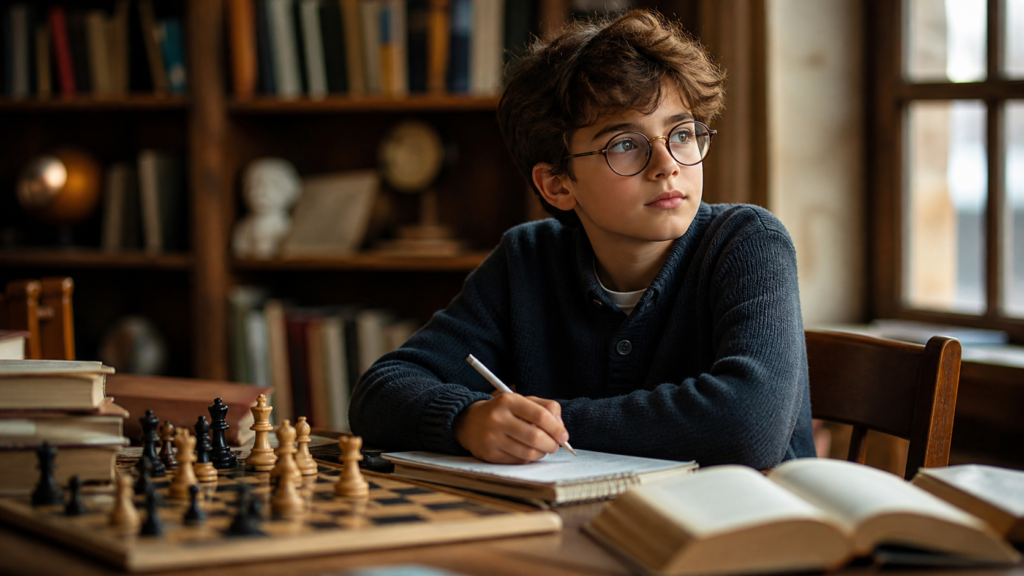
This is where parents often get the wrong idea.
They hear “Kasparov” or “Judit Polgár” and imagine that chess only matters if the child becomes a prodigy.
Nope. Not at all.
That is like saying reading only matters if a child becomes Shakespeare. Or math only matters if he becomes Einstein. Or sports only matter if he becomes Michael Jordan.
The ordinary benefits are already huge.
A child who learns chess may become better at waiting.
Better at noticing.
Better at losing.
Better at explaining his reasoning.
Better at handling difficulty.
Better at seeing consequences before acting.
That is enough.
A society does not need every child to become a grandmaster. But it badly needs more children who can think clearly, delay impulse, respect rules, revise errors, and build plans.
Chess offers that in a form a child can touch.
A board.
Pieces.
Moves.
Consequences.
Simple, but deep.
Just like the best tools usually are.
Chess is more inclusive than it looks
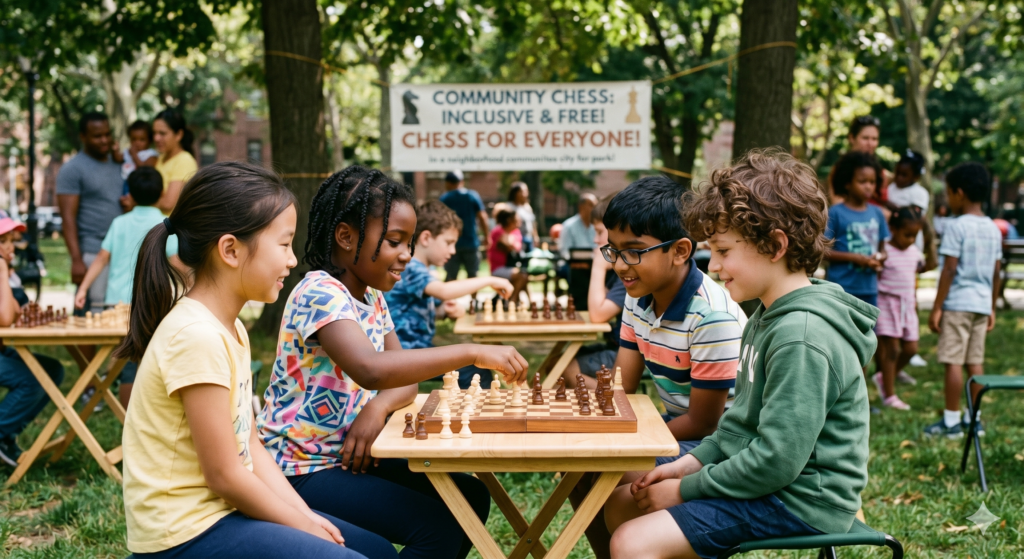
One of the most beautiful advantages of chess is the low cost of entry.
Yes, competitive chess can become expensive. Travel, tournament fees, books, coaches, online platforms, clocks, federation costs, and serious training all add up. Anyone who has taken chess seriously knows that.
But the first contact with the game can happen with very little.
A simple board.
A willing teacher.
A school that cares.
A library.
A borrowed phone.
A community center.
A public square.
An empty classroom.
That matters.
Chess has a civilizing power because it does not require a field, a court, a pool, expensive equipment, or a perfect institutional structure to begin. It requires attention, rules, and continuity.
That does not solve inequality by itself. Of course not. But it opens a crack in the wall.
A child who has never been treated as intellectually capable can discover, over a board, that he can calculate better than an adult. A quiet child can find a place where silence becomes an advantage. A restless child can learn to channel energy into calculation. An impulsive child can discover, after losing pieces again and again, that thinking first is cheaper than repairing damage later.
That should interest every serious school.
Chess is cheap, portable, inclusive, and scalable. It can be taught in groups. It can create internal tournaments. It can connect math, history, logic, reading, writing, technology, and even public speaking when students are asked to explain their decisions.
A chess program can become an after-school club, a classroom activity, a family practice, a community project, or a school identity.
But maybe its most important benefit is symbolic.
It tells the child that thinking is noble.
And in a world that often treats children as consumers before treating them as minds, that message is powerful.
Chess gives shape to imagination
There is a common lie about chess: that it is only cold calculation.
Anyone who plays knows that is not true.
Chess is imagination.
A beautiful combination begins as a mental image. A sacrifice is born first as intuition. A strategic plan requires the player to visualize a position that does not exist yet. A pawn ending forces a child to imagine races, critical squares, opposition, promotion, and zugzwang before any of it actually happens.
The child learns to see the invisible.
That is one of the most powerful aspects of the game. The board is still, but the mind is moving. The pieces are there, but the possibilities are in the future. The real position is only the surface. Underneath it, there is a network of threats, plans, traps, and transformations.
Chess develops a rare form of disciplined imagination.
Not loose fantasy.
Testable fantasy.
The child imagines a move, calculates the reply, compares one line with another, rejects a bad idea, finds an alternative, and tries again.
That is almost a childhood introduction to scientific thinking.
Hypothesis.
Test.
Error.
Correction.
New hypothesis.
In chess, a child learns that imagination without verification becomes disaster. But calculation without imagination becomes dead play.
The best minds need both.
And that is exactly why chess is so valuable. It does not force the child to choose between creativity and logic. It teaches that the strongest thinking often comes when both are working together.
Chess teaches that intelligence is also character
There is a common scene in children’s tournaments: a child loses and cries.
Some adults see only frustration. But there is something deeper happening there. The child has reached a border. He wanted to win. He prepared. He thought he had a chance. Then, suddenly, the game was gone.
A wise adult does not waste that moment.
Because that moment is a rare chance to teach character without giving a sermon.
The child can learn to shake hands even while sad. He can learn to review the game. He can learn to admit a mistake. He can learn to come back in the next round. He can learn that winning without respect makes the winner smaller, and losing without learning makes the loss heavier.
Chess teaches that intelligence is not only spotting tactics.
It is posture.
It is staying at the board when the position gets uncomfortable.
It is not underestimating a weaker opponent.
It is not freezing against a stronger one.
It is not playing on autopilot when the game is nearly won.
It is not giving up mentally when the position gets ugly.
Anyone who has played for years knows this: many games are won after the position has already become unpleasant.
That may be one of the greatest lessons for a child.
Life rarely gives perfect positions. Chess teaches a kid to play the position that exists.
The technical name is “executive functions.” The child calls it thinking better.
When a child learns chess, he begins training a group of abilities psychologists often call executive functions.
The term sounds technical, but the idea is simple: executive functions are the mental skills that help a person organize behavior, control impulse, remember useful information, change plans when needed, and solve problems in new situations.
In everyday language, it is the part of the mind that helps a child avoid becoming a slave to the first impulse.
In chess, this appears constantly.
The child wants to capture a piece, but he has to ask whether the piece is defended.
He wants to give check, but he has to see whether his own king becomes weak.
He wants to attack, but he has to develop first.
He wants to repeat a plan, but the position has changed.
He wants to move fast, but the move requires care.
That is the invisible training.
The board seems still, but inside the child is organizing memory, attention, calculation, imagination, and self-control.
Planning matters.
Flexibility matters.
Working memory matters.
Inhibitory control matters.
A child needs all of that to study, write, solve math problems, handle frustration, live with others, and build autonomy.
Chess teaches these things without preaching. It puts the child in front of a position and quietly asks:
What is the best next step?
That question is simple enough for a child.
And serious enough for a lifetime.
Working memory: holding the board inside the mind
One of the most fascinating skills chess develops is working memory, especially visual-spatial working memory.
The child looks at the board, but he is not only seeing the present. He has to imagine the future.
If the knight goes to f3, what does it attack?
If the bishop moves, which diagonal opens?
If the queen enters the file, which piece becomes loose?
If the pawn advances, which square becomes weak?
He holds pieces of the position in his head and begins moving them mentally.
That is not simple memorization. That is active manipulation of information.
A lot of people think memory means repeating facts: multiplication tables, dates, definitions, formulas. Chess uses memory differently. The child remembers patterns because they have meaning. He recognizes a mating net. A pin. A fork. A loose piece. A battery on a diagonal. A pawn structure. A typical endgame.
Memory becomes practical intelligence.
The child is not just storing information.
He is storing relationships.
And that is much richer.
Impulse control: the hand learns to obey the mind
Anyone who teaches children chess knows the classic scene: the child sees a capture, reaches out, grabs the piece, and moves almost automatically.
Sometimes it works.
Often, it loses.
So one of the first major victories in childhood chess is learning not to move immediately.
That sounds small.
It is huge.
The child begins developing an internal brake. He looks at a tempting capture and learns to ask:
After I capture, what happens?
Can he recapture?
Is there mate against me?
Does my queen get trapped?
Was that piece bait?
That pause between impulse and action is a civilizational victory.
In childhood, many things come from impulse: answering before listening, interrupting, quitting early, grabbing what belongs to someone else, avoiding difficulty, doing the first thing that comes to mind.
Chess creates a simple ritual against that:
before moving, think.
The more a child plays, the more he discovers that haste has a price.
At high levels, this becomes brutal. One rushed move can destroy three hours of excellent play. One poorly placed piece, one pawn pushed without calculation, one trade made at the wrong moment, and a promising position becomes a defensive nightmare.
For a child, the principle is the same, just on a smaller scale.
He learns that self-control is not empty repression.
Self-control is damage prevention.
It is buying time to see better.
Planning: the game teaches that desire without method becomes chaos
Every child wants to attack.
That is natural. Attacking is fun. Giving check is fun. Capturing the queen is fun. Winning quickly feels amazing.
But chess teaches that an attack without preparation is usually just noise.
A child brings the queen out too early and discovers that the opponent gains time by attacking it. He pushes too many pawns and realizes his king is weak. He gives random checks and finds out he helped the opponent develop.
Little by little, he learns a basic sequence:
develop pieces;
protect the king;
control the center;
coordinate forces;
create real threats;
convert the advantage.
That is planning.
And planning in chess has a special virtue: it is visible. The child can see whether his pieces are coordinated or scattered. He can see whether the king is safe or exposed. He can see whether a piece is active or stuck in a corner.
That lesson transfers because it teaches structure.
The child begins to understand that larger goals require steps. It is not enough to want victory without development. It is not enough to want an attack without bringing pieces. It is not enough to want a result without preparing the position.
That principle applies to school, sports, writing, music, coding, business, and any serious long-term project.
Chess teaches a child to build the bridge before trying to cross the river.
Cognitive flexibility: changing the plan without collapsing
There is a cruelly true sentence in chess:
the opponent also gets to play.
A child may come into the game with a perfect plan. He may want to attack on the kingside, trade a specific piece, castle long, push a pawn, or set a trap.
Then the opponent makes a move that changes everything.
Now what?
That is where chess teaches cognitive flexibility.
The child learns that insisting on a dead plan is stubbornness, not strength. He learns that a good strategy must answer reality. He learns that changing his mind when the position demands it is not weakness.
It is intelligence.
This is a huge benefit.
Many people grow up unable to abandon a bad line simply because they already invested in it. In chess, that problem appears all the time. A player sacrifices a piece for an attack. The attack fails. Instead of searching for practical compensation, he keeps forcing a dead idea and loses faster.
A child who learns chess early begins to understand a subtle difference:
persistence means continuing to fight for the goal;
rigidity means obeying a plan that has already died.
That distinction is worth gold.
In school, it helps when one study method fails.
In math, when one solution path breaks.
In social life, when a conversation requires adjustment.
In future work, when a project needs to change direction.
Chess teaches flexibility without chaos.
The position speaks. Reality speaks. The plan serves the position, not the other way around.
Creativity with rules: imagination that accepts being tested
Chess is also a school of creativity, but a very different kind of creativity from random fantasy.
In chess, a beautiful idea has to work.
A child may imagine a spectacular combination. He may want to sacrifice the queen. He may dream of checkmate. He may see a brilliant sequence.
But the opponent has replies.
So he has to test imagination against the board.
That creates a rare kind of creativity:
disciplined creativity.
The child learns that beauty without precision loses games. He learns that courage without calculation becomes a gift to the opponent. He learns that a strange idea can be brilliant, but only if it has a foundation.
That is one reason chess has fascinated people for centuries. It joins art and logic. A sacrifice can be as elegant as a poem, but it has to survive analysis. A quiet positional move can look modest and carry brutal depth. A simple pawn ending can hide beautiful geometry.
The child meets that beauty without needing sophisticated language.
He feels it.
He feels when a piece is trapped.
He feels when a diagonal opens.
He feels when a knight lands on a strong square.
He feels when the enemy king starts running out of air.
Chess gives shape to intuition.
And intuition, when trained by practice, becomes a powerful instrument.
Chess teaches language: explaining your own thinking
There is another benefit that gets too little attention: chess can help a child speak better about his own reasoning.
When a teacher asks, “Why did you make that move?” the child has to turn thought into language.
At first, the answer may be simple:
“Because I wanted to attack.”
“Because he was threatening me.”
“Because I saw a check.”
Later, it becomes more sophisticated:
“I traded because my endgame was better.”
“I allowed the capture because the file would open for my rook.”
“I lost a pawn but gained development.”
“I wanted to remove the defender of that square.”
That is beautiful.
The child learns to justify, argue, reconstruct, and revise. He learns that a good decision has a reason. He learns that “I wanted to” is weaker than “I calculated.” He learns that thought can be organized into words.
That is a major benefit for reading, writing, debate, and self-expression.
A child’s intelligence grows not only when he gets the answer right.
It also grows when he explains how he thought.
The danger: teaching chess like a dead obligation
Now comes an important part.
Chess can be wonderful, but adults can ruin it.
If an adult turns chess into pressure, humiliation, family vanity, or obsession with results, he kills the best part of the game.
A child does not need to begin by memorizing 40 moves of the Najdorf.
He does not need to carry rating like an identity.
He does not need to believe that losing a game means personal failure.
He does not need to become a trophy for his parents.
He does not need to become a tiny competitive adult at seven years old.
The first contact should have wonder.
Big pieces. Stories. Simple problems. Mini-games. Mate-in-one puzzles. Fast games without shame. Light analysis. Celebration of good ideas, not only victories.
Childhood chess needs to protect one essential thing:
the pleasure of discovery.
Because a fascinated child learns far more than a pressured child.
And this is also true at high performance. A strong player who completely loses the joy becomes a broken machine. He studies, plays, calculates, memorizes, and works, but without inner fire.
In chess, as in any difficult art, discipline keeps the road open.
But wonder lights the engine.
How schools could use chess well
A good school does not need to turn every student into a competitor.
It can use chess as a language of thought.
A simple chess class can work on:
sustained attention;
respect for turns;
shared rules;
calculation of consequences;
visual memory;
decision-making;
planning;
error review;
living with victory and defeat.
A teacher can use short positions, mate puzzles, basic endgames, paired games, collective analysis, and small internal tournaments.
The focus does not need to be:
Who is the best kid in the room?
The better questions are:
Who found a good idea?
Who explained the plan clearly?
Who saw the hidden threat?
Who learned from the mistake?
Who improved since last week?
That changes everything.
Because chess, when taught well, does not create only hierarchy.
It creates a culture of thought.
And a classroom with a culture of thought is a better classroom.
Chess as an antidote to superficiality
We live in an age of quick answers, ready-made opinions, and little patience for complexity.
Chess is an elegant antidote to that.
It shows a child that a position may look simple and still hide depth. That first impressions can be false. That an apparent advantage can be a trap. That force without coordination is waste. That one detail can change everything.
That kind of formation is rare.
A child learns to distrust excessive easiness.
To look twice.
To understand that thought requires work.
To see that good decisions are born from attention, not noise.
And maybe this is one of the greatest benefits of chess in childhood:
it trains the mind against the hurry of the world.
The board does not yell.
It does not blink.
It does not beg for attention.
It does not hand out automatic rewards.
It waits.
And when a child learns to stay with it, something changes.
He discovers that thinking can be pleasurable.
Why this matters even more now
There is a deeper reason this matters today.
Many children are growing up in environments designed to weaken their attention before they even understand what attention is. They are trained to react, scroll, tap, consume, and move on. Their nervous systems are surrounded by speed.
Chess offers another rhythm.
Slower.
Sharper.
More demanding.
More human.
It gives the child a problem that does not solve itself. It gives him silence without emptiness. It gives him difficulty without chaos. It gives him competition without physical violence. It gives him rules without killing creativity.
That combination is powerful.
A child sitting at a chessboard is not merely passing time. He is practicing a way of being in the world.
He is learning that before action comes perception.
Before confidence comes preparation.
Before victory comes structure.
Before intelligence becomes useful, it must learn discipline.
That is why chess belongs in childhood.
Not as decoration.
Not as a fashionable school project.
Not as a cheap slogan about “making geniuses.”
It belongs there because it teaches children how to think under pressure.
And that is one of the most valuable skills any child can carry into adult life.
Lizandro Rosberg
Independent analyst of technology, science, and civilizational transformations. He writes about artificial intelligence, science, applied history, the future of work, and the real impact of technology on human life. His focus is on translating complex changes into practical understanding.
You also will like:
-
Wright brothers, Santos Dumont, and the Long Road from the First Airplane to the Moon
The history of aviation is often told as if it belonged to one man, one machine, and one magical afternoon when mankind suddenly beat the impossible. That version is simple. It is also too small. Aviation was never the work of a single hero standing alone under the sky. It was a civilizational project. Long […]
-
21st Century Economy | Artificial Intelligence | Future of Work | Future of Work & Automation | Life Strategy
The World Is Too Old to Run on Yesterday’s Assumptions
Modern societies are aging faster than their institutions, cities, and care systems were designed to handle. Population aging is no longer a forecast. It is a present condition. Fertility rates across developed economies remain structurally below replacement, while life expectancy continues to rise. More people stay in the system for longer, and fewer enter it to sustain what that system demands. This is not a moral debate. It is arithmetic.
The text dismantles the idea that declining birth rates can be reversed through incentives alone. Children have ceased to be a default continuation of life and have become high-risk projects, requiring time, stability, and energy. At the same time, large cities have grown expensive, regulated, and hostile to family formation. Housing costs, long commutes, and constant friction quietly discourage long-term planning. Fertility declines not because people reject families, but because the environment makes them fragile bets.
Longevity adds a second layer of tension. Medical and technological progress has extended human life by decades, but social structures have not adapted accordingly. Families are smaller, communities weaker, and informal care networks thinner. Care, once distributed among many, now concentrates on a few, often exhausted individuals. As demand rises and supply stagnates, eldercare becomes a systemic bottleneck.
At this point, the article reframes technology. Automation, AI, and robotics are not replacing human care. They are filling gaps left by demographic reality. Safety automation, assisted living systems, and care-support technologies emerge as infrastructure, not luxury. The comparison between regions is telling. China treats automation as capacity planning, scaling solutions pragmatically under demographic pressure. Europe, despite facing even sharper aging trends, often responds with moral discourse and procedural delay. The United States sits between these poles, still assuming it has time.
The article closes without apocalypse. It argues for early, practical adaptation. Designing homes and cities that reduce risk. Introducing assistive technology before crisis. Treating care as infrastructure rather than a private afterthought. Building redundancy not only in finances, but in human networks.
The final note is sober but constructive. The world did not become colder. It became older. And older societies need smarter designs. Less nostalgia. More alignment. In that sense, adapting early is not pessimism. It is a form of responsibility, and perhaps the most realistic kind of optimism available.
-
The Mistake That Kept Rome Standing for Centuries
At its height, the Roman Empire controlled millions of square kilometers and governed tens of millions of people. Some estimates place that peak at over four million square kilometers and roughly 60 million inhabitants, a scale that’s hard to visualize without modern maps.
-
Personal AI for Finances: How Language Models Help You Stop Losing Money
When finances are reviewed regularly, without drama and without emotional drain, something subtle happens. Anxiety drops. Decisions stop being reactive. Small corrections happen early, before they turn into damage.
-
The Rat Race Was Designed, Not Chosen
Most people never sit down and choose a life of constant pressure. They don’t decide to trade freedom for anxiety or flexibility for fragility.
-
Big Cities Have Become Too Expensive for What They Offer
Dense environments demand continuous cognitive processing. The brain never truly rests. It just reallocates priorities. Over time, that state extracts a price. Less patience. Less depth. Less tolerance for error.