This morning I did something ordinary. I opened the window and stood there for a moment, listening. The most constant sound wasn’t people talking or traffic rushing by. It was machines doing their quiet work. A delivery truck backing up. An automatic gate sliding open. A short, dry beep from a sensor I couldn’t see.
I made coffee the same way I always do. Water, filter, wait. My phone buzzed with another headline about artificial intelligence “killing jobs.” I didn’t open it. Not because I disagree. Because I’m tired of urgency pretending to be insight.
Sometimes it feels less like something new is arriving and more like something old has finally become impossible to ignore.
The Fear Feels New. It Isn’t.
There’s a comfortable story going around right now. The idea that we’re living through the most violent disruption work has ever seen. That something unprecedented is happening. That until yesterday, things were stable, and then suddenly the floor collapsed.
That story doesn’t hold up.
What changes across history isn’t the brutality of transformation. It’s who feels it first.
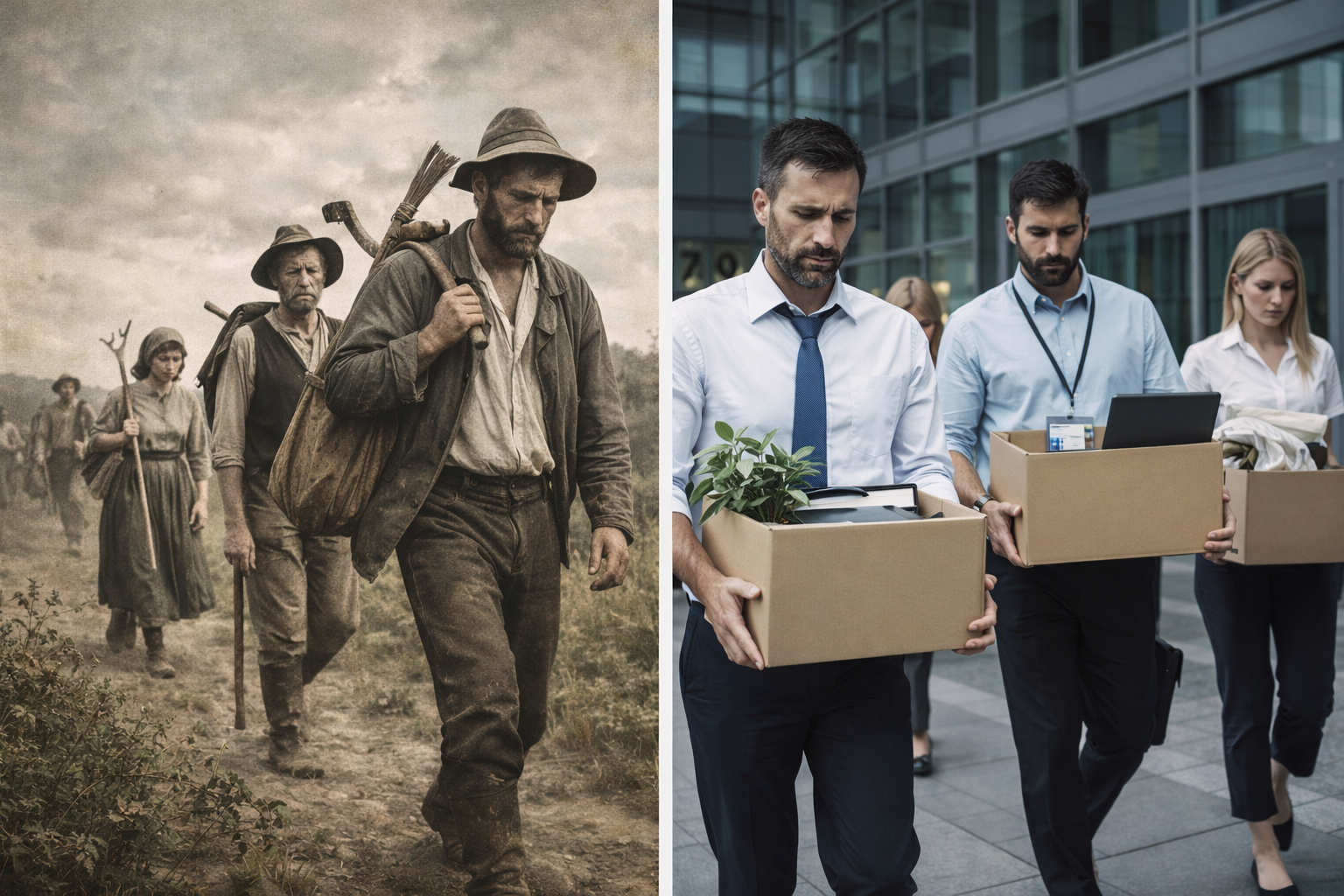
During the Industrial Revolution, automation was far more aggressive than anything we’re seeing today. Not in theory. In lived experience. Entire ways of life that had existed for centuries were erased in a few decades. People weren’t reskilled. They were displaced.
The rural exodus wasn’t a graceful transition. It was history shoving people out of the way.
Between the late 18th and mid-19th centuries, mechanization in agriculture and manufacturing reduced the need for human labor at a pace society wasn’t ready to absorb. Mechanical looms. Steam-powered mills. New farming machines. The math was simple and unforgiving: fewer hands needed, more people left behind.
According to historical census records in the United Kingdom, urban population grew from roughly 20% in 1800 to over 50% by mid-century. That shift didn’t happen because cities were inspiring. It happened because staying put was no longer an option.
People didn’t move chasing opportunity. They moved because the old work disappeared.
Automation Hurt Harder When No One Was Listening

There’s a detail we tend to skip when we compare that era to now.
Back then, the people being displaced didn’t have a voice. They didn’t write op-eds. They didn’t publish think pieces. They didn’t dominate public conversation. They were farmers, artisans, manual workers. When their livelihoods vanished, so did their visibility.
The suffering was real. But it was quiet.
Today, the pattern is reversed.
Modern automation, especially software-driven automation and AI, is hitting symbolic professions first. Not the poorest. Not the wealthiest. It’s hitting the middle layer that learned to trade intellectual routine for stability.
Journalists who mostly rewrite. Designers who follow templates. Analysts who perform spreadsheet rituals instead of thinking. Roles that look cognitive from the outside but behave mechanically on the inside.
These are people with degrees. With platforms. With audiences.
So the disruption feels crueler.
Not because it is, but because for the first time, the people being displaced can describe what’s happening to them in real time. They can narrate the loss.
And loss that speaks always sounds bigger than loss that doesn’t.
The Job Didn’t Fall Apart. The Status Did.
For decades, we told ourselves a comforting lie: that intellectual work was inherently protected. That using your mind was a shield against history. That knowledge work existed on a higher floor, safely above the churn.
The Industrial Revolution shattered a similar illusion. That rural life was permanent. That craftsmanship guaranteed relevance. That tradition was enough.
None of that survived productivity.
What’s collapsing now isn’t thinking itself. It’s standardized thinking. Repeatable cognition. Work that feels complex because it uses language, slides, dashboards, and meetings, but follows the same predictable patterns every day.
That’s not a moral failure. It’s a structural one.
Automation doesn’t eliminate people. It eliminates specific ways of organizing effort. It always has.
When Offices Became Factories in Disguise
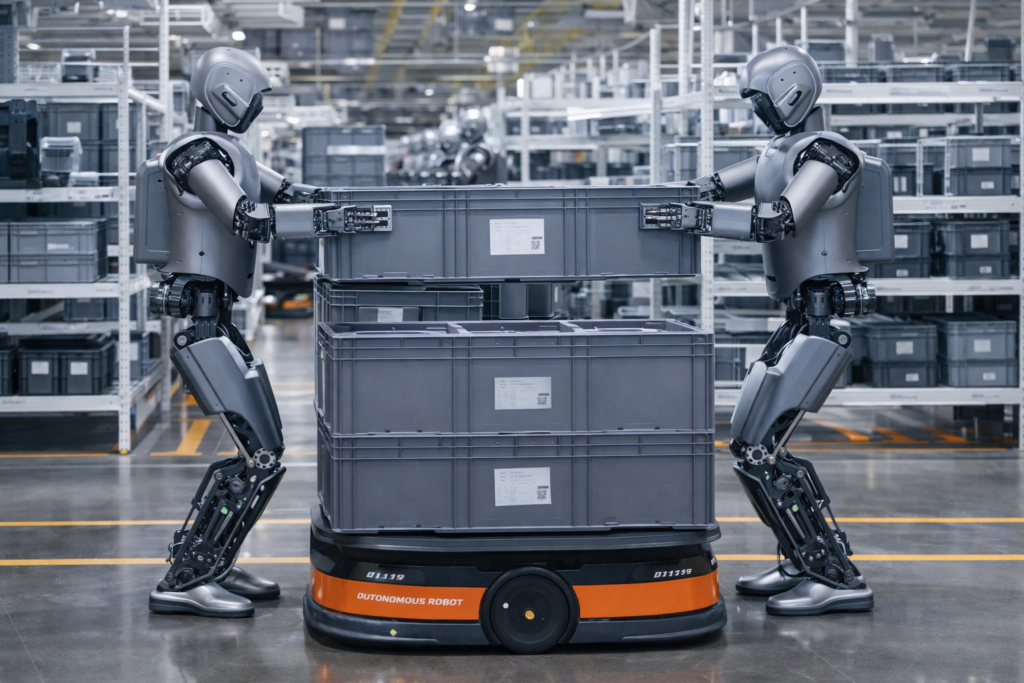
Factories didn’t remove humans from production. They reorganized humans around machines.
The loom didn’t end work. It ended one type of work. Slow, manual, expensive work. What replaced it wasn’t leisure. It was scale.
Something similar happened quietly inside offices.
At some point, we started mistaking a laptop for complexity. Sitting for thinking. Email for judgment. PowerPoint for insight.
The modern office became a factory that didn’t look like one. And because it didn’t look industrial, we assumed it was immune.
It wasn’t.
A report by the McKinsey Global Institute (2017) made this clear in a way most people still misunderstand. Around 60% of occupations have at least 30% of their activities that could be automated with technologies that already exist. Not jobs. Tasks.
Automation doesn’t come for your title. It comes for what you do every day without noticing you’re doing the same thing as thousands of others.
There’s a psychological distortion at play right now, and it matters.
In earlier transitions, the people being displaced had no public voice. Today, the people feeling pressure are articulate, connected, and visible. They know how to frame their anxiety. They know how to turn discomfort into narrative.
That alone amplifies the sense of crisis.
But there’s something deeper and more uncomfortable beneath it. This wave of automation is hitting groups that were long treated as untouchable. Not because they were rich, but because they were credentialed. Not because they owned capital, but because they owned status.
Losing income hurts. Losing identity hurts more.
When someone who spent years building a professional self-image suddenly realizes that a large part of their work can be replicated, the shock isn’t economic first. It’s existential. The machine isn’t taking a paycheck. It’s questioning a story.
That’s why this moment feels personal.
The Poorest Aren’t First in Line
This part tends to surprise people, but it shouldn’t.
Manual, physical, and artisanal work is not the first layer being erased. Not because technology is kind, but because reality is messy. A plumber doesn’t solve the same problem twice. A caregiver reads subtle signals. A technician adapts on the fly, in the physical world, under constraints that don’t translate cleanly into code.
These jobs resist full automation not out of romance, but out of friction.
At the other end, the very wealthy don’t sell execution. They sell coordination, ownership, leverage, and decision-making. They don’t compete with machines because they operate above the task layer altogether.
The real pressure zone has always been the middle.
People who learned to execute intellectual routines extremely well, but were never required to design new ones. People trained to be precise, not adaptive. Efficient, not original.
For a long time, that was enough.
Now it isn’t.
The Real Divide Was Never Manual vs Intellectual (I have a post dedicated)
That distinction is a historical distraction.
The real divide has always been between adaptive work and replicable work.
In the 19th century, what was replicable happened to be physical. Today, it’s cognitive. Same logic. Different surface.
Anyone whose daily value comes from repeating known patterns eventually faces the same outcome, regardless of whether those patterns involve muscles or spreadsheets.
Tradition didn’t save the artisans. Credentials won’t save routine knowledge workers.
History isn’t cruel. It’s indifferent.
What Actually Survives After the Illusion Breaks
Every major transition clears space. Not evenly. Not gently. But decisively.
After the Industrial Revolution, human labor became less valuable for brute force and more valuable for coordination, learning speed, and system awareness.
Now the shift is subtler.
What holds value is judgment. Context. Taste. Responsibility. The ability to ask better questions instead of delivering faster answers. Synthesis instead of accumulation. Ethics that operate under real constraints, not slogans.
None of this is new. It just stopped being optional.
Automation doesn’t remove the human from the equation. It removes the human from the comfortable center of it.
A Short, Honest Ending
Automation isn’t destroying work. It’s dismantling the fantasy of automatic protection.
That fantasy collapses every few generations. We just happen to be standing close enough to hear it crack.
The upside is quiet and unglamorous, which is why it rarely trends: the human still matters. Just not in the way that once made us feel safe.
Those who notice early adapt calmly.
Those who cling to the illusion adapt painfully.
History has always preferred the first group.
If this made sense, don’t stop here
If you recognized yourself somewhere in this text, that’s not coincidence.
It means you’re already sensing the gap between how the world used to reward work and how it actually does now.
This article maps the pattern.
The ebook goes one step further and deals with the individual strategy inside that pattern.
How value shifts.
Why certain people adapt calmly while others panic.
What still compounds in a world where old guarantees quietly expire.
No hype.
No motivational noise.
Just structure, clarity, and long-range thinking.
And yes, it costs only $9.90.
Less than a lunch. Less than most books. Less than the price of staying confused.
👉 Get the ebook here:
https://go.hotmart.com/B103519504F
It won’t promise safety.
It will give you orientation.
Lizandro Rosberg
Independent analyst of technology, science, and civilizational transformations. He writes about artificial intelligence, science, applied history, the future of work, and the real impact of technology on human life. His focus is on translating complex changes into practical understanding.
You will certainly be interested in:
-
21st Century Economy | Artificial Intelligence | Future of Work | Future of Work & Automation | Life Strategy
The World Is Too Old to Run on Yesterday’s Assumptions
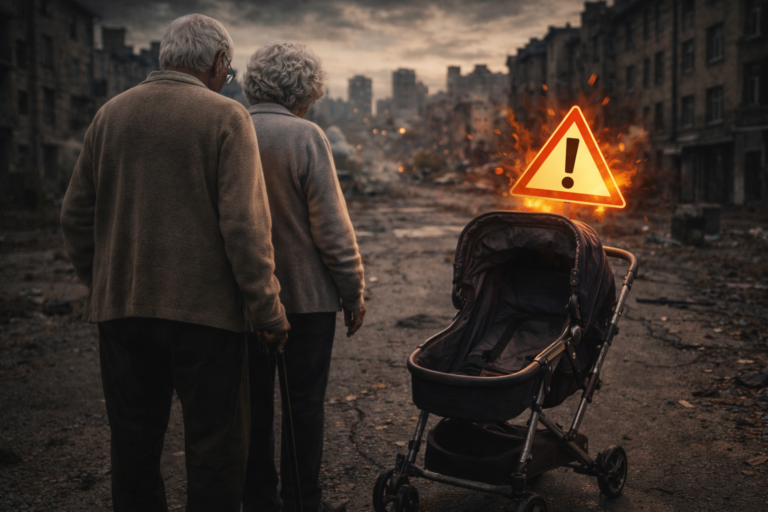
Modern societies are aging faster than their institutions, cities, and care systems were designed to handle. Population aging is no longer a forecast. It is a present condition. Fertility rates across developed economies remain structurally below replacement, while life expectancy continues to rise. More people stay in the system for longer, and fewer enter it to sustain what that system demands. This is not a moral debate. It is arithmetic.
The text dismantles the idea that declining birth rates can be reversed through incentives alone. Children have ceased to be a default continuation of life and have become high-risk projects, requiring time, stability, and energy. At the same time, large cities have grown expensive, regulated, and hostile to family formation. Housing costs, long commutes, and constant friction quietly discourage long-term planning. Fertility declines not because people reject families, but because the environment makes them fragile bets.
Longevity adds a second layer of tension. Medical and technological progress has extended human life by decades, but social structures have not adapted accordingly. Families are smaller, communities weaker, and informal care networks thinner. Care, once distributed among many, now concentrates on a few, often exhausted individuals. As demand rises and supply stagnates, eldercare becomes a systemic bottleneck.
At this point, the article reframes technology. Automation, AI, and robotics are not replacing human care. They are filling gaps left by demographic reality. Safety automation, assisted living systems, and care-support technologies emerge as infrastructure, not luxury. The comparison between regions is telling. China treats automation as capacity planning, scaling solutions pragmatically under demographic pressure. Europe, despite facing even sharper aging trends, often responds with moral discourse and procedural delay. The United States sits between these poles, still assuming it has time.
The article closes without apocalypse. It argues for early, practical adaptation. Designing homes and cities that reduce risk. Introducing assistive technology before crisis. Treating care as infrastructure rather than a private afterthought. Building redundancy not only in finances, but in human networks.
The final note is sober but constructive. The world did not become colder. It became older. And older societies need smarter designs. Less nostalgia. More alignment. In that sense, adapting early is not pessimism. It is a form of responsibility, and perhaps the most realistic kind of optimism available.
-
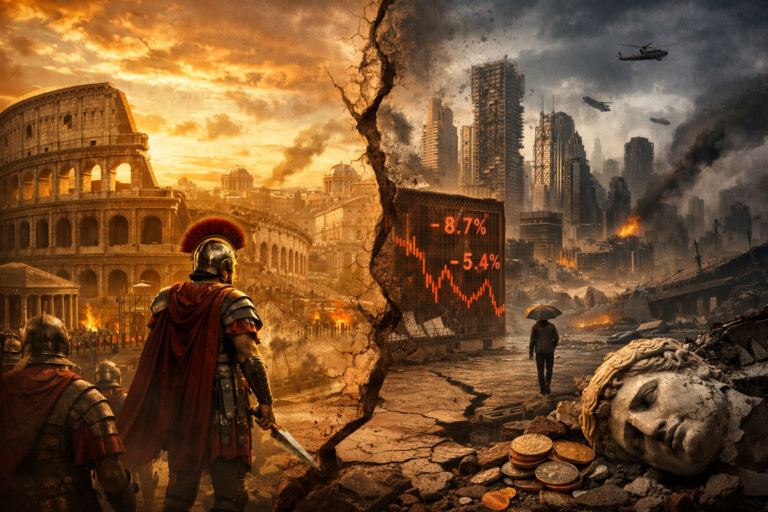
The Mistake That Kept Rome Standing for Centuries
At its height, the Roman Empire controlled millions of square kilometers and governed tens of millions of people. Some estimates place that peak at over four million square kilometers and roughly 60 million inhabitants, a scale that’s hard to visualize without modern maps.
-
Personal AI for Finances: How Language Models Help You Stop Losing Money
When finances are reviewed regularly, without drama and without emotional drain, something subtle happens. Anxiety drops. Decisions stop being reactive. Small corrections happen early, before they turn into damage.
-
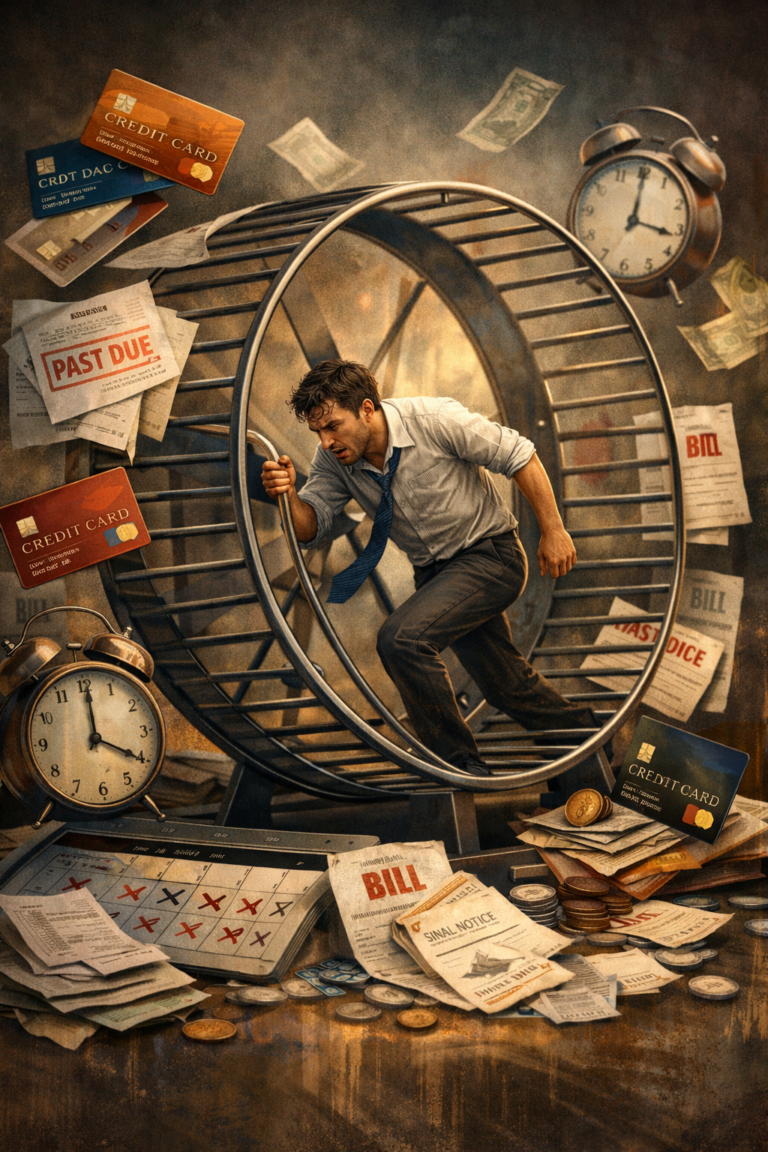
The Rat Race Was Designed, Not Chosen
Most people never sit down and choose a life of constant pressure. They don’t decide to trade freedom for anxiety or flexibility for fragility.
-
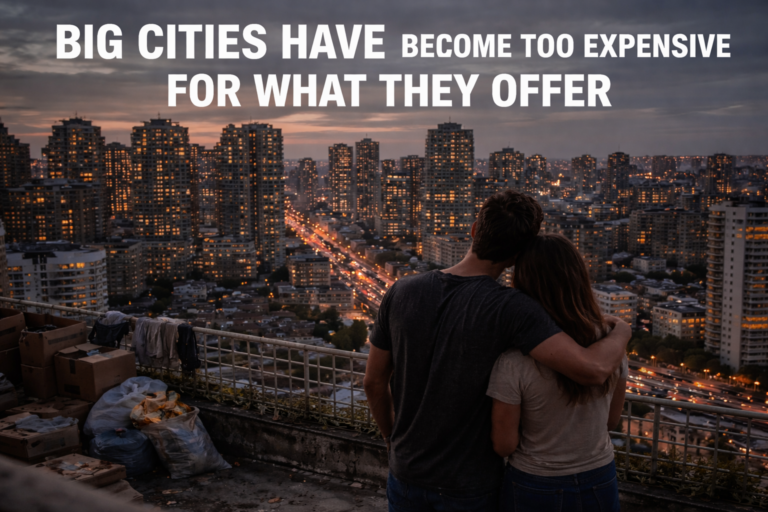
Big Cities Have Become Too Expensive for What They Offer
Dense environments demand continuous cognitive processing. The brain never truly rests. It just reallocates priorities. Over time, that state extracts a price. Less patience. Less depth. Less tolerance for error.
-
21st Century Economy | Artificial Intelligence | Future of Work & Automation | Geopolitics & Energy | Life Strategy
Highly Qualified, Quietly Poor
This morning was unremarkable. I made coffee the same way I always do. Same mug. Same chipped edge. I scrolled through messages I didn’t answer yesterday and noticed something small, almost silly. Three different people, unrelated, all talking about money. Not investment tips. Not ambition. Just fatigue. Quiet, practical fatigue. No drama. No despair. Just […]


One Response
[…] When cities stopped guaranteeing stability […]